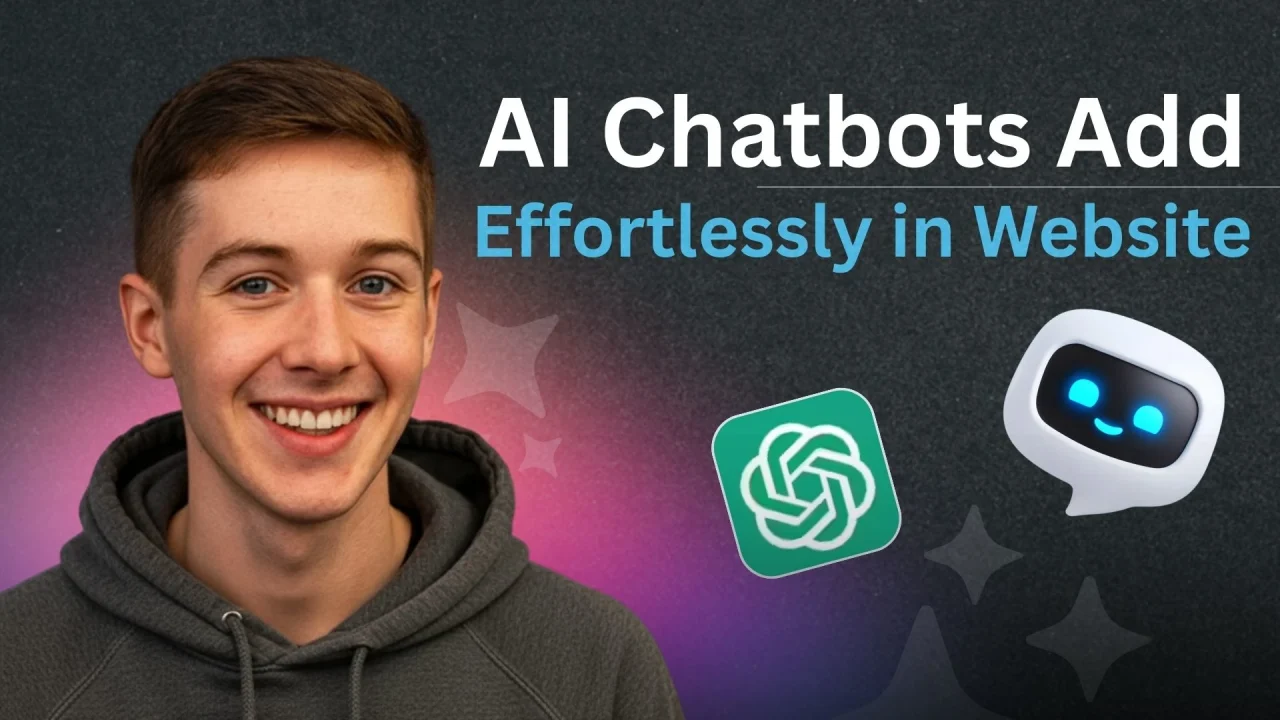
If you’ve visited a website in the last six months, you’ve likely noticed a shift. The little chat bubble in the bottom right corner once a clunky tool that spat out generic links has become surprisingly smart. It understands context, answers complex questions, and sometimes even cracks a joke.
AI chatbots have quietly graduated from being a “nice-to-have” novelty to a fundamental business tool. Today, they are the first line of defense for customer support, a tireless sales development representative, and a concierge for new visitors all rolled into one. They qualify leads while your sales team sleeps, book appointments instantly, and troubleshoot user issues without human intervention.
Launch Your App Today
Ready to launch? Skip the tech stress. Describe, Build, Launch in three simple steps.
BuildBut here is the best part: You no longer need a massive budget or a team of developers to build one.
The rise of no-code AI platforms has democratized access to this technology. Founders, marketers, and small teams can now deploy intelligent, conversational experiences in a fraction of the time it used to take.
In this guide, we are going to break down exactly how no-code chatbots work, why they are often a smarter choice than custom development, and how you can deploy one confidently. We will also look at where the industry is heading specifically how platforms like Imagine.bo are taking no-code beyond just chatbots and into full-scale product development.
The Democratization of AI: Understanding No-Code Platforms
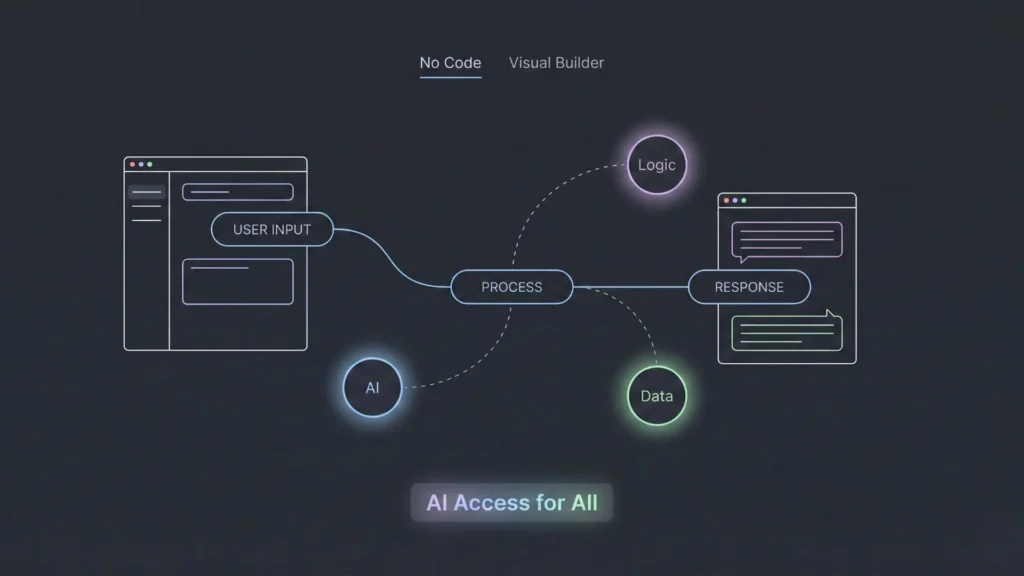
To understand why this is such a game-changer, we have to look at how things used to be. A few years ago, building a chatbot that actually worked required a significant technical stack. You needed natural language processing (NLP) experts, backend engineers to manage the database, and frontend developers to design the chat interface. It was a heavy lift, often costing tens of thousands of dollars.
No-code AI chatbot platforms have removed that technical barrier.
These platforms replace lines of code with visual interfaces. Instead of writing scripts in Python or JavaScript, you use drag-and-drop builders, visual flowcharts, and pre-built templates. You define what the chatbot should do “If the user asks about pricing, show the Basic and Pro plans” and the platform handles the how.
Not All Bots Are Created Equal
It is important to note that “no-code” is a broad umbrella. These platforms vary widely in capability:
- Rule-Based Bots: These are the simplest form. They function like interactive FAQs. If a user clicks button A, the bot shows response B. They are reliable but rigid.
- AI-Driven Bots: These use Large Language Models (LLMs) to understand intent. They don’t just look for keywords; they “read” the user’s message to understand the sentiment and context.
- Integrated Assistants: These bots connect to your CRM, your email marketing tools, and your analytics dashboards to perform actions, not just answer FAQs.
The key to a successful deployment is understanding which level of intelligence your specific use case requires. Over-engineering a simple FAQ bot can be just as detrimental as under-engineering a complex support agent.
Why Businesses Are Flocking to No-Code Solutions
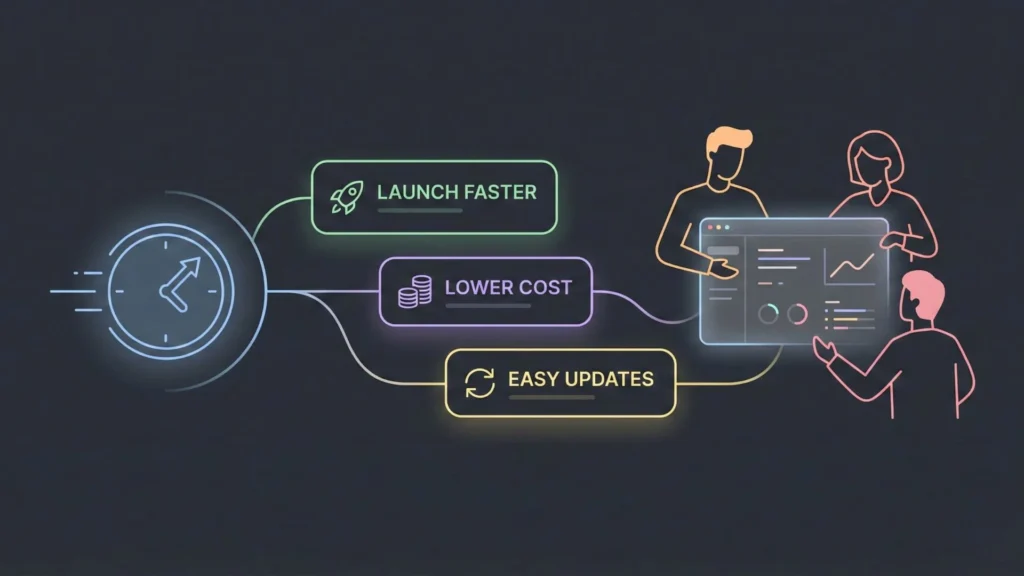
The shift toward no-code isn’t just about laziness or a lack of technical skill; it is a strategic business decision centered on velocity.
1. Speed to Market
In the traditional development model, building a custom AI solution could take months. You have scoping phases, development sprints, QA testing, and bug fixing. With no-code solutions, a functional prototype can often be built in an afternoon, and a production-ready bot can be live in a few days. For small businesses or startups looking to validate ideas without large budgets, this speed is invaluable.
2. Agility and Iteration
Marketing, sales, and support teams are the ones who actually talk to customers. In a no-code environment, these teams can own the chatbot. If the support team notices customers are suddenly asking about a specific shipping delay, they can log into the platform and update the bot’s response in real-time. They don’t have to file a ticket with IT and wait two weeks for a deployment cycle.
3. Cost Efficiency
By eliminating the need for dedicated engineering hours, the cost of entry drops primarily to the subscription fee of the platform. This allows businesses to allocate budget where it matters more: strategy, content creation, and promotion.
The Great Debate: No-Code vs. Traditional Development
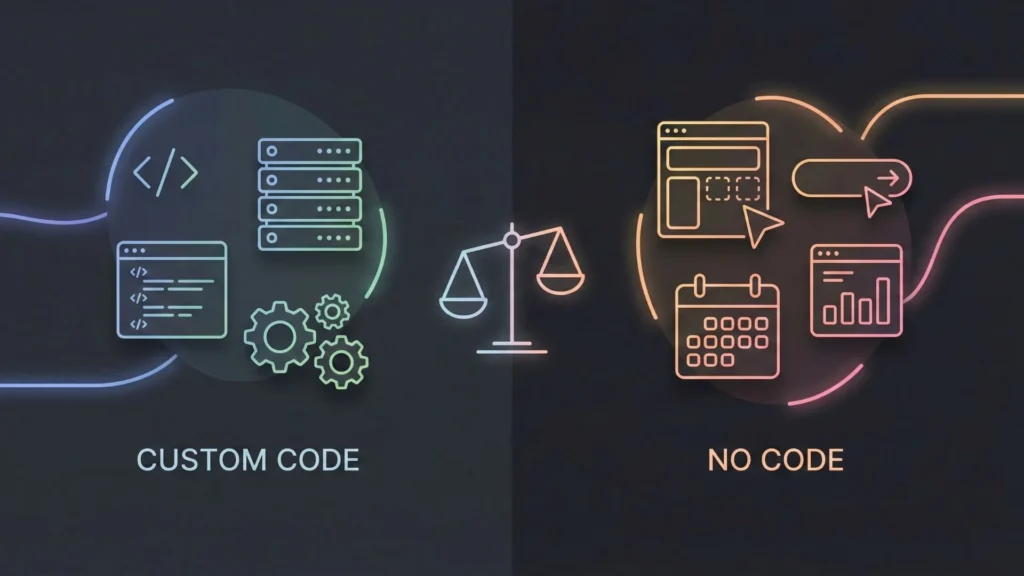
Is there still a place for custom-coded chatbots? Absolutely. But the line is shifting.
Traditional Development relies on custom code and offers infinite flexibility. If you are building a proprietary AI model that requires deep, system-level logic, or if you need to process highly sensitive data on your own private servers (on-premise), traditional development is likely still necessary. It allows for total control over every pixel and data packet.
No-Code Platforms trade that extreme flexibility for speed, simplicity, and maintainability. For 95% of business use cases customer support, lead capture, user onboarding, appointment setting custom code is overkill.
Think of it like building a house vs. renting a high-end apartment. Building a house (traditional code) lets you choose the exact type of insulation in the walls, but it takes years and huge capital. Renting a luxury apartment (no-code) gives you a beautiful, functional space immediately, with maintenance included, even if you can’t knock down the load-bearing walls.
For most businesses, the trade-off makes perfect sense. Unless your chatbot is your product, no-code is usually the smarter starting point.
How to Choose the Right Platform
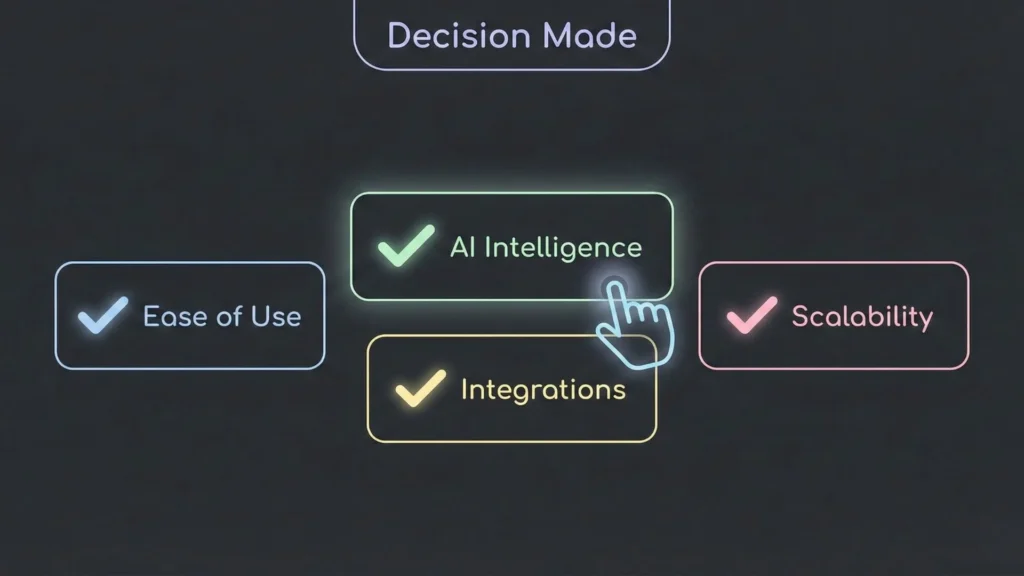
The market is flooded with no-code tools. Choosing purely on popularity is a common mistake; the tool that works for a massive e-commerce giant might be terrible for a B2B consultancy.
Before you commit your credit card, you should evaluate each option against these critical pillars:
1. Ease of Use vs. Power
There is often an inverse relationship here. Extremely simple tools might limit your ability to handle complex logic later. Look for a “low floor, high ceiling” platform one that is easy to start with but offers advanced features (like API integrations) as you grow.
2. AI Depth and Contextual Understanding
Does the platform rely on rigid keyword matching? If a user types “My order is taking forever,” a keyword bot might just trigger a generic “Shipping Policy” link. A true AI bot with Natural Language Understanding (NLU) will recognize the frustration (sentiment detection) and perhaps offer to check the status or escalate to a human agent.
3. Integration Ecosystem
Your chatbot shouldn’t be an island. It needs to talk to the tools you already use. Can it send leads directly to your CRM? Can it pull article snippets from your existing Help Center? If the platform requires you to manually copy-paste data between systems, it’s not truly automating your workflow.
4. Scalability and Pricing Transparency
Scalability matters more than it seems on day one. A chatbot that performs beautifully with 50 concurrent users might crash or lag with 5,000. Furthermore, check the pricing model. Some platforms charge per conversation or “message unit.” Ensure that if your bot becomes wildly successful, your bill won’t suddenly bankrupt you.
Real-World Impact: What Success Looks Like
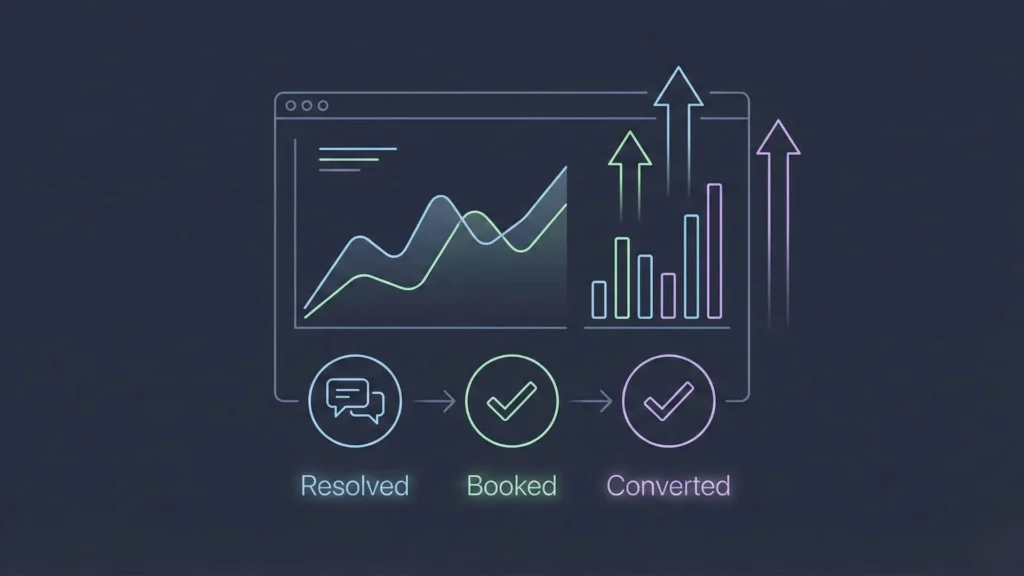
When deployed correctly, the results of these no-code implementations are measurable and significant.
- E-commerce: Smart E-commerce brands are reducing support ticket volume by 30-50% simply by letting bots handle “Where is my order?” and “What is your return policy?” queries. This frees up human agents to handle complex issues that actually require empathy.
- SaaS (Software as a Service): Companies use bots to pre-qualify leads. Instead of a sales rep getting on a call with everyone, the bot asks about budget, timeline, and company size. High-value leads are fast-tracked to a human; smaller leads are guided to self-serve resources.
- Healthcare: Clinics are streamlining appointment scheduling, reducing the burden on front-desk staff and allowing patients to book slots outside of business hours.
The common thread in these success stories is focus. These businesses didn’t try to build a bot that does everything. They picked a specific pain point high support volume, low lead quality, missed calls and solved it.
Step-by-Step: Deploying Your First AI Chatbot
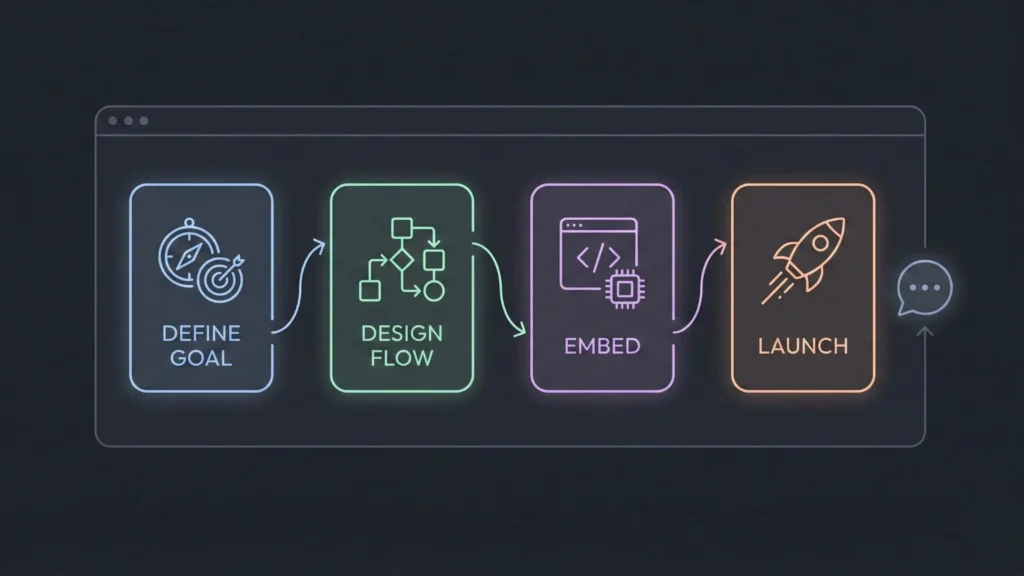
Ready to build? Here is a practical workflow to get your first no-code chatbot from concept to live deployment.
Step 1: Define the Purpose
Resist the urge to start building immediately. Start with a single, well-defined objective.
- Bad Objective: “I want a chatbot.”
- Good Objective: “I want a chatbot that answers the top 10 recurring questions about our pricing and books demos for our sales team.” Clear intent leads to cleaner conversational flows and easier measurement.
Step 2: Design the Conversation Flow
Map out the interaction before you touch the software. You can use a whiteboard or a tool like Miro.
- The Happy Path: What happens when everything goes right? (User asks for price -> Bot shows price -> User buys).
- The Edge Cases: What happens when the user types something unexpected?
- The Fallback: Always have a graceful “I didn’t understand that” response that offers options, such as “Did you mean X?” or “Would you like to speak to a human?”
Step 3: Integrate With Your Website
This is where you enter the no-code platform. Use the visual builder to recreate the flow you mapped out. Most platforms provide a simple Javascript snippet or an “embed code” (similar to embedding a YouTube video). You paste this into your website’s header or footer, or use a plugin if you are on WordPress or Shopify. Pro Tip: Test the mobile view. Chat interfaces can look cramped on small screens if not optimized.
Step 4: Test, Measure, and Iterate
Your launch day version is just the starting line. Once the bot is live, you need to monitor the transcripts.
- Identify Drop-off Points: Are 50% of users closing the chat after the second question? That question might be too aggressive or confusing.
- Review “Unrecognized” Queries: Look at what users are asking that the bot can’t answer. This is a goldmine for improving your bot’s training data.
Personalization and Performance Optimization
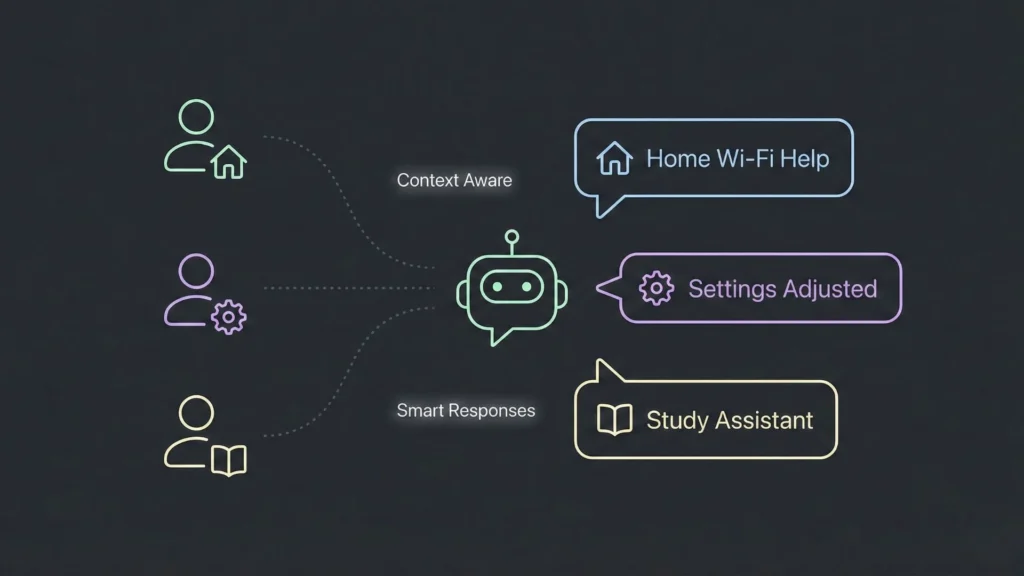
To truly get the most out of no-code AI, you need to move beyond generic responses. Personalization is the key to engagement.
Context is King: If a user is on your “Pricing” page, the bot shouldn’t say “Welcome! What is your name?” It should say, “Hi there! Do you have any questions about our Enterprise plans?” Simple logic based on the user’s current URL or referral source can make the bot feel significantly more intelligent.
Metrics Beyond Volume: Don’t just track how many people talk to the bot. Track Resolution Rate (did the user get an answer without human help?) and Goal Completion Rate (did they book the meeting?). Use these signals to continuously tweak your scripts and logic. Analyzing these patterns gives you better insight into performance, allowing you to refine the experience.
Going Beyond Chatbots: The Rise of Comprehensive No-Code AI
While chatbots are often the entry point, they are rarely the final destination. Once teams see the power of no-code automation, they often want to build more: client portals, internal dashboards, or fully-fledged SaaS applications.
This is where the ecosystem is evolving. We are seeing a shift from “chatbot builders” to “AI-driven product builders.” A prime example of this evolution is Imagine.bo.
Where Imagine.bo Fits Into the No-Code Ecosystem
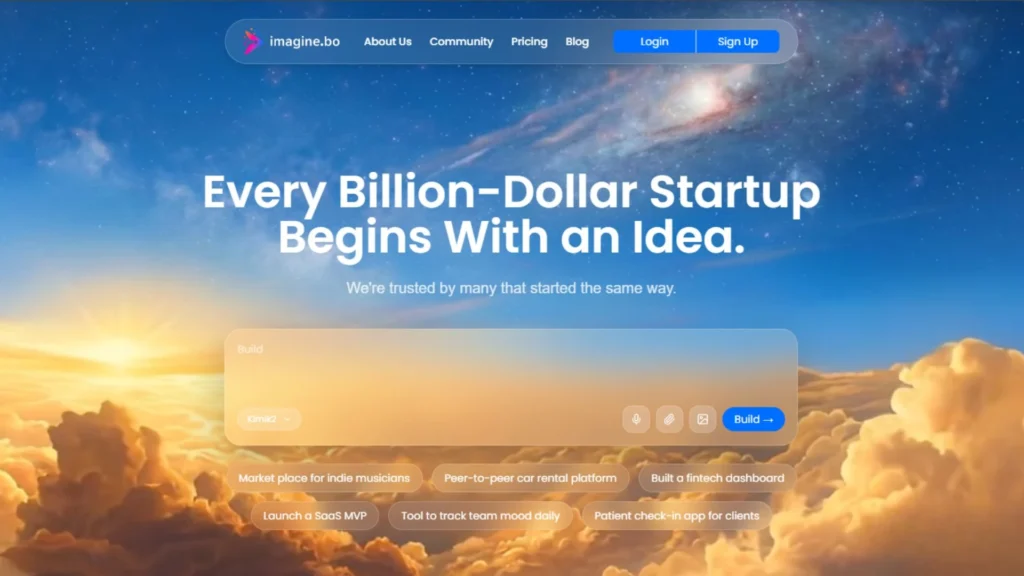
Most no-code tools focus on one slice of the pie interfaces, databases, or logic. Imagine.bo is different. It is an AI-driven no-code platform designed for founders and teams who want to move from a raw idea to a revenue-ready product without managing technical complexity.
While a chatbot manages the conversation, platforms like Imagine.bo manage the entire product lifecycle.
How It Works: Instead of dragging and dropping individual elements to build a page, you describe your product in plain English. You can start building your app for free to see how the system applies AI reasoning to design the architecture, the database workflows, the backend logic, and the user flows instantly.
Why This Matters: The result isn’t just a surface-level prototype; it is a scalable, secure application built with real engineering standards. It handles the frontend, backend, database management, and deployment in one unified system. For a business that starts with a simple chatbot, Imagine.bo offers a path to scale. You might start by automating support chat, but eventually, you realize you need a custom dashboard for your support team to view those chats, analyze sentiment, and trigger refunds. Imagine.bo allows you to build that infrastructure and scale without rebuilding from scratch.
It bridges the gap between “I have an idea” and “I have a scalable software business.”
Security, Privacy, and Trust
We cannot discuss AI deployment without addressing the elephant in the room: Data Security.
When you use no-code platforms, you are entrusting a third party with your customer data. This means your due diligence must be thorough.
- Encryption: Ensure data is encrypted both in transit and at rest.
- Compliance: If you are in healthcare or finance, does the platform support HIPAA or GDPR compliance?
- Data Policies: Be clear with your users. If they are talking to a bot, tell them it’s a bot. If you are storing their chat history to improve the service, state that in your privacy policy.
No-code does not mean cutting corners on safety. Any AI tool handling user data must prioritize security. In fact, reputable no-code platforms often have better security protocols than a custom solution built by a junior developer, because their entire business model depends on maintaining trust at scale.
The Future of No-Code AI Experiences

We are in the early innings of this shift. No-code AI is rapidly moving beyond simple automation.
We are already seeing the rise of multilingual support where bots instantly translate conversations, breaking down global barriers for small businesses. We are seeing sentiment-aware conversations where the bot adjusts its tone becoming more empathetic if the user is angry, or more concise if the user is in a hurry.
But the biggest shift is connectivity. Chatbots are ceasing to be isolated widgets. They are becoming deeply integrated parts of the product experience connected to inventory, shipping logistics, and user profiles.
The teams that win in this new era won’t be the ones with the biggest engineering departments. They will be the ones who stay flexible, test often, and treat AI as an evolving system rather than a one-time setup.
Final Thoughts
Adding an AI chatbot to your website used to be a six-month project reserved for the Fortune 500. Today, it is a Tuesday afternoon task for a solo founder.
No-code platforms have dismantled the technical gatekeeping that once surrounded artificial intelligence. They have made it accessible, fast, and practical for businesses of all sizes to automate conversations and improve customer experience.
The best advice? Start small. Don’t try to build Skynet on day one. Focus on real user needs answering FAQs, booking meetings, guiding new users. Once you have mastered the conversation, look to platforms like Imagine.bo to expand that efficiency into full-scale applications.
The goal remains the same, whether you are deploying a simple chat widget or a complex AI-powered platform: create helpful, scalable, and human-centric experiences that grow with your business. Launch your project today and see what you can build. The tools are ready. The rest is up to you.
Launch Your App Today
Ready to launch? Skip the tech stress. Describe, Build, Launch in three simple steps.
Build