
The world of software development is undergoing a seismic shift. For decades, building a functional application required deep technical expertise and thousands of lines of code. The no-code revolution challenged this, offering visual, drag-and-drop interfaces. Today, we’re at the next frontier: the fusion of artificial intelligence with these no-code platforms.
This “hybrid AI” approach is not just a feature; it’s a new development paradigm. It combines the generative power of AI—which can create UI, backend logic, and even entire app skeletons from plain English prompts—with the precision and control of a visual no-code editor. The result is a democratized ecosystem where founders, designers, and business experts can build and launch sophisticated, scalable applications faster and more affordably than ever before.
Launch Your App Today
Ready to launch? Skip the tech stress. Describe, Build, Launch in three simple steps.
BuildThis article provides a full comparison of the leading hybrid AI no-code platforms, examining their unique features, target audiences, and the specific problems they solve.
What Defines a “Hybrid AI” No-Code Platform?
Before comparing tools, it’s important to understand what we mean by “hybrid AI.” It’s a spectrum, but these platforms generally blend several key components:
- AI-Powered Generation: Using natural language prompts to generate app components, from a single button to an entire user flow or database schema.
- Visual Drag-and-Drop Editor: The classic no-code interface where users can visually refine, customize, and connect the components the AI generated.
- Backend & Database Management: Integrated tools to manage data, user authentication, and server-side workflows, often with AI assistance for setup.
- Human-in-the-Loop: A critical “hybrid” element. This can mean a non-technical founder visually refining AI output, or, in some cases, the ability to bring in a professional developer for complex tasks the platform can’t handle alone.
- Scalability & Deployment: Tools and infrastructure to launch the app to the public and scale it as user demand grows.
Comparison of Leading Tools
We’ll explore a range of platforms that embody this hybrid approach, from established no-code giants integrating AI to new, AI-first contenders.
- Bubble.io
- Builder.io
- FlutterFlow
- Imagine.bo
- Webflow
Bubble.io: Visual Web App Builder
Overview
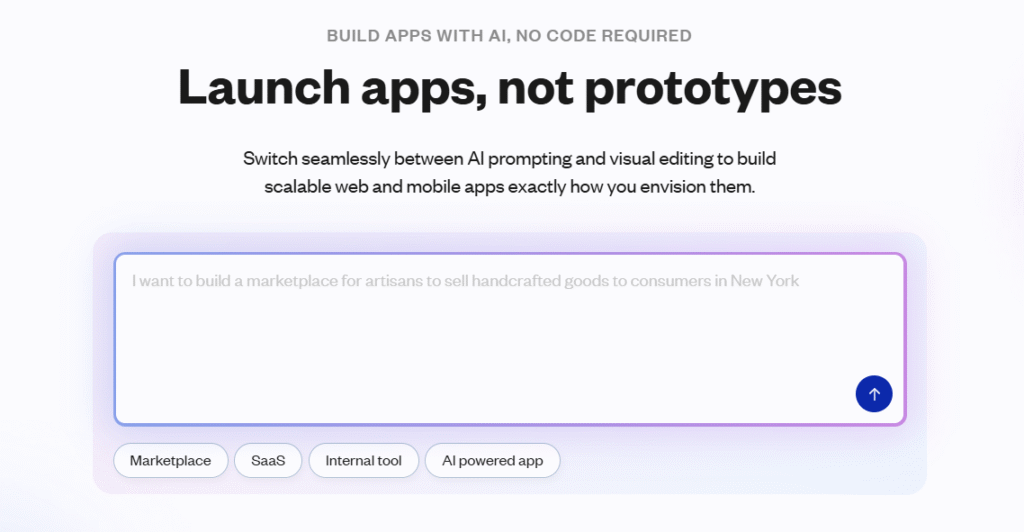
Bubble is arguably the most powerful and mature platform for building complex web applications without code. It provides total control over design and logic through its visual editor and robust workflow system. Its “hybrid” nature traditionally came from its sheer flexibility, allowing non-technical users to build anything, but it has recently embraced generative AI.
AI/Hybrid Features
Bubble’s AI integration acts as an assistant within its powerful editor. Users can use AI to:
- Generate page layouts and UI elements from a text prompt.
- Define database structures and data types automatically.
- Build workflows and backend logic by describing the desired process.
- Get suggestions for fixing issues or optimizing expressions.
The core loop involves generating with AI and then immediately refining within Bubble’s standard visual editor, giving the user fine-grained control.
Target Audience Founders, startups, and entrepreneurs who need to build and iterate on a fully custom Minimum Viable Product (MVP) or internal tool.
Strengths
- Unmatched Flexibility: If you can think of a web app feature, you can almost certainly build it in Bubble.
- Mature Ecosystem: A vast library of plugins, templates, and community support.
- Full-Stack Control: Manages both the frontend design and the backend database/logic in one place.
Weaknesses
- Steep Learning Curve: Its power comes at the cost of complexity. It can take weeks or months to master.
- Performance: While scalable, apps can become slow if not built with best practices, particularly on lower-priced plans.
Builder.io: AI-Assisted App Development Platform
Overview
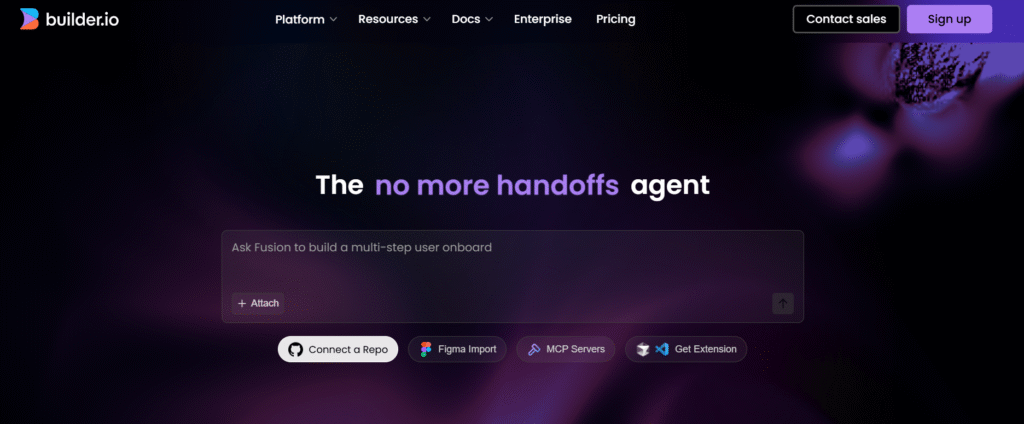
Builder.io takes a different approach to “hybrid.” It’s less a do-it-yourself (DIY) tool and more of an AI-powered, human-backed assembly line for software. It begins with “Natasha,” an AI product manager that helps you spec out your app idea. This spec is then used to assemble your app using a combination of AI, reusable code blocks, and a vetted network of human developers.
AI/Hybrid Features
- AI Project Scoping: Natasha AI guides users through a Q&A process to create a detailed project specification.
- Prototyping: The AI generates an interactive prototype based on the spec, allowing for quick validation.
- Human-in-the-Loop: This is Builder.io’s core. The AI does the initial work, but a global network of human experts takes over to build, customize, and ensure the final product is flawless.
Strengths
- Done-for-You Service: Requires minimal technical effort from the user.
- Cost and Time Guarantees: Provides fixed quotes and timelines, removing financial uncertainty.
- Access to Source Code: Unlike most no-code platforms, you can get the code for your app (for an additional fee).
Weaknesses
- Not a DIY Tool: You are not in the editor building the app. It’s a managed service, which means less direct control.
- Cost: While cheaper than a traditional agency, it is significantly more expensive than a monthly subscription to a DIY platform like Bubble or Imagine.bo.
FlutterFlow: Low-Code Native App Builder
Overview
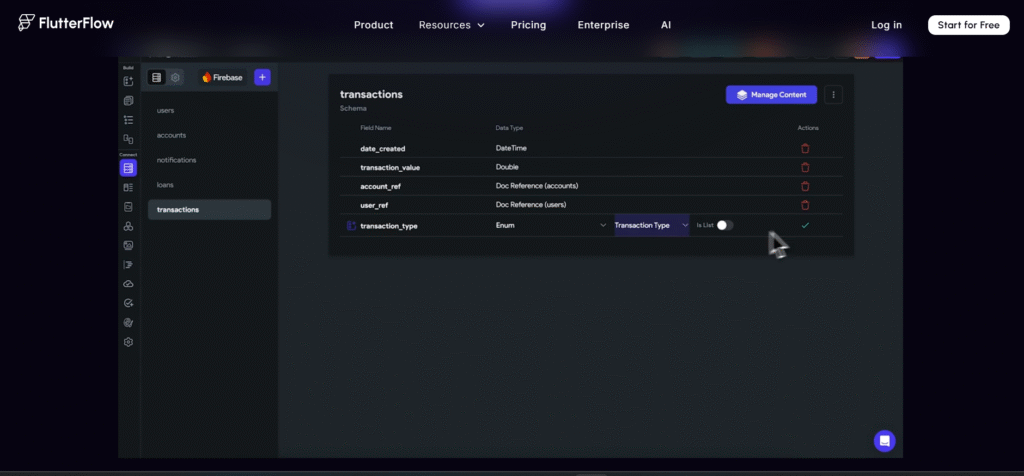
FlutterFlow is a low-code platform focused specifically on building high-performance, cross-platform native mobile apps (iOS and Android) and web apps. It uses Google’s Flutter framework, and its AI features are designed to rapidly accelerate the development process, producing clean, exportable code.
AI/Hybrid Features
- AI Gen: Allows users to generate entire pages (e.g., “a user profile page with a profile picture, name, and a grid of their posts”) from a single text prompt.
- AI Code Generation: Can generate custom functions and logic in Dart (the language Flutter uses) from a description.
- Code Handoff: The “hybrid” aspect is strong here. A non-technical user can build 80% of the app, and a professional Flutter developer can then export the clean code to add highly custom features.
Strengths
- True Native Performance: Apps built with FlutterFlow are high-performance native applications, not web wrappers.
- Exportable Code: You are not locked into the platform. You can download the full Flutter/Dart codebase at any time.
- Strong Mobile Focus: Rich support for mobile-specific features like push notifications, gestures, and hardware access.
Weaknesses
- Niche Focus: It is not the best tool for building a standard, web-only application.
- Requires Some Technical Knowledge: To use it to its full potential, a basic understanding of app structure and (for custom logic) Flutter/Dart is beneficial.
Imagine.bo: AI No-Code App Builder
Overview
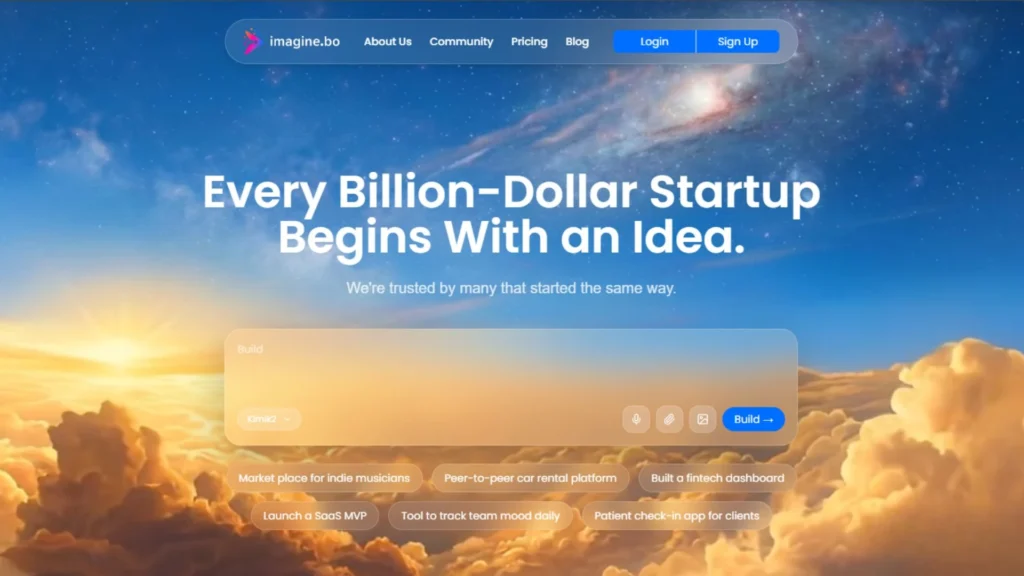
Imagine.bo is an AI-powered no-code platform designed to make app development accessible for anyone. The system generates production-ready web applications from simple natural-language prompts, and users can further refine them with an intuitive drag-and-drop interface. Its combination of AI automation and visual editing drastically accelerates the process of building and launching functional applications.
AI/Hybrid Features
- AI App Generation: Users describe their app in plain English, and the platform automatically creates the core structure, features, and workflows.AI-Powered Logic: The system can generate app logic, workflows, and data models without requiring any coding knowledge.
- Human Support: When AI automation isn’t enough, users can assign tasks to a real developer for custom features or troubleshooting, blending no-code simplicity with professional support.
AI-Powered Logic: The system can
Target Audience
Entrepreneurs building MVPs, small businesses digitizing processes, and creative professionals who need to prototype and deploy fully functional apps without writing code.
Strengths
- No-Code Simplicity: Apps can be built end-to-end without touching code, using natural-language inputs and visual builders.
- Fast Launch Workflow: A streamlined three-step process—Describe, Build, Launch—significantly reduces development time.
- Scalable Infrastructure: Apps run on cloud providers like AWS or GCP and include strong security measures, high performance, and compliance-ready architecture.
- Expert Backup: Access to real engineers allows users to solve complex problems and go beyond typical no-code limitations.
- Growth Tools Built In: Supports SEO, built-in analytics, mobile responsiveness, and data export options for better visibility and scaling.
Webflow: No-Code Website Design & CMS Platform
Overview
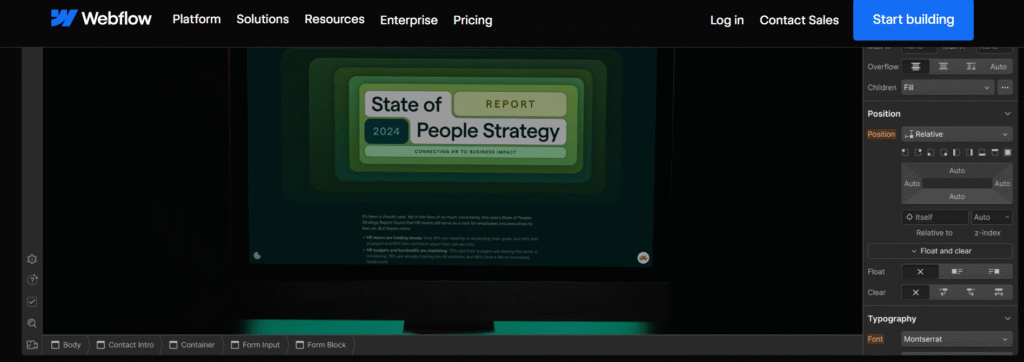
Webflow is the gold standard for designers building high-performance, content-driven websites. It provides unparalleled, pixel-perfect control over HTML and CSS in a visual-first environment. While historically focused on websites and complex interactions (not full apps), its recent AI additions and logic features are pushing it into the hybrid tool space.
AI/Hybrid Features
- Webflow AI: This suite of tools focuses heavily on content and design. It can write and refine SEO-optimized copy, generate image alt-text, and (in the future) will assist with layout and design.
- Logic: A newer feature that allows for simple backend workflows, like processing form data or triggering emails, without code.
- Hybrid Workflow: The primary loop is designer-centric. A designer builds the “look and feel” with 100% precision, and the AI assists with populating the content.
Target Audience Freelance designers, marketing teams, and creative agencies who need to build beautiful, custom, high-performance websites.
Strengths
- Unmatched Design Control: Replicates the power of CSS grid and flexbox visually. What you design is exactly what you get.
- World-Class CMS: Its integrated Content Management System (CMS) is powerful and easy for non-technical clients to use.
- Performance & Reliability: Sites are hosted on a fast, scalable global network.
Weaknesses
- Not an App Builder: It is not designed for building complex, data-heavy applications with user accounts and complex backend logic (like Bubble or Imagine.bo).
- AI is Content-Focused: The AI is currently an assistant for designers/writers, not a generator for app logic or databases.
Feature Comparison Matrix
| Platform | Core Strength | AI Generation | Visual Builder | Backend Logic | Human-in-the-Loop |
|---|---|---|---|---|---|
| Bubble.io | Complex Web Apps | UI, DB, Workflows | Advanced | Advanced | Developer Handoff |
| Builder.io | Managed Service | Full App Spec | Prototype Only | Managed | Core Feature |
| FlutterFlow | Native Mobile Apps | UI, Dart Code | Advanced | Advanced | Code Export |
| Imagine.bo | AI-First Web Apps | Full App, DB, Logic | Standard | Advanced | Core Feature |
| Webflow | Design & Websites | Content, SEO | Advanced | Basic | Designer-led |
How to Choose the Right Platform
- For Founders building a complex MVP: Bubble.io offers the raw power and flexibility to build anything, with AI to speed up the process.
- For Non-Technical Entrepreneurs who want it “done for you”: Builder.io provides a guaranteed, managed service from idea to launch.
- For Mobile-First Startups: FlutterFlow is the clear winner, offering AI-assisted native app development and clean code export.
- For Creators who want AI-first speed and developer backup: Imagine.bo provides a pure AI-to-app workflow with the safety net of real human developer support for complex issues.
- For Designers and Marketing Teams: Webflow offers the best-in-class tool for building beautiful, content-driven websites, with AI to assist in copy and design.
Conclusion
The rise of hybrid AI no-code platforms marks a pivotal moment in technology. The barriers to software creation are no longer technical skill and capital, but creativity and a clear vision. By blending the generative power of AI with the intuitive control of visual editors—and, crucially, the expertise of human developers when needed—tools like Bubble, Imagine.bo, and FlutterFlow are creating a new class of builders.
The future of development is not just “no-code” or “AI”; it’s a hybrid, collaborative process between human and machine, turning more ideas into reality than ever before.
Launch Your App Today
Ready to launch? Skip the tech stress. Describe, Build, Launch in three simple steps.
Build