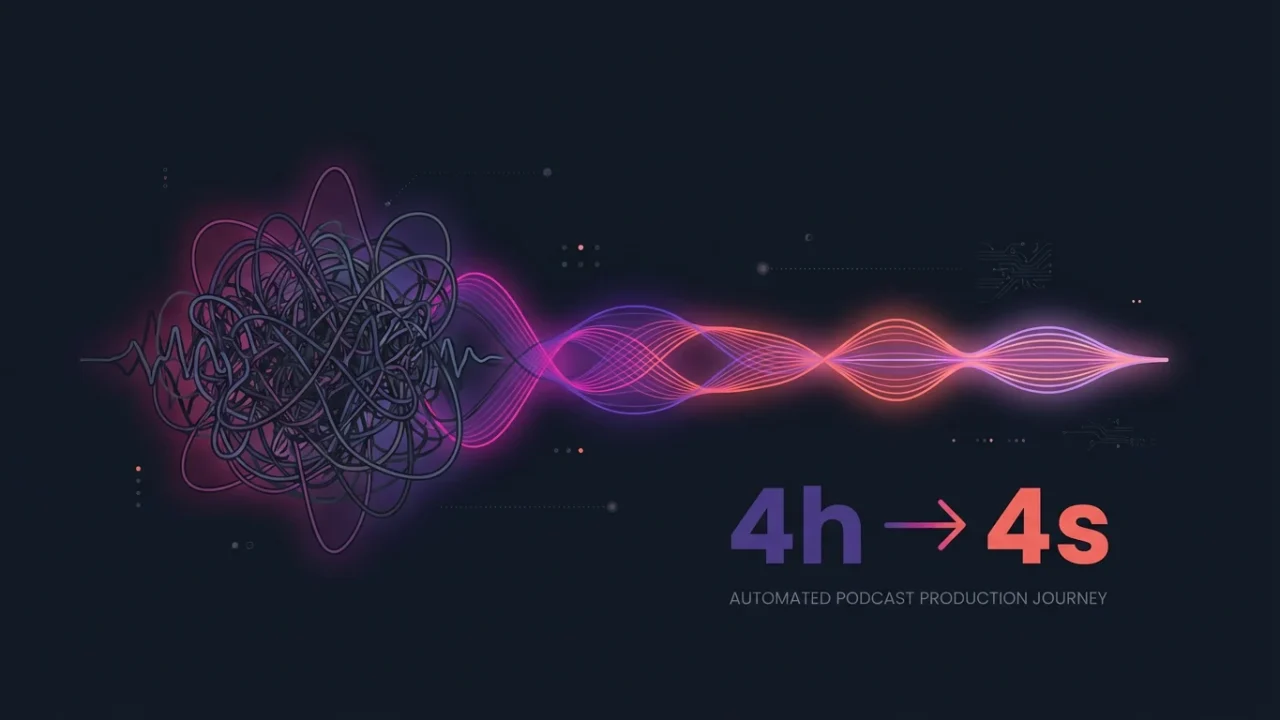
Don’t spend 4 hours editing a recap. Build an app that does it in 4 seconds.
You record a podcast episode. Great content. Real insights. Your audience will love it.
Launch Your App Today
Ready to launch? Skip the tech stress. Describe, Build, Launch in three simple steps.
BuildThen comes the part you hate.
You open your DAW and scrub through 47 minutes of audio, cutting filler words and dead air. You listen three more times to write show notes. You manually create chapter markers. You copy-paste timestamps into a doc. You write a summary for your newsletter. Another version for social media. You generate a transcript. You format it. You publish to seven different platforms.
Four hours later, you’re done with one episode.
Meanwhile, competitors are publishing daily. AI-generated podcasts are flooding RSS feeds. Audio newsletters arrive in inboxes every morning. The content velocity war is real, and manual workflows are losing.
Here’s the truth: podcast automation isn’t a luxury anymore. It’s table stakes. And if you can describe your workflow in plain English, you can build an AI audio summarizer app that handles everything in seconds, not hours.
This article shows you exactly how.
Why Podcast Automation Is Exploding

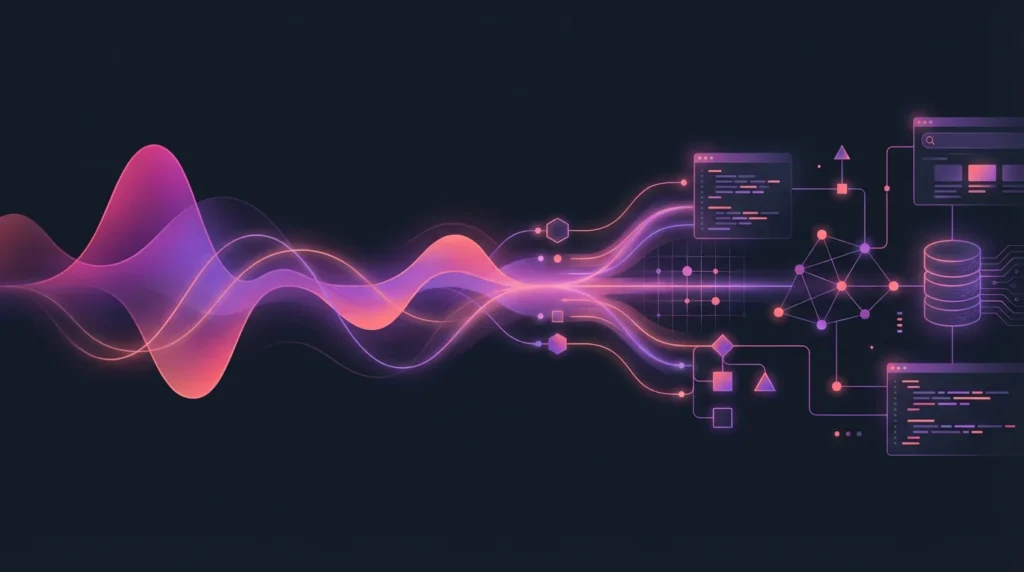
Audio used to be locked inside waveforms. You could listen to it, but you couldn’t query it, structure it, or transform it at scale.
Not anymore.
Modern AI treats audio as structured data. Speech-to-text models like Whisper achieve human-level accuracy. Large language models extract insights, generate summaries, and create entire content derivatives from transcripts. Text-to-speech engines sound increasingly human. This is part of a broader shift toward AI workflow automation that’s transforming how teams handle repetitive content tasks.
The result? Audio is now programmable.
This shift is driving massive adoption across industries. Companies automate sales call analysis. Teams turn hour-long meetings into action items. Creators repurpose long-form interviews into clips, threads, and blog posts. News organizations generate daily audio briefings from written content. The same AI automation tools for business powering other industries are now transforming audio production.
The podcast space is particularly explosive. Daily shows that once required full-time producers now run on autopilot. Indie creators launch multiple audio products simultaneously. B2B companies transform internal knowledge into searchable audio archives.
The pattern is clear: teams that automate audio workflows scale faster, publish more consistently, and reach audiences their competitors can’t match.
If you’re still editing manually, you’re not competing with other humans anymore. You’re competing with systems that process audio at machine speed.
The question isn’t whether to automate. It’s how to build the right automation for your specific workflow.
The Modern AI Audio Workflow

Let’s break down how podcast automation actually works. Understanding the full pipeline is critical before you build or buy anything.
1. Audio Ingestion
Your workflow starts with audio input. This could be:
- Direct file uploads (MP3, WAV, M4A)
- RSS feed monitoring for new episodes
- Recording platform integrations (Riverside, SquadCast, Descript)
- Live stream captures
- Meeting recordings (Zoom, Teams, Google Meet)
The ingestion layer handles file validation, format conversion, and storage. Production systems need to manage multiple audio sources simultaneously and queue processing jobs efficiently.
2. Speech-to-Text Conversion
Modern transcription doesn’t just convert audio to text. It identifies speakers, timestamps every word, detects language automatically, and often includes speaker diarization.
The best systems use:
- OpenAI Whisper for accuracy and language support
- Google Gemini for integrated multimodal understanding
- AssemblyAI for specialized podcast features
- Azure Speech for enterprise compliance
Quality transcription is non-negotiable. Every downstream process depends on accurate text. Garbage in, garbage out applies aggressively here.
3. AI-Powered Summarization
This is where the magic happens. Your transcript becomes structured insights:
Chapter Detection: AI identifies topic shifts and creates logical segments with timestamps. Listeners can jump to exactly what interests them.
Key Points Extraction: The system pulls out main ideas, memorable quotes, and actionable takeaways. No more “listen to the whole thing to find the good parts.”
Multi-Format Summaries: Generate versions optimized for different platforms. A 280-character thread starter. A 150-word newsletter blurb. A detailed blog post. All from the same source material. This is similar to how AI content generation tools for marketing adapt messaging across channels.
Insight Generation: Advanced systems don’t just summarize, they analyze. What questions were answered? What problems were solved? What’s the business value of this content?
4. Content Generation
Summarization feeds into content creation. Your audio-to-text automation can produce:
- Episode show notes with SEO-optimized descriptions
- Social media posts optimized by platform
- Email newsletter content
- Blog articles expanding on key topics
- Quote graphics with visual templates
- Video clip scripts with suggested timestamps
The AI understands context and adapts tone. A LinkedIn post sounds professional. A Twitter thread sounds conversational. A blog post includes proper structure and transitions.
5. Optional Audio Regeneration
Some workflows close the loop by generating new audio:
- Create audio summaries of long episodes
- Build audio newsletters from written content
- Generate trailer clips in the host’s voice style
- Produce intro/outro variants for different audiences
Text-to-speech has reached the point where synthetic voices sound natural, especially for scripted content like summaries and announcements.
6. Distribution and Publishing
The final step pushes content everywhere:
- Podcast hosting platforms (Transistor, Captivate, Buzzsprout)
- RSS feed updates
- YouTube with auto-generated captions
- Social media schedulers
- Email marketing platforms
- Your website CMS
Advanced podcast automation workflows handle republishing, A/B testing different show notes, and tracking which content derivatives perform best.
Every step in this pipeline runs automatically. Upload audio, get complete content packages in return. That’s the promise of modern AI podcast generators.
The Hidden Problem With Most “AI Podcast Tools”
Here’s what usually happens when founders discover podcast automation tools.
They search “AI podcast transcription” or “podcast summarization API” and find dozens of options. Notta. Podsqueeze. Castmagic. Swell AI. They all promise to automate your workflow.
So you sign up. You upload an episode. You get… a summary.
It’s fine. Decent even. But it’s also generic, inflexible, and fundamentally limited.
The Template Trap: These tools give you their templates. Their chapter styles. Their summary formats. If you want something different, too bad. You can’t customize the AI instructions. You can’t change the output structure. You’re stuck with their one-size-fits-all approach.
The Integration Wall: You want to automatically pull from your RSS feed and push to your CMS? That’s extra. Connect to your email platform? Different tool. Generate specific content formats for your brand? Not supported. You end up stitching together five services and manually moving data between them. If you’re trying to automate workflows without writing code, these limitations become deal-breakers.
The Ownership Gap: You don’t own the workflow logic. You can’t see the prompts. You can’t modify the processing pipeline. If the tool shuts down or changes pricing, your entire content operation breaks. You’ve built on rented land.
The Product Limitation: These are features, not platforms. They solve “transcribe my podcast” but not “build my audio content engine.” If you want to create an actual product, a custom solution for clients, or a differentiated workflow, you’re blocked.
This matters more than founders realize. The companies winning with audio automation aren’t using off-the-shelf tools. They’re building custom podcast content repurposing systems tuned exactly to their audience, brand, and distribution strategy.
Generic tools give you generic results. Custom systems give you competitive advantage.
Build vs Buy: The Real Decision

Every founder faces this question eventually. Here’s the honest comparison:
| Option | Pros | Cons |
|---|---|---|
| Off-the-shelf tools | Fast setup, no technical work | Limited customization, template-locked, recurring costs scale poorly, no ownership, can’t build products on top |
| Custom development | Complete flexibility, exact workflow match, own the code | $50k+ development cost, 3-6 month timeline, requires ongoing maintenance, need technical team |
| Imagine.bo | Full customization, production-ready architecture, built in hours not months, SDE-level quality, own the logic | Requires describing your workflow clearly |
Most founders pick off-the-shelf tools because custom dev seems impossible. They accept limitations because flexibility feels out of reach.
But there’s a third path: describe exactly what you want in plain English, and get a production-ready app built automatically. This is what modern no-code AI app builders enable—the power of custom development without the cost or timeline.
That’s not theoretical. It’s how modern AI no-code workflow builders work.
How to Build a Podcast Automation Tool With Imagine.bo
Here’s the fundamental shift: you don’t need to know how to code. You need to know what you want.
The old model: hire developers, explain requirements, wait months, pay for every change, maintain infrastructure.
The new model: describe your audio summarization pipeline in detail, and an AI systems architect builds it for you. This approach to building AI applications removes the technical barrier entirely.
Here’s how it works:
You provide a clear description of your workflow. Be specific. For example:
“Build an AI podcast generator that accepts uploaded MP3 files, transcribes them using Whisper, identifies key topics and timestamps, generates three content formats—detailed show notes, a 150-word email summary, and five social media posts—and stores everything in a dashboard where I can edit and export.”
Imagine.bo reads that description and:
Designs the architecture: Creates a scalable backend with proper audio processing queues, transcription service integration, AI summarization logic, and content storage.
Implements the AI logic: Configures speech-to-text pipelines, writes prompts for summarization and content generation, handles different content format requirements, and builds quality validation.
Builds the interface: Creates upload flows, processing status displays, content review dashboards, and export functionality.
Deploys production infrastructure: Sets up secure file storage, API endpoints, database structures, and user authentication if needed.
The result is a working application with SDE-level quality. Not a prototype. Not a proof of concept. A production-ready system you can use immediately or extend further.
What makes this different from no-code tools?
Traditional no-code platforms make you drag boxes and connect nodes. You’re still building, just with visual tools instead of code. You still need to understand system architecture, API integration, and data flow.
Imagine.bo eliminates that layer. You explain the outcome. The system architects the solution. It’s the difference between no-code and AI-powered development—one requires you to construct, the other understands intent and builds accordingly.
What makes this different from hiring developers?
You get the same quality output—proper error handling, scalable architecture, security by default—but in hours instead of months. And you can iterate instantly by describing changes in plain English. This is why more founders are choosing to build SaaS with AI and no-code rather than traditional development approaches.
The practical difference:
Off-the-shelf tool: “Here’s our podcast summarization template. Take it or leave it.”
Traditional development: “Describe requirements. Wait 3 months. Hope we understood correctly.”
Imagine.bo: “Describe your exact workflow. Get a working app today. Modify it tomorrow if needed.”
This matters enormously for founders. You’re not locked into someone else’s vision. You’re not blocked by technical limitations. You own the logic, control the outputs, and can pivot as your needs evolve.
Example Use Cases: What You Can Actually Build
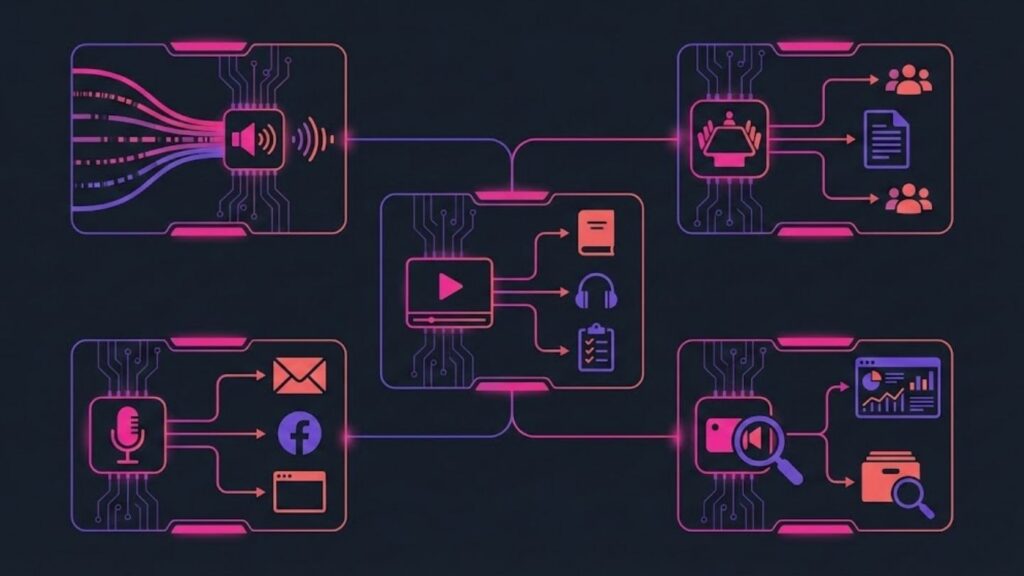
Let’s get concrete. Here are real podcast automation workflow examples you can build:
Daily News Podcast Generator
The workflow: Monitor RSS feeds from five news sources. Every morning at 6 AM, pull top stories, generate a script highlighting the three most important developments, create audio using text-to-speech in your chosen voice, publish to podcast feed automatically.
Time saved: 90 minutes daily. No human intervention unless you want editorial control.
Business value: Consistent daily content. Audience knows exactly when new episodes arrive. You compete with organizations that have full-time producers.
Internal Meeting Recap Engine
The workflow: Automatically record company all-hands meetings, transcribe with speaker identification, extract action items and decisions by department, generate customized summaries for different teams, send via Slack with relevant timestamps.
Time saved: 2+ hours per meeting across the organization. People get exactly the information relevant to them.
Business value: Better organizational alignment. Searchable knowledge base of company decisions. Remote teams stay synchronized.
Creator Podcast-to-Newsletter Machine
The workflow: Upload interview episodes, generate detailed show notes with guest bio and key insights, create email newsletter content with timestamp links to best moments, produce quote graphics for social promotion, auto-publish to website with SEO optimization.
Time saved: 3-4 hours per episode. Publish across platforms in minutes.
Business value: Maximize content ROI. One recording becomes 10+ distribution assets. Grow email list by offering multiple content formats. Similar strategies work for AI content repurposing tools across industries.
B2B Knowledge Audio Summarizer
The workflow: Sales team records product demos and customer calls, system transcribes and analyzes for common questions and objections, generates insights dashboard showing trending topics, creates searchable archive where team can find “all discussions about pricing” or “how we’ve explained feature X.”
Time saved: Eliminates hunting through recordings. Instant knowledge retrieval.
Business value: Faster rep onboarding. Consistent messaging across team. Data-driven product insights from actual customer language.
Course Content Repurposing System
The workflow: Record video lessons, extract audio, transcribe and summarize each lesson, generate study guides with key concepts and timestamps, create quiz questions from content, produce audio-only versions for commuter learning.
Time saved: 5+ hours per course. Content becomes accessible in multiple formats automatically.
Business value: Better student outcomes through diverse learning formats. Higher completion rates. Premium feature for course platforms. This type of generative AI application development opens entirely new product possibilities.
Each of these examples solves a real problem. Each saves hours weekly or daily. Each would cost $50,000+ to build traditionally and months of development time.
With AI no-code workflow automation, you describe the system and launch it the same day. This is the promise of modern prompt-based app development—turning descriptions into production systems.
The Future of Audio Apps
We’re entering a phase where audio becomes queryable infrastructure.
Right now, most audio still lives in files. You play it start to finish, or you don’t consume it at all. It’s linear, locked, and hard to extract value from at scale.
That’s changing fast.
The next generation of audio products treats voice content like structured databases. You don’t just listen to podcasts; you query them. “Find all episodes where guests discussed pricing strategy.” “Show me every time we’ve explained our product positioning.” “What are the top 10 insights from this quarter’s customer calls?”
AI agents will consume audio automatically. Your personal AI assistant will listen to podcasts while you sleep, extract the insights relevant to your projects, and brief you in the morning. Company AI will monitor competitor earnings calls and alert you to strategic shifts.
Podcasts won’t just be content. They’ll become APIs for insight. The actual audio file is less important than the structured intelligence you can extract from it.
This creates massive opportunity for builders. The tools that win aren’t the ones that produce the best transcripts. They’re the ones that build the best workflows, solve the most specific problems, and integrate audio intelligence into business processes.
Early movers have a huge advantage. While most creators still edit manually, you can launch automated audio products, scale content operations, and build the infrastructure that will power the next decade of audio applications. The same principles that enable rapid AI prototyping for startup pitches apply to audio automation—speed to market creates competitive moats.
The question is: are you building for today’s constraints or tomorrow’s possibilities?
Start Building Your Podcast Automation Tool
Here’s what you actually need to do:
Stop thinking about podcast automation as a tool you buy. Start thinking about it as a system you build specifically for your workflow, your content, and your audience.
The technical barriers that made this impossible three years ago are gone. You don’t need a development team. You don’t need to learn Python or understand API documentation. You need clarity on what you want to create.
If you can explain your podcast workflow in one paragraph—describe what goes in, what should happen to it, and what should come out—you can build it with Imagine.bo.
No stitching together five different services. No monthly limits on processing. No template you’re forced to accept. Just a production-ready audio summarization pipeline built exactly how you need it.
The founders who automate their audio workflows now won’t just save time. They’ll build systems their competitors can’t replicate, publish at velocities that seem impossible, and own the infrastructure that turns audio into actionable intelligence.
Your podcast automation tool doesn’t exist yet because you haven’t built it.
Launch Your App Today
Ready to launch? Skip the tech stress. Describe, Build, Launch in three simple steps.
Build