If you are reading this, you probably have an idea burning a hole in your pocket. You’re a founder, a maker, or someone who just wants to build a SaaS product without spending six months learning syntax errors. You know that “no-code” is the answer, but the landscape has shifted.
For years, Bubble has been the undisputed king of the hill—the powerful, complex giant that runs half the no-code world. But as we settle into 2026, a new wave of AI-native builders has arrived, led by no-code platforms like Lovable or Imagine.bo.
Launch Your App Today
Ready to launch? Skip the tech stress. Describe, Build, Launch in three simple steps.
BuildThis isn’t just a feature comparison; it’s a look at two different philosophies. Do you want to learn a visual programming language, or do you want to describe your idea and have AI build it for you?
Here is the honest, no-fluff comparison to help you decide which tool deserves your time and trust.
Quick Summary / TL;DR
If you are in a rush, here is the bottom line:
- Choose Bubble if: You want granular, pixel-perfect control over every single element and you are willing to spend weeks or months learning a complex visual editor. It is powerful, but it feels like learning a new trade.
- Choose Imagine.bo if: You want to launch a production-ready MVP in minutes, not months. It uses AI to generate your backend, database, and frontend from natural language prompts. It creates real code that you can export, and it bridges the gap between AI automation and human engineering.
At a Glance: Key Differences
| Feature | Bubble | Imagine.bo |
|---|---|---|
| Primary Method | Visual Programming (Drag & Drop) | AI-Native (Describe-to-Build) |
| Time to MVP | Weeks to Months | In Minutes |
| Learning Curve | High (Steep) | Low (Conversational) |
| Code Export | No (Vendor Lock-in) | Yes (Standard Code) |
| Best User | Aspiring Developers / Designers | Founders / Solopreneurs |
What Bubble is Good At
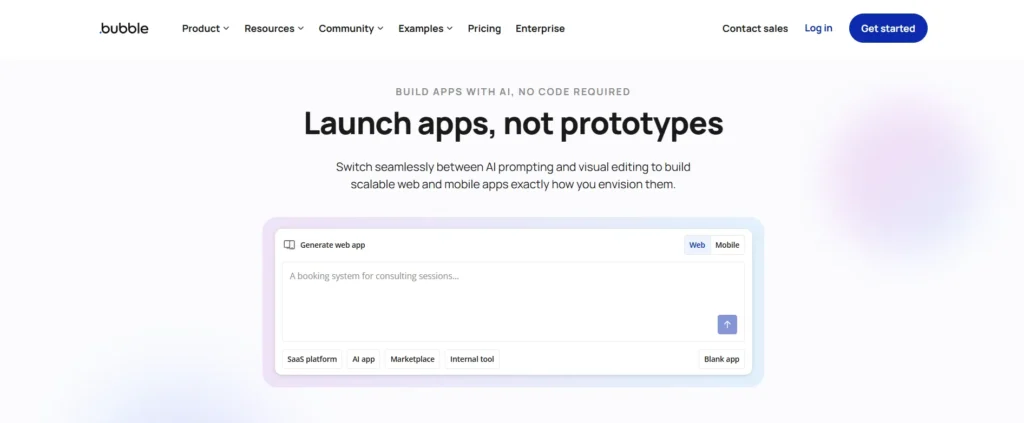
Bubble is the veteran in the room. It has been around long enough to have a massive community and a plugin for almost anything you can think of.
Visual Programming Power
Bubble isn’t just a website builder; it is a full-stack visual programming interface. This means you can build almost any logic you can dream up without writing code.
- Backend Workflows: Beyond simple button clicks, Bubble allows you to schedule recurring server-side events, process data in loops, and handle secure transactions away from the user’s browser.
- Complex Logic: If you need a workflow that says, “When a user clicks this button, check if they are logged in, then charge their card, then send an email, but only if it’s Tuesday,” you can build that manually in Bubble’s workflow editor.
Granular Design Control
Bubble’s responsive engine allows for “pixel-perfect” design. You can control padding, margins, and conditional visibility down to the smallest detail. If you are a designer who needs the button to be exactly 4px to the left on an iPhone 14 but 2px to the right on an iPad, Bubble gives you those knobs to turn. It uses a flexbox-style layout engine that, while complex to learn, offers professional-grade responsiveness across all device sizes.
Ecosystem and Infrastructure
Because it has been around so long, the Bubble Marketplace is huge. If you need to connect to Stripe, SendGrid, or a random weather API, there is likely a plugin for it. If not, their API Connector lets you build the connection yourself. Furthermore, Bubble handles all the hosting complexity. Your app runs on enterprise-grade AWS servers and uses Cloudflare for content delivery, meaning you can scale without needing a DevOps engineer to manage your infrastructure.
What Imagine.bo is Good At
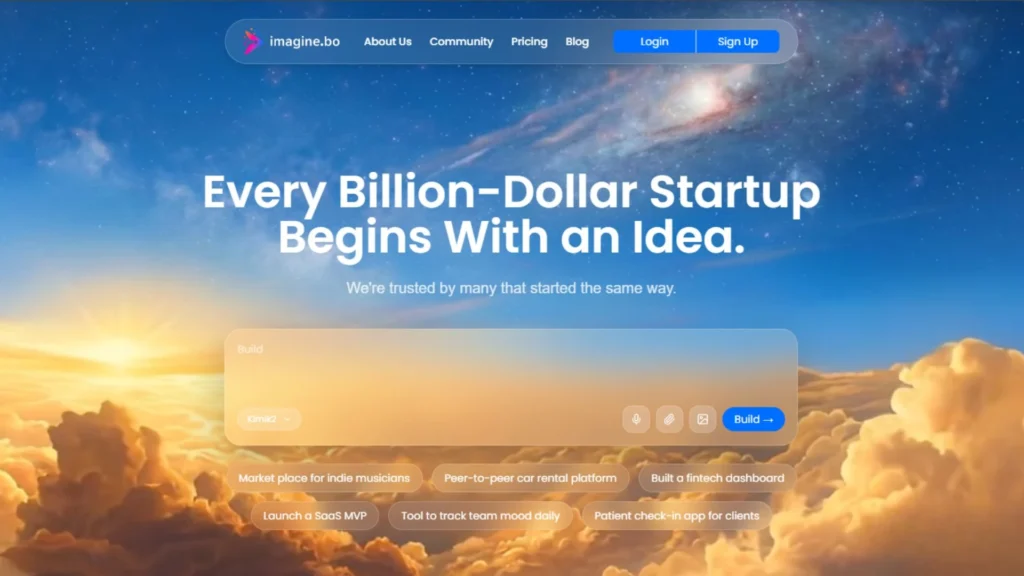
Imagine.bo represents the “next generation” of builders—tools that are AI-native rather than AI-adapted.
Speed to MVP via “Blueprints”
The core philosophy of Imagine.bo is “Describe-to-Build”. You don’t start with a blank canvas; you start by typing, “Build a task management app for small teams where admins can assign tasks and users get email notifications”.
- Architectural Intelligence: Before building, the AI generates a comprehensive Blueprint. It maps out your database schema, user flows, and permissions logic, acting like a software architect to ensure the final app makes logical sense.
- Instant Generation: Once approved, the AI generates the database structure, the frontend UI, and the backend workflows instantly.
Real Code and Enterprise Readiness
One of the biggest fears for founders is “vendor lock-in”—being stuck on a platform you can’t leave. Imagine.bo allows you to export or hand off code if needed.
- Standard Infrastructure: Unlike proprietary runtimes, Imagine.bo deploys to standard, scalable infrastructure using Vercel, supabase and railways. It is capable of handling high traffic loads (up to 1,000 transactions per second).
- Security First: Apps are built with GDPR and SOC2-ready foundations by default, ensuring your data handling meets modern compliance standards immediately.
Hybrid AI + Human Support
Imagine.bo acknowledges that AI might get you 90% of the way there. For the last 10%—the complex, custom logic—they have a feature where you can “Hire a Human”.
- Expert Assistance: You can assign specific tasks to real engineers within the platform to handle complex API integrations or advanced logic.
- Guaranteed Turnaround: Depending on your plan, you get guaranteed response times (as fast as 12 hours), giving you the speed of AI with the safety net and reliability of a human engineering team.
Ease of Use & Learning Curve
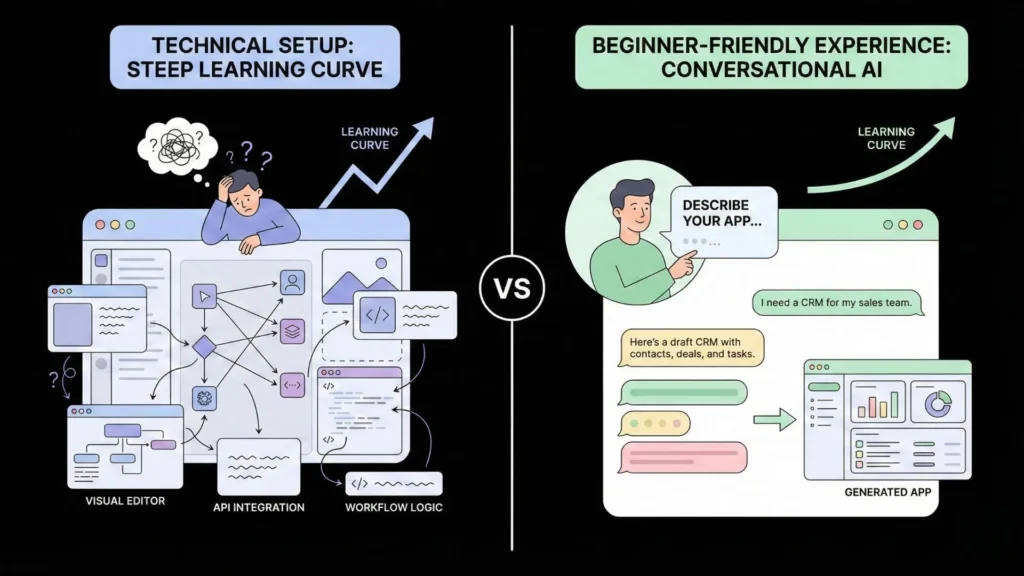
This is where the divergence between the two platforms is most obvious.
The Bubble Learning Curve
Let’s be honest: Bubble is hard. It is famous for its steep learning curve. New users are encouraged to join “bootcamps” or watch hours of academy videos just to understand the basics. You have to understand concepts like “states,” “data types,” “privacy rules,” and “workflow triggers” before you can build a functional app. It is rewarding if you want to become a professional “Bubble Developer,” but it is a heavy lift for a founder who just wants a product.
The Imagine.bo Experience
Imagine.bo is designed for non-technical users. The interface is conversational. You write a prompt in plain English, and the platform handles the technical translation. You don’t need to manually create a “User” table in the database; the AI infers you need one because you mentioned “login” in your prompt. The learning curve isn’t about learning software mechanics; it’s about learning how to write a clear prompt.
Winner for Beginners: Imagine.bo. It removes the intimidation factor of staring at a blank editor.
Building Speed & Workflow
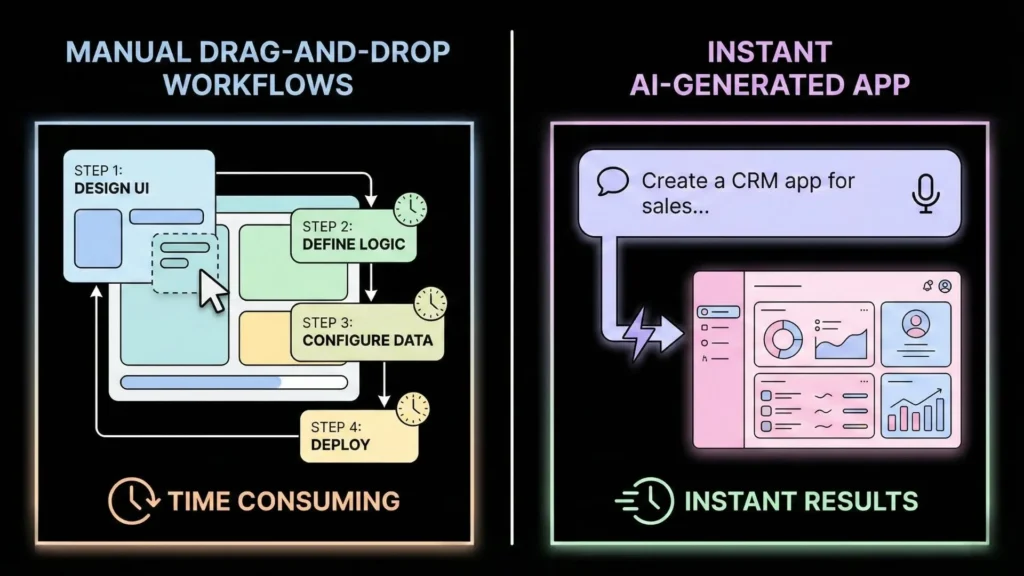
Time is the most valuable resource for a solopreneur. How fast can you go from idea to live link?
Bubble’s Manual Workflow
In Bubble, building is a manual process. You drag an input field onto the canvas. You drag a button. You double-click the button to start a workflow. You select “Sign the user up.” You map the input field to the email field in the database. It is logical, but it is click-heavy. Even with their new AI app generator, you often find yourself tweaking workflows step-by-step.
Imagine.bo’s Automated Workflow
In Imagine.bo, that same sign-up flow is generated automatically because you asked for a “SaaS app with user accounts”. The backend logic, the database schema, and the frontend forms are created in one shot. You then use the visual tools to refine or customize, rather than building from scratch.
For a founder, this difference is massive. Bubble requires you to be the architect and the construction worker. Imagine.bo acts as the general contractor—you tell it what you want, and it pours the foundation for you.
Workflow Comparison
| Action | Bubble | Imagine.bo |
|---|---|---|
| Starting Point | Blank Canvas | Natural Language Prompt |
| Database Creation | Manual Setup | AI-Inferred & Generated |
| UI Construction | Pixel-by-pixel drag & drop | AI-generated layouts |
| Logic Implementation | Manual Logic Trees | AI-written Workflows |
AI Features & Modern App Building
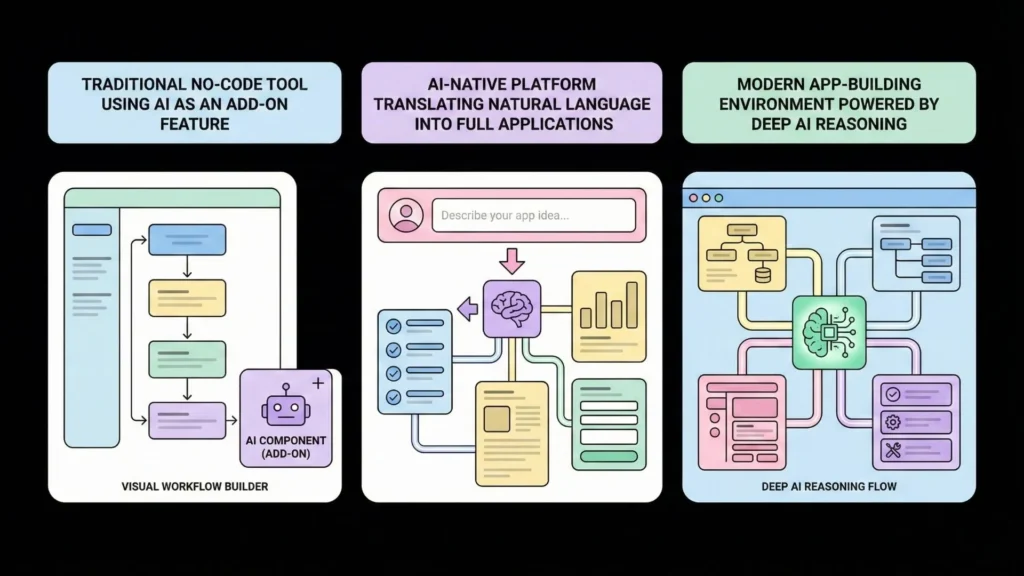
Both platforms claim to be AI-powered, but they use AI in very different ways.
Bubble’s AI Approach
Bubble has integrated AI as a feature set on top of its existing editor. You can use it to generate a starting point or helper text, but the core of the platform is still the manual visual editor. It is helpful, but it feels like a plugin for a legacy system.
Imagine.bo’s AI-Native Core
Imagine.bo was built around LLMs (Large Language Models). The “Prompt Engineering” guide for Imagine.bo shows just how deep this integration goes. You can define actors, problems, and edge behaviors in text, and the system translates that into working software. It even understands negative constraints (e.g., “Only admins can delete records”) and builds the security rules to match.
This makes Imagine.bo feel smarter.
Pricing & Value: The Cost of Building
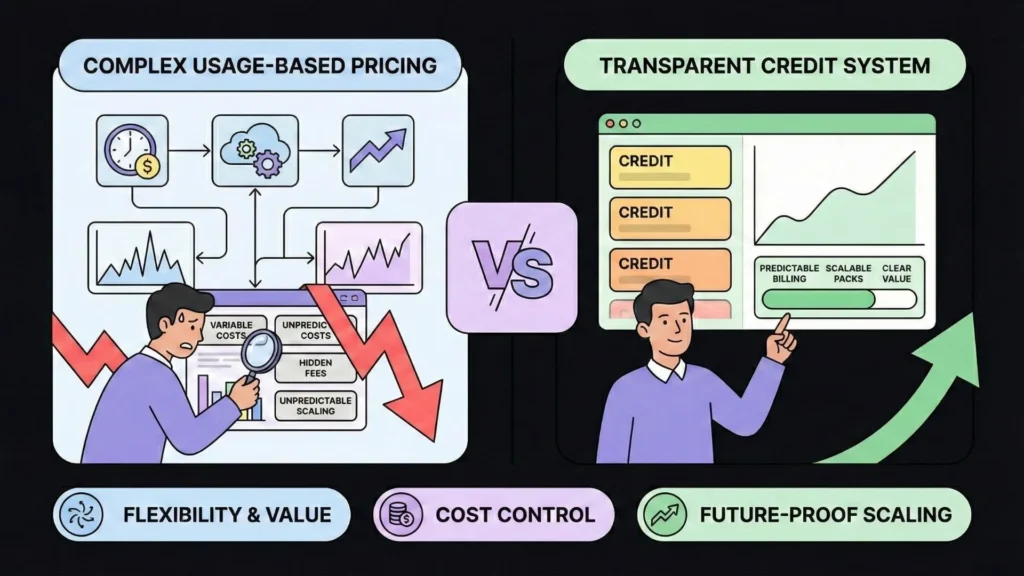
When choosing a platform, you aren’t just paying for features; you are paying for predictability. Here is how the two stack up.
Bubble: The “Workload” Model
Bubble operates on a complex matrix of subscription tiers plus usage-based billing known as Workload Units (WU).
- Per-App Pricing: You pay for every single app individually. If you have three ideas, you pay three subscriptions.
- Unpredictable Scaling: If your app goes viral or has heavy logic, you burn through Workload Units. Once you hit your limit, you must pay overage fees or buy expensive tiers to keep your app running.
- No Rollover: Unused capacity does not carry over. If you have a quiet month, that value is lost.
- No Refunds: Payments are strictly non-refundable.
Imagine.bo: The “Credit” Model
Imagine.bo uses a transparent, credit-based system designed to be founder-friendly.
- Accessible Tiers: Plans start at just $7/month (Lite), with a highly capable Pro plan at $20/month.
- Credit Rollover: Unlike Bubble, Imagine.bo supports Credit Rollover on all paid plans. If you don’t use your credits in January, they stack up for February. You never lose the value you paid for.
- Human Support Included: The paid plans include discounted or priority access to “Assign a Developer”—a feature where real engineers help you fix issues.
- Flexible Capacity: A single Pro subscription (150 credits) is enough to build a robust multi-page SaaS app with authentication and forms.
Pricing Comparison
| Feature | Bubble | Imagine.bo |
|---|---|---|
| Entry Price | Free / Paid plans (Per App) | $0 (Free) / $7/mo (Lite) |
| Billing Model | Subscription + Workload Units | Subscription + Credits |
| Unused Capacity | Lost at end of month | Rolls over to next month |
| Hidden Costs | Overage fees for server load | None (Optional top-ups) |
| Human Support | Community / Expensive Agencies | Integrated “Hire a Human” |
Verdict on Value: Imagine.bo wins on transparency and flexibility. The ability to roll over credits and the inclusion of human developer support makes it a safer bet for founders who want to avoid surprise bills.
Conclusion
Ultimately, the choice between Bubble and Imagine.bo comes down to your priorities: control versus speed. If you want to master a visual programming language and need total pixel-perfect dominance, Bubble remains the industry standard. However, if your goal is to launch a scalable, production-ready product today without the steep learning curve, Imagine.bo is the smarter, future-proof choice for 2026.
Related Articles
- Weekend Warrior: Build Your CRM App with Bubble (Step-by-Step)
- How MBA Students Can Validate Startup Ideas with No-Code Tools
- Adding AI Chatbots in No-Code Platforms for Enhanced User Interaction and Automation
- Unlock Android AI Power: Your Guide to the Best AI App Builders
- How a Non-Developer Launched a Startup App Using Only No-Code Platforms: Your Ultimate Guide
Launch Your App Today
Ready to launch? Skip the tech stress. Describe, Build, Launch in three simple steps.
Build