
Hey everyone, Jayesh Bharti here.
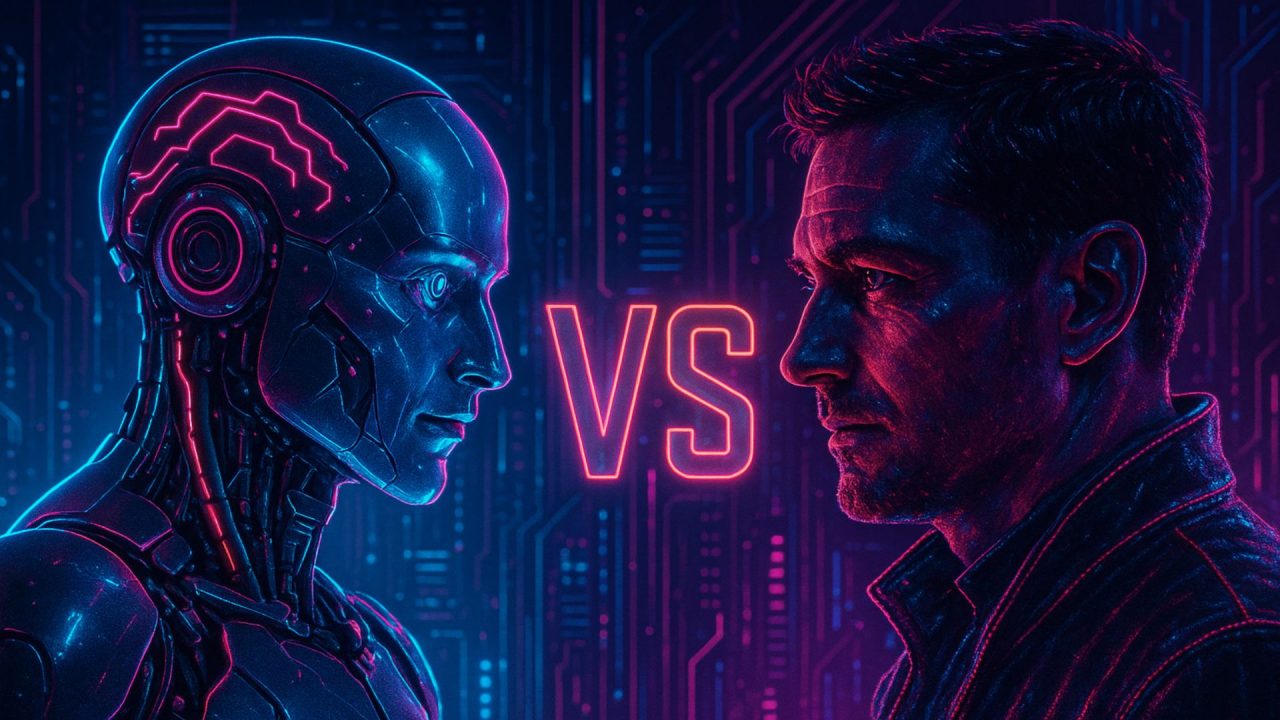
Hardly a day goes by that someone doesn’t ask me the big question, usually in a half-joking, half-terrified whisper: “So… is AI coming for our jobs?”
Launch Your App Today
Ready to launch? Skip the tech stress. Describe, Build, Launch in three simple steps.
BuildIt’s the “AI vs. Human” narrative, and it’s everywhere. We picture this epic showdown between a flawless, ultra-fast robot and a flawed, creative human.
Honestly, I was tired of the theoretical debate. I’m a builder. I prefer to test things.
So, I decided to run a little experiment. I set up a “Daily Task Challenge” to pit AI against a human (me) in a series of tasks that founders, marketers, and builders face every single day.
Who actually did it better? The results were… not what I expected.
The Setup: Defining the Challenge

To make this a fair fight, I broke down the challenge into four distinct rounds, each representing a critical part of the product-building journey.
- The “Human” Contestant: Me. Armed with a B.Tech in Computer Science, years of development experience, a blank Google Doc, a code editor, and a strong cup of coffee.
- The “AI” Contestant: A suite of modern AI tools, including generative AI for text and, for the building phase, our own AI-powered no-code platform, Imagine.bo.
The tasks were:
- Ideation: Brainstorm 10 new feature ideas for a SaaS app.
- Content Creation: Write a short, persuasive email to a potential investor.
- Prototyping: Build the functional scaffolding for a new user sign-up page.
- Debugging: Find and fix a critical logic error in a workflow.
Let’s ring the bell.
Ideation & Brainstorming

We all know this feeling. You’re staring at your product, and you know you need that next “killer feature,” but your mind is blank.
My Human Approach (Time: 45 minutes): I opened a blank document and set a timer. My first few ideas were… fine. “User profiles.” “Better analytics.” Pretty generic. I started mind-mapping, which led me down a rabbit hole of what our competitors were doing. After about 45 minutes of distracted Googling and deep thinking, I had a list of 10 ideas. A few of them felt genuinely innovative, born from my specific experience and understanding of our users’ pain points.
The AI Approach (Time: 45 seconds): I opened an AI chat interface and typed: “I have a project management SaaS. Give me 10 unique feature ideas to increase user engagement.”
In less than a minute, I had a list. “AI-powered task prioritization.” “Gamified leaderboards for teams.” “Automated project summary reports.”
The Verdict: Who Won? The AI won on speed and quantity, hands down. It was incredible at pattern recognition and synthesizing common ideas from across the web.
But the human (me) won on originality and strategic insight. The AI’s ideas were good, but they lacked context. They didn’t know the specific problem my (hypothetical) users were facing. My best ideas came from a place of empathy and experience—something AI can’t just “generate.”
Winner: A draw. AI for the first draft, Human for the game-changing insight.
Content Creation (The Investor Email)
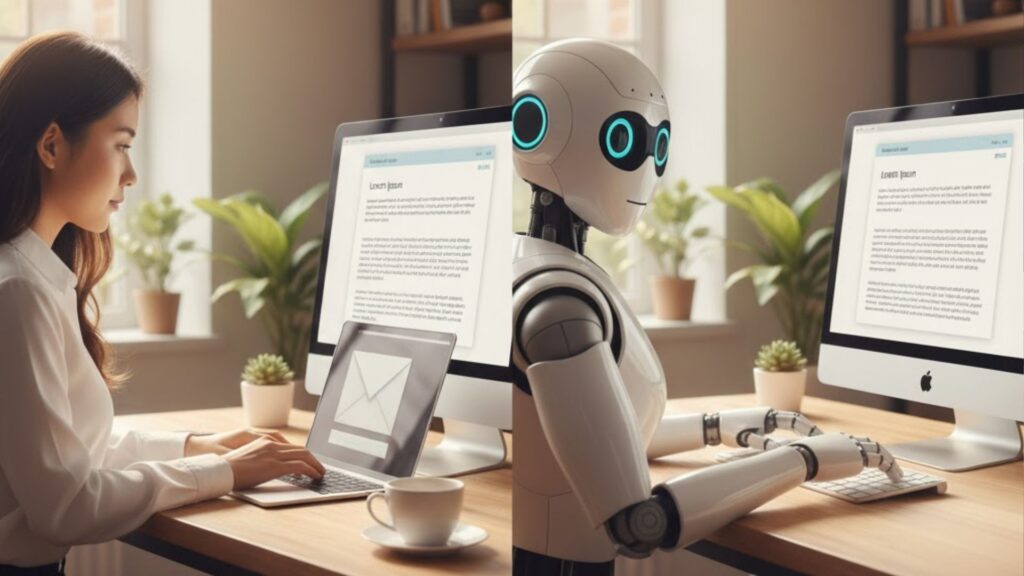
Okay, now for a task that requires a bit more… finesse. I needed to write a 150-word email to a potential investor, introducing my app idea and asking for a meeting. This requires a blend of persuasion, clarity, and professionalism.
My Human Approach (Time: 30 minutes): Writing is hard. I agonized over the opening line. “Dear Mr. Smith,” (Too formal?) “Hi John,” (Too casual?). I wrote a draft, deleted it. Wrote another. Read it aloud. Tweaked the “ask” at the end to sound more confident. After 30 minutes, I had a solid, personalized email I felt good about.
The AI Approach (Time: 2 minutes): Prompt: “Write a 150-word cold email to a venture capitalist. My app is an ‘AI-powered no-code builder for entrepreneurs.’ The tone should be professional, confident, and concise. The goal is to get a 15-minute meeting.”
Ding. The AI spat out a frighteningly good email. It was clear, structured (Problem, Solution, My App, The Ask), and incredibly professional. It even included a line I hadn’t thought of about “democratizing software development.”
The Verdict: Who Won? I’ll be honest: the AI won this round.
My ‘human’ version was good, but the AI version was perfectly optimized. It was a flawless execution of a “best-practice” template. My human touch actually introduced hesitation (“Am I being too pushy?”). The AI was pure, confident execution. I’d still do a final human pass to add a specific personal touch, but the AI did 95% of the work in 5% of the time.
Prototyping (The Sign-Up Page)
This is my home turf. Building things. The challenge: create a functional, secure, and scalable sign-up page. Not just a pretty picture—a page that actually works.
My Human Approach (The “Traditional” Way): This isn’t a 30-minute task. This is a “clear-my-schedule” task.
- Open my code editor (e.g., VS Code).
- Set up a new project (React, Vue, etc.).
- Install dependencies.
- Write the HTML for the form.
- Write the CSS to make it look good (and responsive on mobile).
- Write the JavaScript for client-side validation (e.g., “Is this a real email?”).
- Set up a backend server.
- Provision a database.
- Write the API endpoint to receive the data.
- Write the logic to hash the password (for security).
- Finally, save the user to the database.
- Deploy it all to a cloud provider (like AWS or Vercel).
Time: For a professional, secure version? A full day. Maybe two. Cost: High (developer time is expensive).
The AI Approach (The “Imagine.bo” Way): This is where the challenge changed. I didn’t just use a text-based AI; I used our platform, which is designed for this.
- Describe: I typed in plain English: “I need a user sign-up page with fields for first name, last name, email, and password.”
- Build (AI): The AI handled all the coding. It generated the secure backend, the database connections, the API, and the scalable, cloud-ready infrastructure.
- Launch (Human + AI): I was presented with a visual, drag-and-drop builder. The AI had built the scaffolding, and now I, the human, could art-direct. I dragged the “email” field above the “password” field. I changed the button color to our brand’s blue. I added our logo.
Time: 10 minutes. From idea to a live, deployable, professional-grade application.
The Verdict: Who Won? This wasn’t even a contest. The AI-Human Hybrid (Imagine.bo) won, and it’s not close.
The traditional ‘Human’ approach, while powerful, is unacceptably slow and expensive for 90% of tasks, especially for founders building an MVP.
But—and this is critical—a “pure” AI (like just a text generator) would have just given me a chunk of code. I’d still have to do all the hard work of deploying, securing, and scaling it.
The winner was the platform that combines AI and a no-code visual builder. The AI did the 80% of heavy lifting (the coding, the infrastructure) that I hate doing, so I could focus on the 20% that I love (the design, the user experience, the strategy).
Debugging (The Logic Error)
Last round. I intentionally introduced a subtle but critical bug into a workflow: “What if a user tries to sign up with an email that’s already in the database?” A simple AI or a simple code editor won’t catch this. It’s not a syntax error; it’s a logic error.
The AI Approach: I fed the code and the problem to an AI. It… struggled. It suggested fixes for syntax. It re-wrote the function. But it couldn’t grasp the context of the entire application. It didn’t understand that a “user” is a unique person and that an “email” is a unique identifier. It’s just processing tokens.
My Human Approach: My developer brain kicked in. I thought, “What are the edge cases?” I immediately ran a test case: “Sign up as ‘test@test.com’. Now… try to sign up as ‘test@test.com’ again.”
Crash. (Or worse, a non-crash that just overwrites the user).
I knew exactly where to look. I needed to add a check: “BEFORE creating a new user, check if an email for that user already exists. If it does, return an error message.”
The Verdict: Who Won? The Human won, decisively.
AI is a phenomenal pattern-matcher. But it (currently) struggles with true contextual understanding, user empathy, and abstract reasoning. I found the bug not because I’m a better code-processor, but because I can put myself in the shoes of the user.
The Final Score: It’s Not “Vs.” at All
So, who won the challenge?
Neither.
The “AI vs. Human” framing was wrong from the start. My experiment proved, without a doubt, that the most powerful, effective, and fastest results always came from a Human + AI collaboration.
- AI is your tireless, lightning-fast research assistant (Round 1).
- AI is your expert copywriter that drafts the perfect 95%-complete email (Round 2).
- AI is your infrastructure engineer, building a scalable, secure backend in seconds (Round 3).
But the Human is…
- The Strategist who provides the creative spark and market insight (Round 1).
- The Finisher who adds the final 5% of personalization and voice (Round 2).
- The Architect and Designer who directs the AI and ensures the final product matches the unique vision (Round 3).
- The Detective who uses empathy and context to find the logic flaws that AI misses (Round 4).
This is exactly our philosophy at Imagine.bo. We didn’t build just an AI. We built a platform where the AI handles the repetitive, technical, no-fun parts of building an app, so you can be the human-in-the-loop focusing on what matters.
And that’s why we have one of the most important features on our platform: when the AI does reach its limit (like in Round 4), you’re not stuck. You can “assign to a real developer.”
It’s the ultimate hybrid model. It’s not AI vs. Human. It’s AI empowering the Human, with a human-in-the-loop backup for when things get tricky.
AI isn’t coming for your job. It’s coming to take away the parts of your job you were never meant to do, so you can finally be the founder, the creator, and the strategist you were always meant to be.
Launch Your App Today
Ready to launch? Skip the tech stress. Describe, Build, Launch in three simple steps.
Build