In the rapidly shifting landscape of 2026, the challenge for founders and business teams is no longer just “building an app,” but choosing a foundation that can sustain long-term growth. While AI-native platforms like Lovable, Bolt.new, and Imagine.bo have streamlined the generation of full-stack, production-ready code, Airtable remains a staple for managing structured business data. The decision between these tools often comes down to a fundamental architectural choice: are you building a tool to manage internal work, or a scalable product to serve external customers?
This comparison breaks down the technical and operational differences between Imagine.bo and Airtable to help you identify which platform aligns with your goals for security, performance, and total cost of ownership.
Launch Your App Today
Ready to launch? Skip the tech stress. Describe, Build, Launch in three simple steps.
BuildThe No-Code Landscape in 2026: Why It Matters
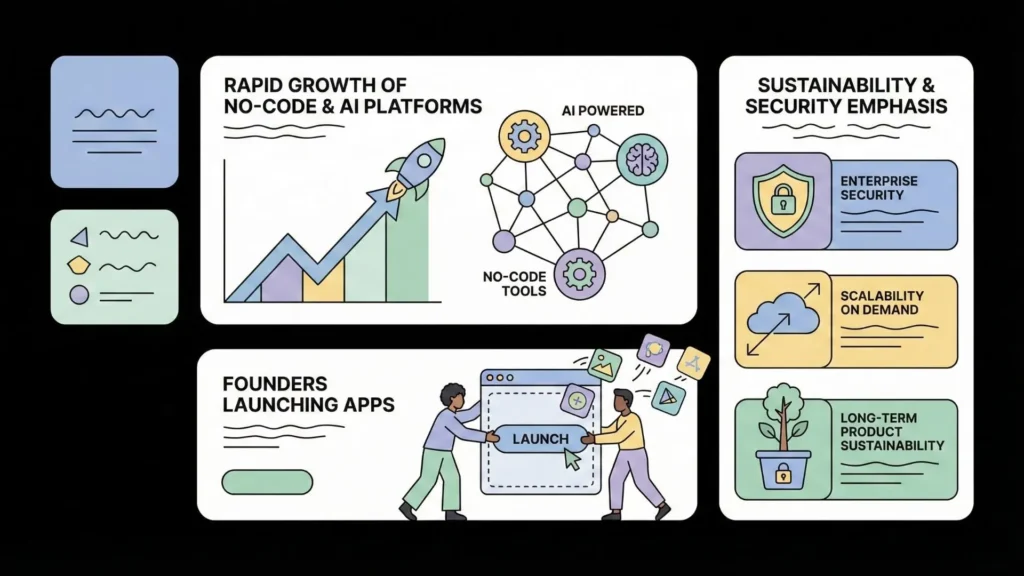
No-code and low-code platforms are no longer fringe tools. By 2026, the landscape has shifted dramatically from “simple website builders” to enterprise-grade application generators.
- The global no-code market is valued at $8.6 billion.
- 70%+ of new business applications are built using no-code/AI-assisted platforms.
- More than half of startups launch their first MVP without traditional engineers.
Yet, a troubling statistic persists: over 60% of no-code MVPs fail within 6 months.
The primary reasons applications fail are not lack of ideas, but structural limitations:
- Poor architecture: Using a database tool as a backend for a high-traffic app.
- Security vulnerabilities: Exposing sensitive data due to weak role-based access controls.
- Scalability limitations: Hitting record limits or API rate caps just as user growth spikes.
- Technical debt: Building on a proprietary platform that cannot be exported or customized.
- Data governance issues: Lacking the compliance tools needed for GDPR or HIPAA.
In other words, building an app is no longer the challenge — building a sustainable, long-term product is. This is the context in which we compare Imagine.bo and Airtable.
Understanding the Core Purpose
Airtable: The Ultimate Data Tool
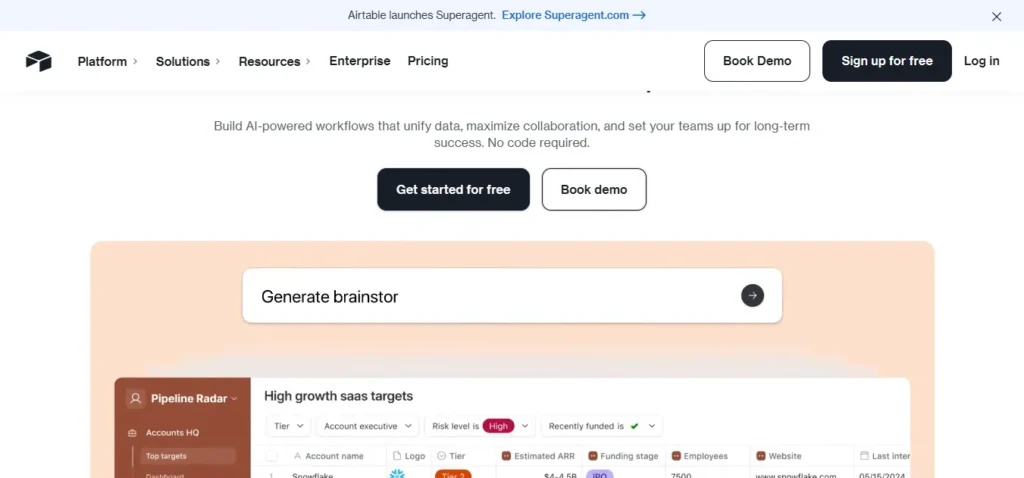
Airtable began as a spreadsheet-meets-database platform. Its goal was to help teams manage structured data without writing SQL or managing infrastructure. It succeeded brilliantly at this, becoming the de facto standard for “connected apps” within organizations.
Today, Airtable is primarily used to:
- Track records: From inventory to marketing assets.
- Build simple internal tools: Using Interface Designer to create dashboards for employees.
- Coordinate projects: managing intricate content calendars and product roadmaps.
- Manage CRM workflows: Tracking sales leads and deal stages.
- Store structured business data: Acting as a “single source of truth” for operational data.
It feels like a spreadsheet, but it behaves like a database with relationships, views, automations, and integrations. However, despite features like Interface Designer and AI Agents, Airtable is fundamentally a data operations tool — not an application builder for public-facing software. It is where you manage the work, not where you build the product.
Imagine.bo: The Business-First App Builder
Imagine.bo exists to solve a different, more critical question: “Can a non-technical founder build a revenue-ready application that can scale, secure data properly, handle traffic, and go into production without rewriting the app later?”
Imagine.bo is not just a database; it is an AI-powered Software Architect. It is built around:
- Full-stack app creation: Generating the frontend (React), backend (Node.js), database (PostgreSQL), and logic simultaneously.
- Engineering-grade Architecture: Structuring the app exactly like a software engineer would, ensuring clean code separation.
- Security designed into the core: Role-Based Access Control (RBAC) and secure API endpoints are standard, not add-ons.
- Performance guarantees: Leveraging standard cloud infrastructure (like Vercel and Railway) to handle unlimited traffic.
- Guided workflows: Taking you from a natural language description to a deployed app in minutes.
- Human + AI review: A unique “Human-in-the-Loop” service where vetted engineers review complex logic to prevent AI hallucination.
In short, Imagine.bo is designed to help you build real products and SaaS businesses, not just manage internal data.
Comparing Purpose and Scope
| Feature | Airtable | Imagine.bo |
|---|---|---|
| Core Purpose | Data management and lightweight workflows | Full-stack app creation (SaaS, Marketplaces) |
| Best For | Internal operations, Project Management, Product Ops | Revenue-ready customer apps, High-scale tools |
| App Logic | Basic workflow automations (triggers/actions) | SDE-level logic, complex algorithms, & security |
| Backend | Managed tables, views, proprietary “Base” | Full backend with REST/GraphQL APIs and hosting |
| UI/UX | Data-centric screens (Interface Designer) | User-centric, production-ready React interfaces |
| Performance | Good for internal usage (5-10 requests/sec) | Scalable to public traffic (Millions of users) |
Ease of Use: Learning Curve and Setup
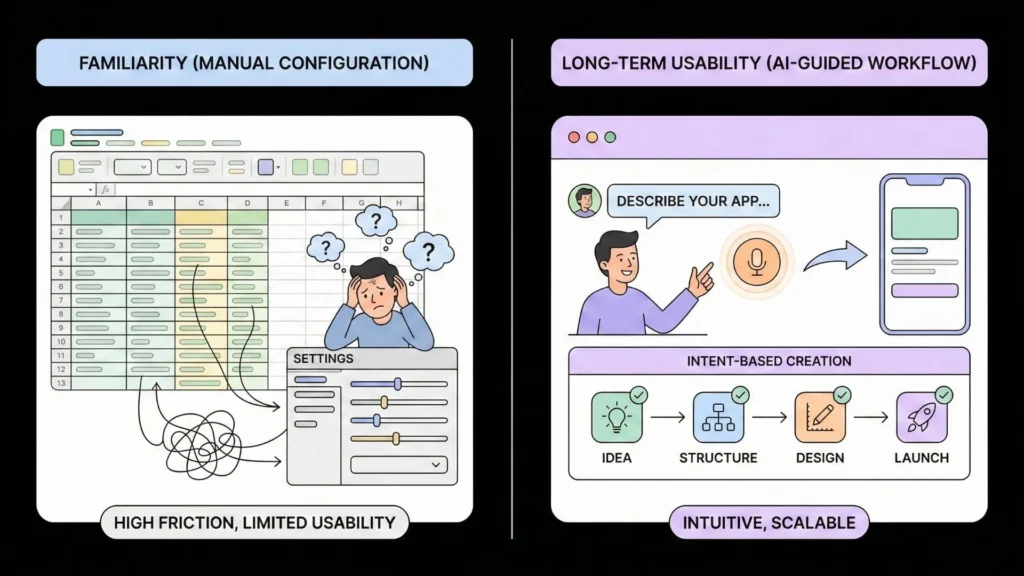
Airtable: Familiar but Limited
Airtable’s biggest advantage is familiarity. Millions of people know how to use Excel or Google Sheets. Shifting to Airtable feels natural because the paradigm is identical:
- Tables feel like sheets: You add rows and columns.
- Views filter records easily: You can toggle between Grid, Kanban, and Calendar views instantly.
- Links create relationships: Connecting a “Projects” table to a “Tasks” table is intuitive.
However, Airtable becomes significantly more complex when you try to treat it as an app backend:
- Add automations: You must learn their specific logic builder or use Zapier.
- Build integrations: Connecting to external tools often requires third-party middleware like Make.com.
- Manage relational data at scale: As record counts grow, managing dependencies becomes fragile.
Airtable is easy to start with but gets harder as complexity grows. You hit a “complexity ceiling” where the tool fights back against advanced requirements.
Imagine.bo: Guided From the Start
Imagine.bo is designed for rapid progress without technical confusion. It bypasses the “spreadsheet” paradigm entirely in favor of an Intent-Based approach.
Instead of asking you to wire up fields and automations manually, Imagine.bo:
- Asks for vision and intent: You describe what you want (e.g., “Build a two-sided marketplace for dog walkers”).
- Generates a full stack system: The AI determines the necessary database schema, API routes, and frontend components automatically.
- Walks you through business logic: It prompts you to define critical flows, like “How should payment processing handle refunds?”
This saves:
- Time spent learning internal mechanics: You don’t need to learn proprietary formulas.
- Mistakes from misconfigured logic: The AI generates code based on best practices.
- Future rework: The architecture is scalable from Day 1.
Imagine.bo allows non-technical and technical users to build collaboratively without requiring deep training in database theory.
Speed and Time to Value
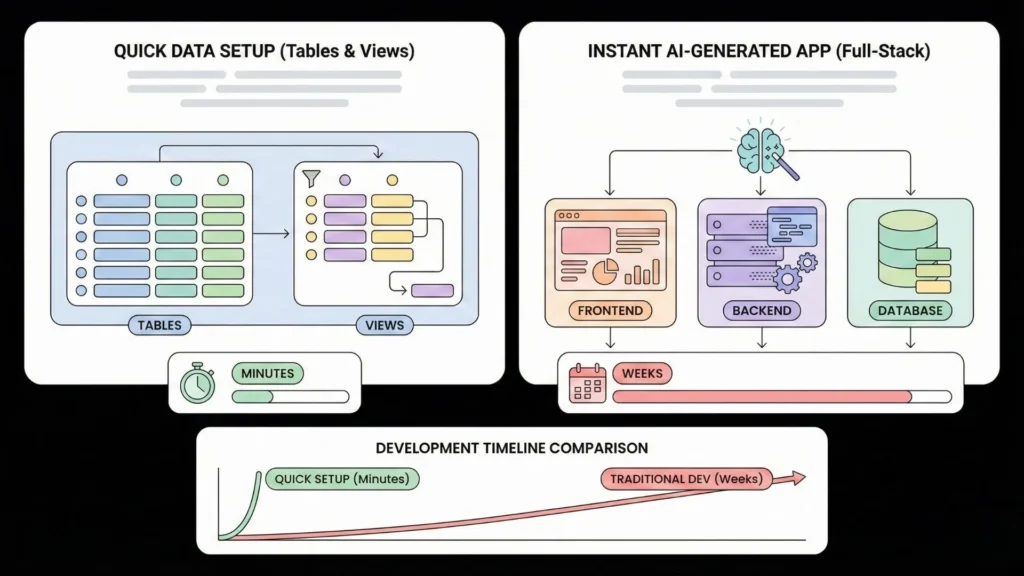
Airtable: Fast for Data Tracking
Because Airtable behaves like a spreadsheet, setting up a table and view is instant. If you need to track a list of attendees for an event, you can:
- Import CSV data quickly.
- Set filters in minutes.
- Create simple “When record enters view, send email” automations.
However, the speed halts when you need a public-facing product:
- Scaling to public apps: You cannot just “publish” a base as a secure SaaS app. You need tools like Softr or Stacker to build the frontend.
- Logic limitations: Any logic beyond simple “if/then” triggers requires writing JavaScript in the Scripting Extension or using external iPaaS tools.
- Hosting: You still need separate hosting for any truly custom interface.
So while Airtable is fast as a data entry tool, it is slow as an application builder because of the required “glue code.”
Imagine.bo: Fast for Real Apps
Imagine.bo is built for speed across the entire app lifecycle, not just data entry. From concept to a deployed, scalable application:
- AI and guided workflows: The reasoning engine architects the system in minutes, a process that usually takes weeks.
- Integrated Backend: There is no need to connect external tools (like Make or Zapier) just to handle basic logic; the backend is generated as standard Node.js code.
- UI/Backend Integration: The frontend React components are already wired to the backend APIs.
- One-Click Deployment: The app deploys to professional infrastructure (Vercel/Railway) instantly.
This means that while Airtable may help you set up a table quickly, Imagine.bo helps you build a customer-facing product rapidly — and with fewer moving parts.
UI and User Experience: Form vs Product
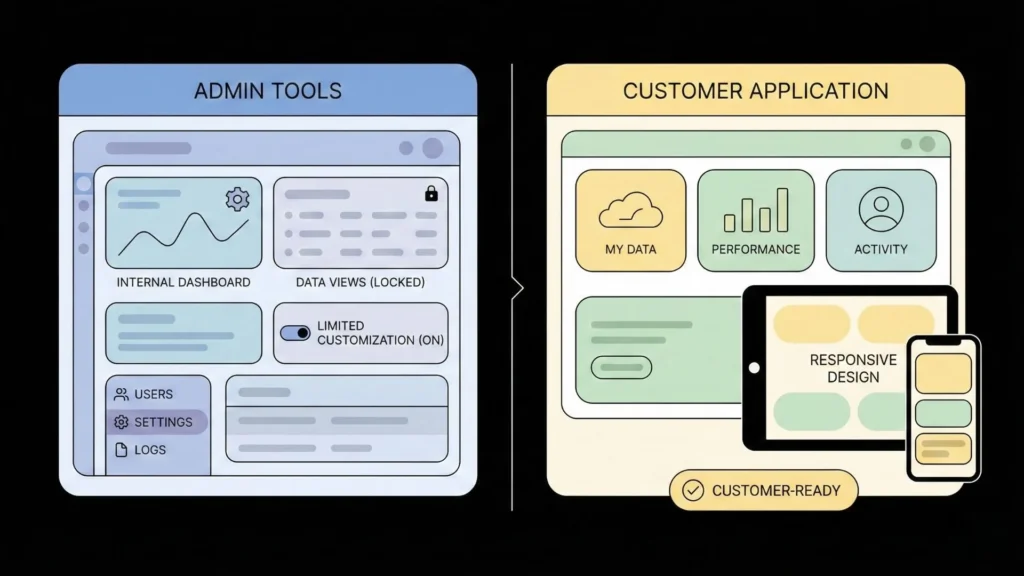
Airtable: Data-First UX
Airtable’s Interface Designer has improved, but it remains a data-first tool. Its interface is excellent for:
- Managing data grids.
- Filtering records for internal reports.
- Sorting and grouping views for project management.
Its UI is efficient for internal users who understand the data structure. But:
- Not optimized for customers: You cannot easily build a custom landing page, a complex checkout flow, or a gamified user dashboard.
- Limited Branding: You are stuck with Airtable’s general look and feel (buttons, fonts, layouts).
- Rigid Navigation: The navigation flows are determined by the “Base” structure, not user experience best practices.
Airtable is not a UI tool — it is a data visualization tool.
Imagine.bo: Product-First UI
Imagine.bo generates User interfaces designed for customers, not data administrators.
- Responsive layouts: The generated React code is fully responsive for mobile, tablet, and desktop.
- Navigation flows: The AI constructs logical user paths (e.g., Login -> Dashboard -> Settings).
- Secure frontend components: Input forms and data displays are hardened against common web vulnerabilities.
- Real UX patterns: It uses modern design libraries (like Tailwind CSS) to ensure the app looks professional and trustworthy.
In Imagine.bo, UI and logic are integrated. The interface is part of the product experience, and design decisions are made automatically to support user flows.
Logic and Workflow Complexity
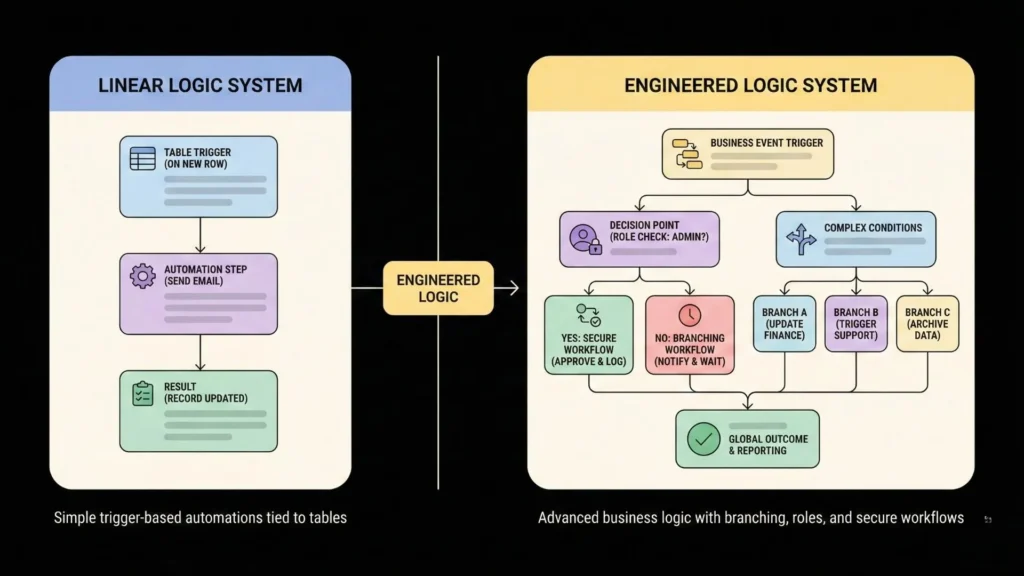
Airtable: Straightforward Logic
Airtable supports basic logic through its Automations panel.
- Triggers: “When record is created,” “At a scheduled time.”
- Actions: “Send email,” “Update record,” “Run script.”
This is suitable for:
- Internal notifications (Slack/Teams).
- Simple state changes (moving a lead from “New” to “Contacted”).
- Email triggers.
However:
- Complexity Management: As you add more automations, visualizing the dependencies becomes impossible. It’s easy to create loops or break workflows.
- Branching limitations: Conditional logic is often limited to linear paths.
- Business Rules: Enforcing complex rules (e.g., “Only allow approval if budget > $500 AND user is Manager”) requires clumsy workarounds.
Imagine.bo: Full Business Logic
Imagine.bo treats business logic as a first-class concept, akin to traditional software engineering.
- Conditional workflows: It supports complex
if/elsebranching, loops, and parallel processing. - Secure data flows: Logic executes on the server side, ensuring users cannot bypass rules by manipulating the frontend.
- Role-based access: Logic is tied to user roles (Admin, Editor, Viewer) at the code level.
- Integration: It can generate code to connect with Stripe, OpenAI, or Twilio natively.
Instead of tying logic to individual table actions, Imagine.bo models logic like a software engineer designs it — consistently and holistically.
Backend and Database Architecture
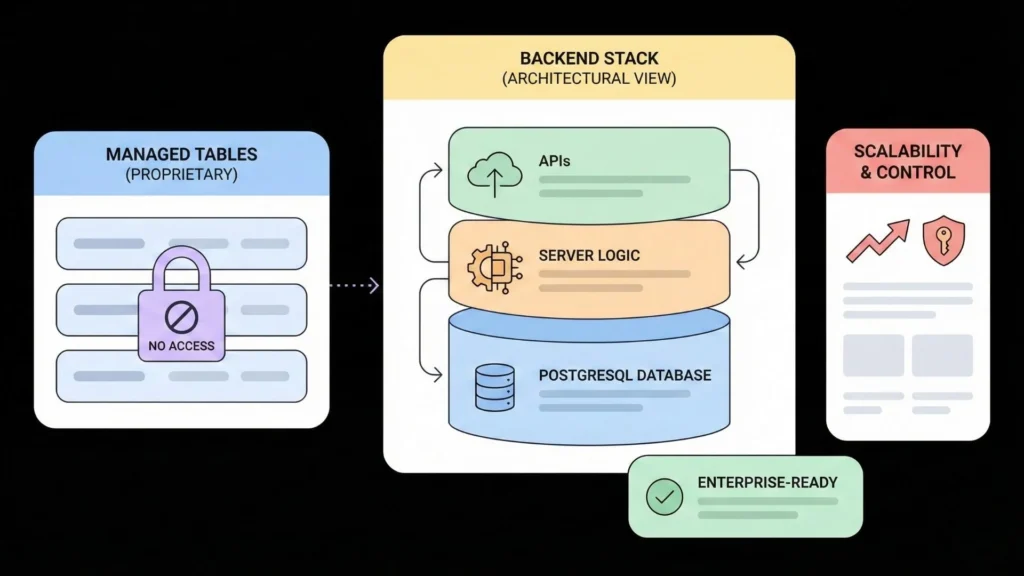
Airtable: Managed Tables
Airtable provides a proprietary mix of spreadsheet and database.
- Tables with fields: Easy to add columns like “Single Select” or “Attachment.”
- Linked records: Allows for basic relational data modeling.
But:
- Backend Limitations: You do not have access to the actual database. You cannot run SQL queries, index columns for performance, or optimize storage.
- Normalization: Data relationships are simple and often lead to denormalized, messy data structures.
- Dependency: You need APIs and external middle layers (wrappers) to build full apps, adding latency and failure points.
In short, Airtable’s database is usable for internal data workflows but is not engineered for scalable public usage.
Imagine.bo: Full Backend Stack
Imagine.bo generates a Standard Tech Stack:
- Database: A real PostgreSQL database with normalized tables, foreign keys, and referential integrity.
- APIs: It automatically generates RESTful or GraphQL APIs for your frontend to consume.
- Scalable Infrastructure: The backend runs on Node.js/Express, hosted on scalable cloud platforms.
- Optimization: The AI ensures queries are efficient and data structures are sound.
This difference is core: Airtable is a data storage tool. Imagine.bo is a full backend service with storage, APIs, logic, and governance all in one.
Performance & Scalability: Internal Teams vs Public Traffic
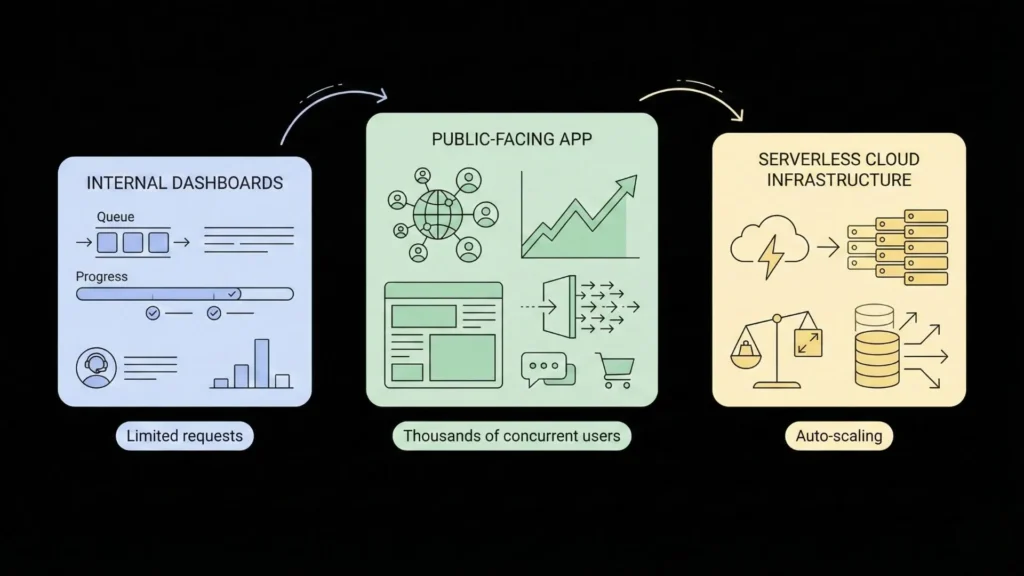
Airtable: Good for Internal Use
Airtable performs well with:
- Dozens of internal users.
- Internal workflows and reporting tasks.
- Team dashboards.
But as you scale:
- Record Limits: Even the expensive Business plan caps at 125,000 records per base. The Enterprise Scale plan offers 100M records, but at a massive cost.
- API Throttling: Public apps hit API rate limits (5 requests/second) quickly, causing the app to crash or hang for users.
- Load: Complex views with many lookups and rollups become noticeably slow.
Airtable is not optimized for high traffic, public access, or transaction-heavy applications.
Imagine.bo: Built for Scale
Imagine.bo is designed to support:
- High user concurrency: Handling thousands of simultaneous users via serverless scaling.
- Customer traffic: Public apps that need to load instantly.
- Performance guarantees: Capable of processing thousands of transactions per second because it uses standard databases (Postgres).
- Caching: Can implement Redis caching for speed.
This means Imagine.bo can support SaaS applications, Ecommerce checkout flows, and Marketplace logic. Airtable simply isn’t designed for this level of performance.
Security: Role-Based vs Architecture-First
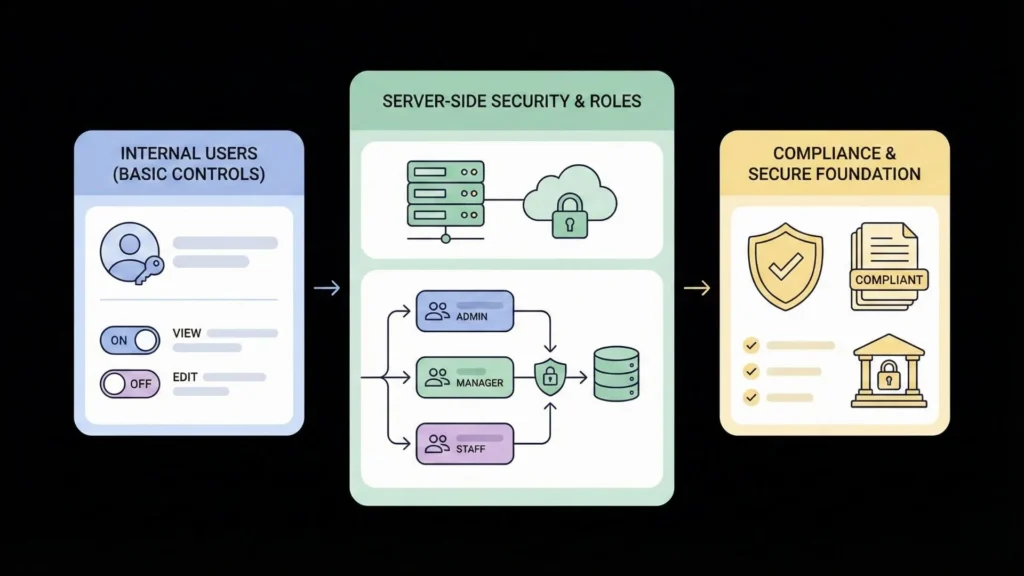
Airtable’s Security Model
Airtable provides:
- Workspace permissions: (Creator, Editor, Commenter, Read-only).
- Interface permissions: Controlling who can see specific dashboards.
This is sufficient for trusted internal teams. However:
- Public Access: To make data public, you often rely on third-party tools which may introduce security gaps.
- Data Exposure: In many configurations, the frontend “wrapper” loads all data and filters it locally, meaning a savvy user could inspect the code and see data they shouldn’t.
- Compliance: Achieving HIPAA or SOC2 compliance on standard plans is difficult or impossible.
Imagine.bo’s Security Foundations
Imagine.bo designs security into the core of the logic and architecture:
- Server-Side Security: Data filtering happens on the backend. A user never receives data they aren’t authorized to see.
- Role and Identity: Authentication flows (Signup/Login) are generated automatically with secure session management.
- Code-Level Validation: Input validation prevents SQL injection and XSS attacks.
- Compliance Ready: The architecture follows standard security practices, making it easier to audit for GDPR or HIPAA.
This eliminates common security mistakes that happen when teams stitch together external tools.
Real-World Costs: Time, Money, and Maintenance
Airtable’s Cost Structure
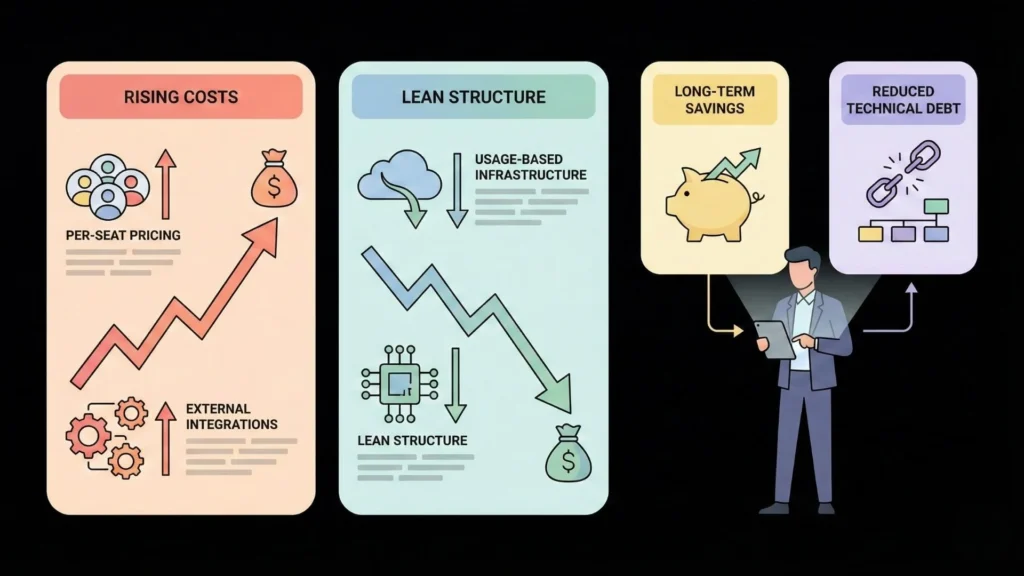
Airtable uses a per-seat pricing model:
- Seat Costs: $20 – $45 per user/month. If you have 50 employees, that’s $1,000 – $2,250/month just for access.
- Portals/External Users: Adding external users (clients/customers) requires expensive add-ons or Enterprise plans.
- Integration Costs: You will likely pay for Zapier, Make, and Softr on top of Airtable.
This can add up quickly. A “simple” app can easily cost $30,000/year in licensing fees.
Imagine.bo’s Cost Efficiency
Imagine.bo reduces Total Cost of Ownership (TCO):
- Usage-Based Hosting: You pay for the infrastructure you use (Vercel/Railway), which is often pennies for low-traffic apps.
- No Per-Seat Fees: You can have 10,000 users on your app without paying extra licensing fees.
- Reduced Developer Effort: You save tens of thousands of dollars on engineering salaries.
- Maintenance: The clean code reduces technical debt, lowering long-term maintenance costs.
By removing infrastructure complexity and minimizing rework, Imagine.bo often results in significantly lower long-term costs.
The “Last 20%”: Where Most Tools Fail
Every app has the “last 20%” — edge cases, custom logic, payment flows, security nuances.
Airtable’s Limitation
When you hit the last 20% in Airtable:
- You end up writing complex Scripts that hit timeout limits.
- You are forced to hire a developer to build a custom external service.
- You layer security manually, increasing risk.
- Result: You effectively rebuild the app outside of Airtable anyway.
Imagine.bo’s Finish Line Advantage
Imagine.bo’s deep reasoning approach helps you cross the finish line:
- AI Reasoning: It predicts edge-case behavior and generates logic to handle it.
- Human-in-the-Loop: Imagine.bo offers a unique “Hire a Human” feature. If the AI can’t handle a specific complex integration (like a legacy banking API), a human engineer steps in, writes the code, and integrates it into your project.
- Production Readiness: The final output is standard code, meaning there are no “platform limitations.” If you need to change something, you can always edit the code directly.
Where Each Platform Fits in 2026
Airtable Is Best For:
- Internal Process Tracking: Marketing calendars, hiring pipelines.
- Data Workflows: Managing product catalogs and inventory.
- Team Coordination: Project management and OKR tracking.
- Reporting: Visualizing internal business metrics.
Imagine.bo Is Best For:
- SaaS Products: Building subscription-based software for customers.
- Public-Facing Applications: Customer portals, directories, social apps.
- Customer Engagement: Tools that require secure login and user-specific data.
- Secure Data Systems: Apps requiring strict compliance and security.
- Performance-Driven Systems: High-traffic applications.
Side-by-Side Summary
| Category | Airtable | Imagine.bo |
|---|---|---|
| Core Purpose | Data management | Full app creation |
| UI/UX | Data-centric (Interface Designer) | Product-centric (Custom React) |
| Backend | External integrations required | Integrated, standard backend |
| Logic Complexity | Simple (Automations) | Advanced, secure (Node.js) |
| Scalability | Limited (Record caps, API limits) | High (Standard Cloud Scale) |
| Security | Basic Permissions | Architecture-first (RBAC) |
| Performance | Internal use only | Production traffic ready |
| Total Ownership Cost | Higher over time (Per-seat) | Lower with scale (Usage-based) |
| Best For | Teams, internal apps | Customer apps, SaaS, Startups |
Final Verdict: Build Data or Build a Business?
Airtable is an exceptional tool for managing structured data, coordinating teams, and automating internal workflows. It is familiar, intuitive, and solves real problems in day-to-day operations. If your goal is internal coordination, tracking, or data workflows — Airtable is a smart choice.
But Airtable is not an application platform in the same way that Imagine.bo is. It is a “Rental” model where you live within their walls and abide by their strict rules.
Imagine.bo is the “Ownership” model.
If your goal is to build:
- A revenue-ready product that you own.
- A scalable customer-facing app that can handle millions of users.
- A secure digital business that isn’t dependent on per-seat licensing.
- A system that survives growth without a complete rewrite.
…then Imagine.bo is the clear winner.
In 2026, building an app is easy. Building a business-grade application that you actually own is not. Imagine.bo bridges that gap.
Related Articles
- Security Best Practices for No-Code Applications: Protecting Your App in a Visual Development World
- Supercharge Your App: Add AI Features Without Coding
- No-Code MVPs: How Founders Are Shipping Products Without Dev Teams
- How No-Code Automation is Redefining Entrepreneurship in 2025
- Scalable SaaS Architecture for No-Code Platforms: Building Robust and Flexible Solutions
Launch Your App Today
Ready to launch? Skip the tech stress. Describe, Build, Launch in three simple steps.
Build