

Job seekers today face unprecedented challenges. The sheer volume of applications for a single role means recruiters rely heavily on technology to sift through candidates. If your resume isn’t optimized for these systems, it’s akin to sending a letter without a stamp – it simply won’t get delivered.
This comprehensive guide will demystify the world of resume optimization, providing you with practical, actionable strategies to beat the ATS and significantly increase your chances of landing an interview.
Launch Your App Today
Ready to launch? Skip the tech stress. Describe, Build, Launch in three simple steps.
BuildWhat is a Resume Beater & Optimizer?
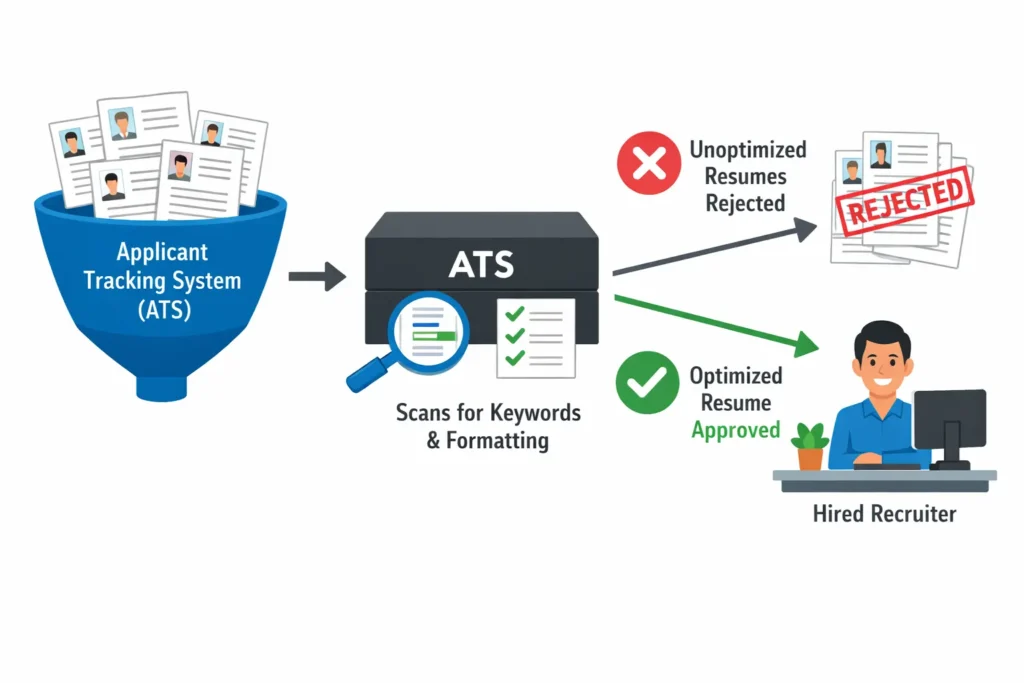
A Resume Beater & Optimizer refers to the strategic process and tools used to tailor your resume specifically for Applicant Tracking Systems (ATS) and human recruiters. It’s about ensuring your resume is both machine-readable and compelling. In essence, it’s the art and science of making your resume stand out in a crowded digital environment.
Understanding ATS Resume Filtering
Applicant Tracking Systems are software applications that manage the recruitment process. When you submit your resume online, it’s first uploaded into an ATS. These systems then scan, parse, and analyze your resume for keywords, skills, experience, and other criteria defined by the hiring company. The ATS assigns a compatibility score, or match rate, based on how well your resume aligns with the job description. Only resumes that meet a certain threshold are then forwarded to a human recruiter
In 2026, ATS technology has evolved significantly. Modern systems integrate Artificial Intelligence (AI) at every step of the hiring process, moving beyond simple keyword matching to semantic understanding. This means the context in which you use keywords now matters more than ever . While some older systems might still struggle with complex formatting, the general trend is towards more intelligent parsing. However, the core principle remains: if the ATS can’t read or understand your resume, it won’t get through.
Why Resume Optimization Matters Today
The importance of resume optimization cannot be overstated. With the majority of large companies using ATS, an unoptimized resume is a direct path to the rejection pile.
Optimizing your resume ensures that your qualifications are accurately captured and presented to the hiring team. It’s not just about getting past a machine; it’s about leveraging personal branding tools to make a strong first impression that leads to an interview.
Step-by-Step Resume Beater & Optimizer Guide

To ensure your resume bypasses the ATS and impresses hiring managers, follow this step-by-step guide to optimization:
1. ATS-Friendly Formatting
Simplicity is key. Opt for a clean, single-column layout. Use standard, professional fonts like Arial, Calibri, or Times New Roman. Ensure clear and consistent headings for sections such as
“Work Experience,” “Education,” and “Skills.” Avoid using headers, footers, or any graphical elements that could interfere with the parsing process .
2. Keyword Optimization from Job Descriptions
Carefully analyze the job description for each position you apply for. Identify and extract keywords related to skills, qualifications, job titles, and industry-specific terminology. These are the terms the ATS will be searching for. Integrate these keywords naturally throughout your resume, particularly in your professional summary, skills section, and work experience descriptions .
3. Writing Strong Summaries
Your professional summary is the first thing a recruiter will read. It should be a concise, 3-5 sentence overview of your career, highlighting your most relevant skills and achievements. While you can use generative AI tools for content creation to draft ideas, ensure the final output sounds human. Incorporate 3-5 high-priority keywords from the job description to immediately signal your suitability for the role.
4. Skills Optimization
Create a dedicated “Skills” section on your resume. List both hard skills (technical abilities like Python, SQL, or project management) and soft skills (interpersonal qualities like communication, leadership, and teamwork). This makes it easy for both the ATS and recruiters to quickly identify your capabilities.
5. Improving Experience Bullets
Transform your work experience section from a list of duties to a showcase of accomplishments. Use action verbs to start each bullet point and quantify your achievements whenever possible. For example, instead of saying “Managed social media accounts,” say “Increased social media engagement by 20% over six months by implementing a new content strategy.” This demonstrates your impact and value.
6. Quantifying Achievements
Numbers speak louder than words. Quantifying your achievements provides concrete evidence of your abilities and makes your resume more compelling. Use metrics, percentages, and dollar amounts to showcase your contributions. This is a powerful way to stand out to both ATS and human reviewers .
7. Formatting Best Practices
- File Type: Unless the job posting specifies otherwise, save and submit your resume as a .docx file. Some ATS have been found to parse .docx files more accurately than PDFs .
- Headings: Use standard section headings like “Work Experience,” “Education,” and “Skills.”
- Layout: Stick to a single-column layout. Avoid tables, columns, and text boxes.
- Fonts: Use standard, easy-to-read fonts.
Resume Optimization Mistakes to Avoid
While it’s crucial to optimize your resume, it’s equally important to avoid common mistakes that can undermine your efforts.
- Keyword Stuffing: Overloading your resume with keywords to the point where it sounds unnatural or robotic can be detrimental. Balancing human vs. AI writing styles is essential. Modern ATS can often detect keyword stuffing, and it’s a major red flag for human recruiters .
- Graphic-Heavy Resumes: While a visually appealing resume might seem like a good idea, it’s a nightmare for ATS. Stick to a clean, text-based format to ensure your resume is parsed correctly .
- Long Paragraphs: Recruiters spend only a few seconds scanning each resume. Long, dense paragraphs are a turn-off. Keep your paragraphs short and use bullet points to improve readability.
- Generic Resumes: As mentioned earlier, sending the same resume for every application is a recipe for rejection. Customization is key to passing the ATS and impressing recruiters .
- No Customization: Failing to tailor your resume to each specific job is one of the biggest mistakes you can make. Take the time to align your resume with the requirements of the role.
Resume Example — Before vs After Optimization
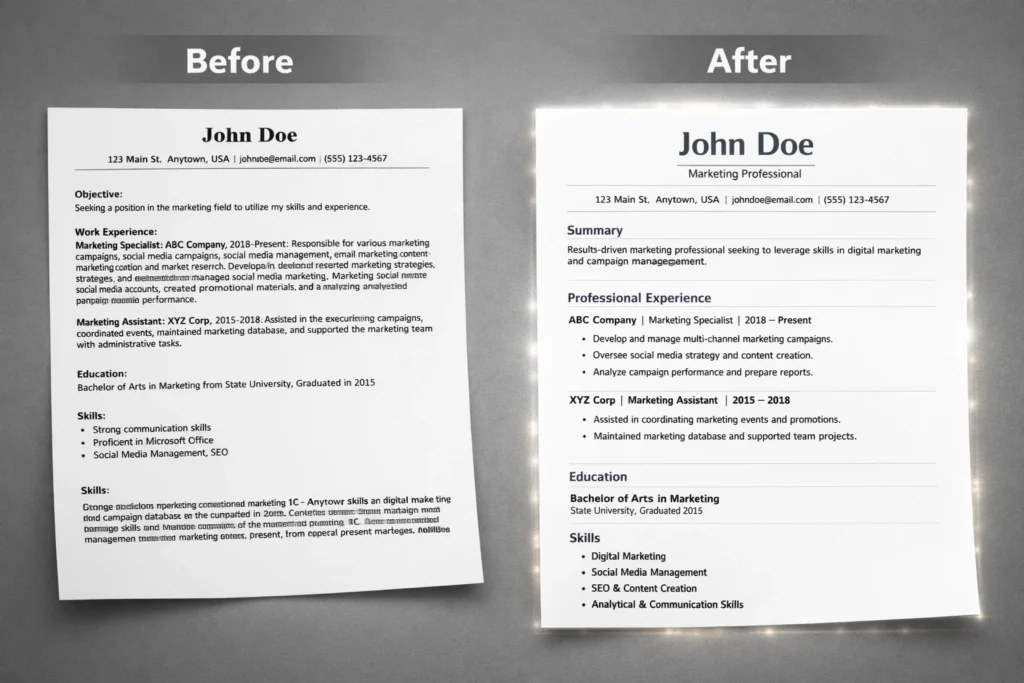
To illustrate the power of resume optimization, let’s consider a before-and-after example:
Before Optimization:
Work Experience Marketing Manager
- Responsible for marketing campaigns
- Managed social media
- Wrote blog posts
After Optimization:
Work Experience Marketing Manager
- Led the development and execution of 15+ multi-channel marketing campaigns, resulting in a 30% increase in lead generation.
- Grew social media following by 50% across all platforms through targeted content and community engagement initiatives.
- Authored and optimized 50+ blog posts, driving a 40% increase in organic website traffic.
The “after” example is far more effective because it uses action verbs, quantifies achievements, and provides specific details about the candidate’s impact.
Expert Tips to Beat ATS Systems
Here are some insider tips to give you an edge in the job application process:
- Use Both Long-Form and Acronyms: For example, include both “Master of Business Administration” and “MBA.”
- Mirror the Job Title: If the job title is “Senior Project Manager,” use that exact title in your resume (if it accurately reflects your experience).
- Check for Plural and Singular Keywords: The ATS may search for “skill” or “skills.” Include both if it makes sense.
- Don’t Forget Soft Skills: While hard skills are crucial, many companies are now programming their ATS to look for soft skills like “communication,” “teamwork,” and “problem-solving.”
Conclusion + Call to Action

In the competitive job market of 2026, a Resume Beater & Optimizer is no longer a luxury – it’s a necessity. By understanding how Applicant Tracking Systems work and implementing the strategies outlined in this guide, you can transform your resume from a document that gets lost in the digital shuffle to a powerful tool that opens doors to new opportunities. For students entering the workforce, utilizing essential AI tools for college students can also provide a competitive edge in preparing these documents.
Frequently Asked Questions
Does resume optimization increase interview chances?
Absolutely. By ensuring your resume is read and understood by the ATS, you significantly increase the likelihood that it will land in the hands of a human recruiter, which is the first step to getting an interview.
How many keywords should a resume contain?
There’s no magic number. The goal is to use enough keywords to naturally align your resume with the job description without it sounding forced or robotic. Focus on relevance and context.
Do resume optimizer tools work?
Yes, they can be very effective. They provide valuable insights and can save you a significant amount of time. However, they should be used as a supplement to, not a replacement for, your own judgment and a final human review.
Should resumes be customized per job?
Yes, in today’s job market, customization is non-negotiable. Tailoring your resume for each application is the single most effective thing you can do to increase your chances of success
Launch Your App Today
Ready to launch? Skip the tech stress. Describe, Build, Launch in three simple steps.
Build