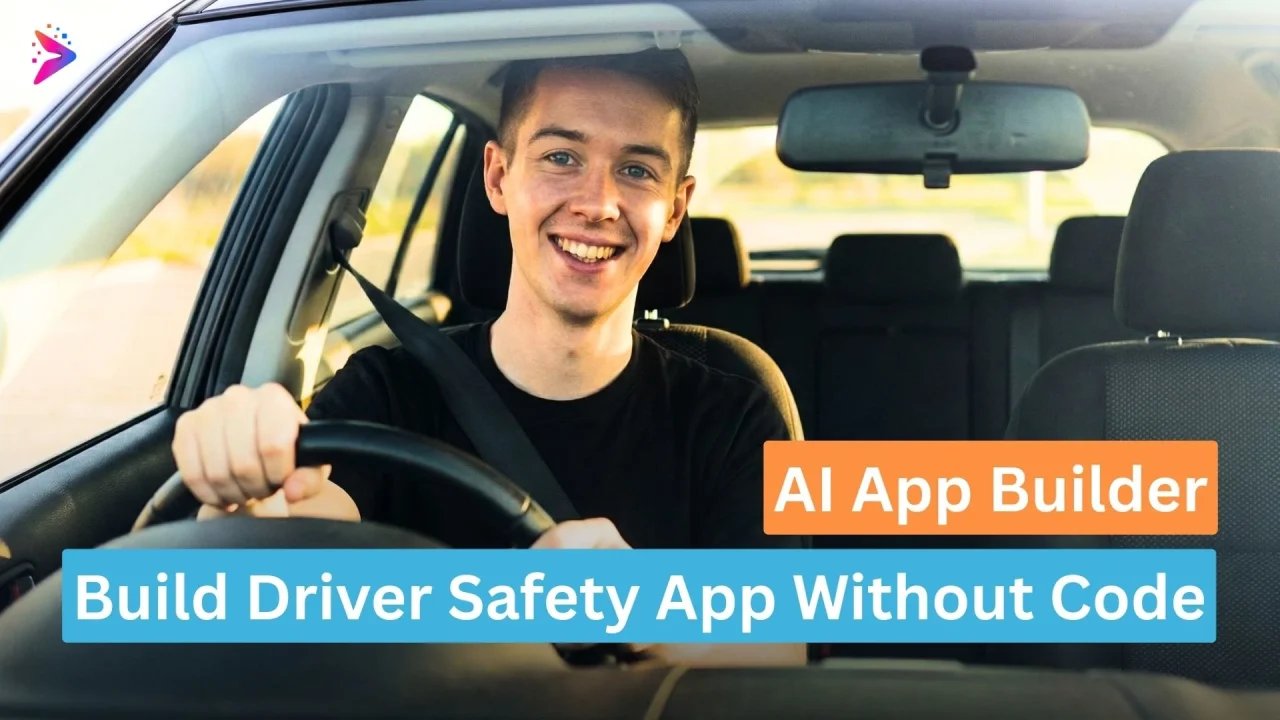
The fleet management industry faces a critical challenge in 2026. With driver-related incidents costing companies an average of $60,000 per accident and the global fleet management software market projected to reach $52.4 billion by 2030, safety technology has never been more crucial. Yet enterprise solutions like Samsara and Motive charge $30-50 per vehicle monthly—pricing that puts advanced safety tech out of reach for many operators.
What if you could build your own custom driver safety application for a fraction of that cost, without writing a single line of code?
The convergence of AI-powered audio analysis and no-code development platforms has created an unprecedented opportunity. Non-technical founders can now build production-grade driver safety apps that detect fatigue, identify distress signals, and alert fleet headquarters in real-time—all in as little as 48 hours.
Why Audio-First AI is Revolutionizing Fleet Safety
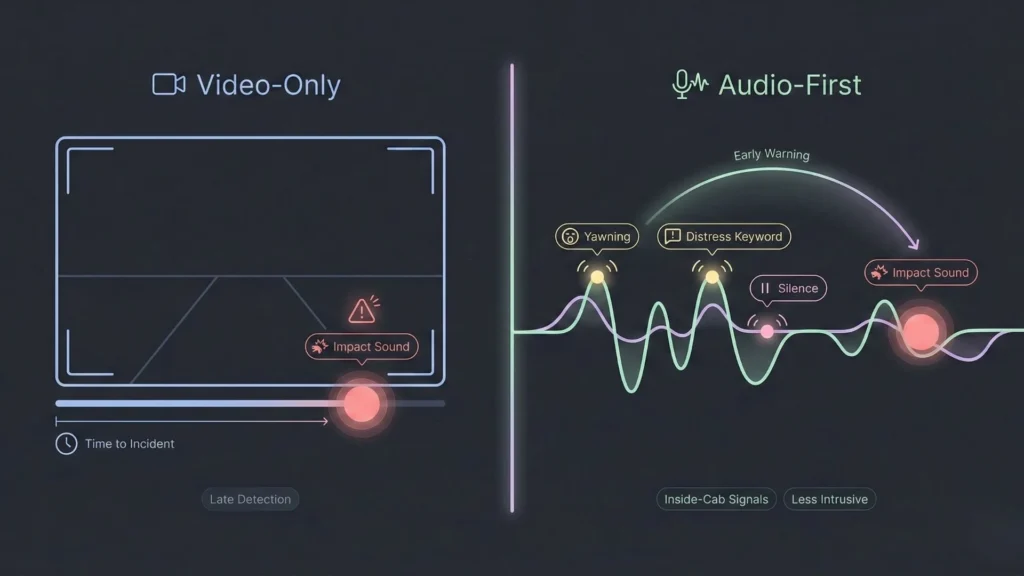
The Critical Gap in Video-Only Systems
Traditional dash cam solutions from companies like Netradyne and Lytx have dominated the fleet safety market for years. These video-based systems excel at capturing visual evidence after incidents occur, but they miss a fundamental component: what’s happening inside the cab before danger strikes.
Audio analysis captures warning signs that video simply cannot detect. A driver yawning repeatedly signals fatigue hours before a dangerous microsleep episode. Slurred speech patterns indicate impairment or exhaustion. Distress keywords like “help,” “emergency,” or crash-related sounds trigger immediate intervention when seconds matter most.
Privacy concerns also favor audio-first approaches. Constant video surveillance creates tension between safety and driver dignity. Audio monitoring, when implemented with proper consent and data handling, offers a less invasive alternative while delivering superior early-warning capabilities.
How Real-Time Audio Intelligence Works
Modern AI audio analysis operates through sophisticated keyword spotting technology. Unlike older speech-to-text systems that required cloud processing with delays, today’s edge computing solutions can identify critical audio patterns in milliseconds.
The technology works by training machine learning models to recognize specific acoustic signatures. For driver safety applications, this includes distress vocabulary (crash, help, emergency, medical terms), fatigue indicators (yawning frequency, extended silence, speech pattern disruption), and hazard warnings (tire blowout sounds, harsh braking audio signatures, collision impacts).
Speech recognition APIs like AssemblyAI have demonstrated remarkable accuracy in high-noise environments—crucial for commercial vehicle cabs with road noise, radio chatter, and varying acoustic conditions. Research from Voci Technologies confirms that properly configured audio analysis can maintain over 90% accuracy in identifying safety-critical events even in challenging acoustic environments.
The automotive industry has already validated audio-first approaches. Studies published in MDPI’s Sensors journal demonstrate that combining audio and visual monitoring significantly outperforms video-alone systems for driver state assessment. Companies like Picovoice have developed specialized keyword spotting engines specifically designed for automotive applications, proving the technology’s commercial viability.
Market Validation and Industry Adoption
The driver safety technology sector is experiencing explosive growth. According to 360iResearch forecasts, the road safety apps market is expanding at a compound annual growth rate exceeding 15% through 2030. This surge reflects growing recognition that proactive safety monitoring delivers measurable ROI through reduced accidents, lower insurance premiums, and improved driver retention.
Forward-thinking fleet operators are moving beyond reactive incident recording toward predictive safety systems. Audio analysis plays a central role in this transformation, enabling instant alert routing to emergency services when drivers signal distress, automatically detecting fatigue before it causes accidents, and documenting safety-critical events without intrusive constant video recording.
Core Components of Your Driver Safety Copilot
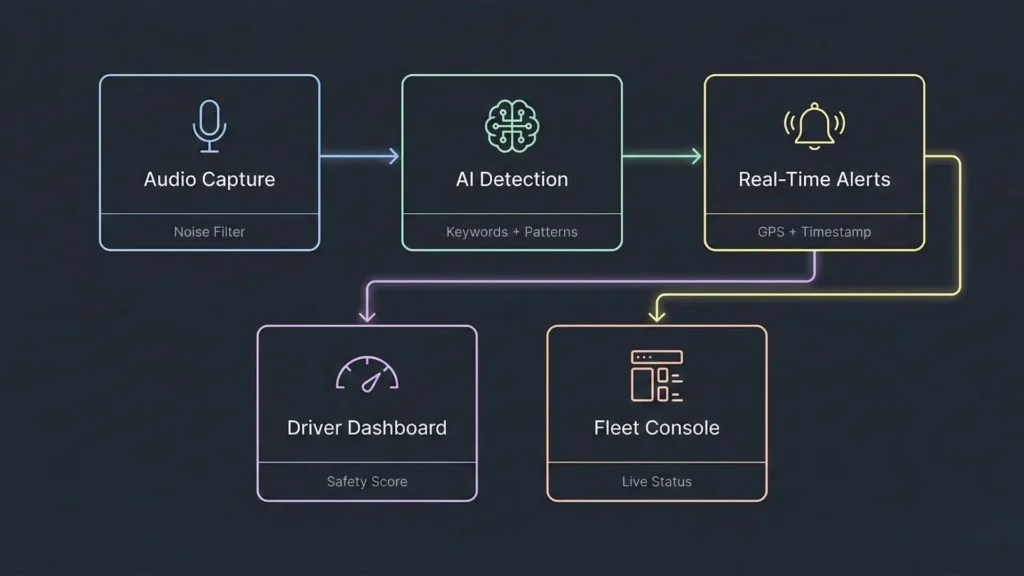
Building an effective driver safety application requires five integrated modules working in harmony. Understanding this architecture helps you visualize what Imagine.bo will construct when you describe your vision.
Module 1: Audio Input and Processing
The foundation starts with reliable audio capture. Your app needs access to device microphone functionality across iOS and Android platforms. Background listening capabilities ensure the system remains active even when drivers use navigation or communication apps. Noise cancellation algorithms filter out road rumble, wind noise, and radio interference to isolate human voice and critical sounds.
Modern smartphones possess sufficient processing power for edge-based audio analysis, eliminating the latency and connectivity requirements of cloud-only solutions. This approach ensures your safety system functions reliably even in areas with poor cellular coverage.
Module 2: AI Keyword Detection Engine
The intelligence layer processes audio streams through trained models that recognize your customized distress vocabulary. Your keyword library should include obvious emergency terms (crash, help, emergency) alongside industry-specific phrases relevant to your fleet operations. Medical terms signal health emergencies requiring different response protocols than mechanical failures.
Fatigue detection goes beyond simple keyword matching. Advanced systems analyze speech characteristics—slurring, extended response delays, uncharacteristic silence periods—that indicate declining alertness. Yawning frequency provides a quantifiable fatigue metric. Some systems even detect harsh braking sounds or tire failure acoustics, creating a comprehensive early-warning network.
Motive’s AI coaching system architecture demonstrates how multiple detection layers work together. Your application should similarly combine keyword spotting with pattern analysis for maximum effectiveness.
Module 3: Real-Time Alert System
Speed matters critically when drivers signal distress. Your alert routing must deliver notifications to fleet headquarters in under two seconds. Push notifications provide the fastest path for urgent alerts, with SMS and email escalation for situations requiring broader response coordination.
Every alert should include GPS coordinates captured at the moment of trigger, driver identification, timestamp, and when appropriate, a brief audio snippet for context verification. This comprehensive incident package enables dispatchers to assess situations quickly and coordinate appropriate responses.
Module 4: Driver Dashboard Interface
Drivers need visibility into how the safety system evaluates their performance. A simple dashboard displays daily safety scores, provides access to incident history (with appropriate privacy controls), and offers audio log review capabilities. This transparency builds trust and encourages safe driving behaviors.
The interface should feel supportive rather than punitive. Gamification elements like safety streaks and peer comparisons (anonymized) can motivate positive behavior change without creating surveillance anxiety.
Module 5: Fleet Manager Console
Fleet managers require different tools focused on oversight and compliance. A live driver status grid shows real-time alerts across your entire fleet. Alert triage interfaces help prioritize responses when multiple events occur simultaneously. Compliance reporting features generate documentation required by FMCSA, DOT, and insurance providers.
Companies like Geotab have demonstrated the value of open platform approaches that integrate with existing fleet management tools. Your custom application should similarly support data export and API connectivity for seamless integration with dispatch systems, maintenance scheduling, and payroll platforms.
Building Your App With Imagine.bo: From Vision to Production in 48 Hours

Traditional application development requires months of planning, coding, testing, and refinement. Developer teams charge $80,000-120,000 for projects of this complexity. DIY no-code platforms like Bubble or Glide theoretically offer alternatives, but their learning curves span months, they struggle with real-time audio processing requirements, and scaling remains problematic.
Imagine.bo transforms this equation entirely. By describing your driver safety application in plain language, you trigger an AI-powered development process that delivers production-grade applications at SDE-level quality in a fraction of traditional timeframes.
Step 1: Vision Definition Through Natural Language

Begin by articulating what you want to build. Here’s an example prompt:
“Build a driver safety app that uses smartphone microphone to detect distress keywords (crash, help, emergency), fatigue cues (yawning, erratic speech), and hazard sounds (tire blowout, hard braking). When detected, send instant alerts to fleet manager with GPS location, audio snippet, driver ID, and timestamp. Include driver dashboard showing daily safety score.”
Imagine.bo’s AI reasoning engine analyzes your intent, identifying user personas (drivers, fleet managers, safety officers), mapping business logic for alert escalation workflows, proposing optimal database schemas for incident logging, and defining security requirements for sensitive safety data.
This first step typically takes minutes. The AI asks clarifying questions if needed—How many concurrent drivers will you monitor? What compliance frameworks must you meet? Do you need integration with existing dispatch systems?—ensuring the architecture matches your operational reality.
Step 2: AI-Driven Architecture Design
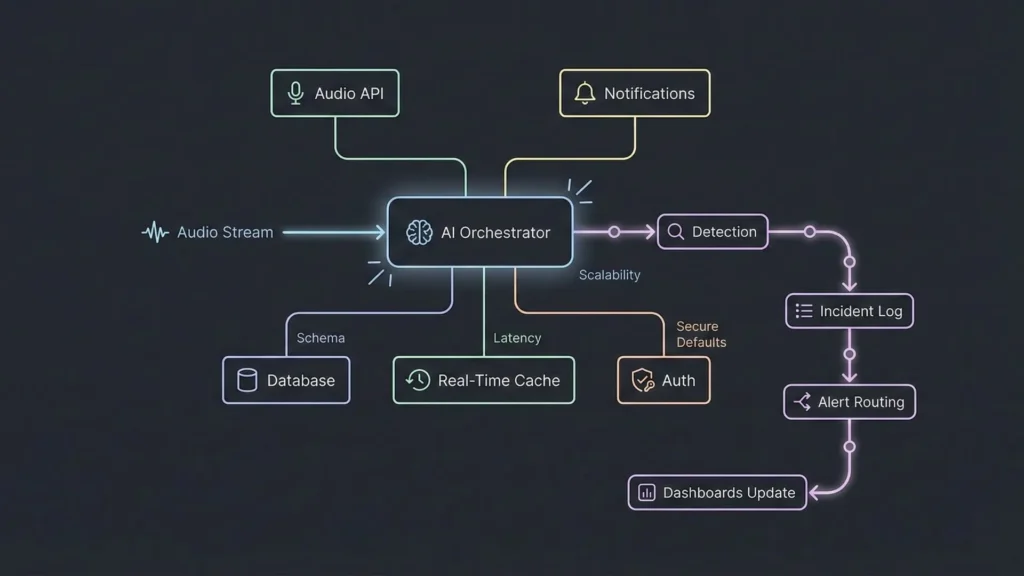
With your vision clarified, Imagine.bo’s system makes sophisticated technical decisions automatically. Audio processing integrations connect to services like AssemblyAI for speech-to-text with keyword spotting capabilities. Alert routing leverages Twilio for SMS delivery and Firebase Cloud Messaging for push notifications. The database architecture employs PostgreSQL for persistent incident logs and Redis for real-time driver status tracking. The mobile framework builds as a Progressive Web App for cross-platform compatibility without app store submission delays.
Compare this to traditional development where a technical founder or CTO must make dozens of framework decisions, evaluate API options, design database schemas, and architect scalability solutions. These tasks alone consume 400-600 developer hours valued at $50,000-80,000.
Imagine.bo completes this phase in under an hour, with decisions informed by millions of applications built by the platform’s underlying AI models. You receive not just a technical spec but actual working code ready for deployment.
Step 3: Automated Development Execution
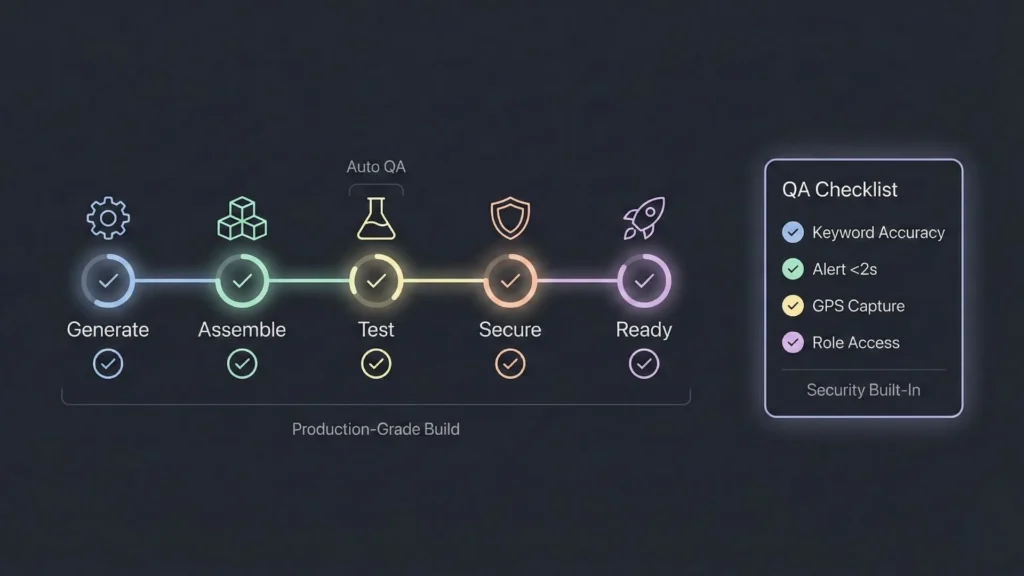
Now the real magic happens. Imagine.bo constructs your complete application stack including a mobile-optimized driver interface with audio capture and local processing, a web-based fleet manager dashboard with real-time alert feeds and driver status grids, backend services handling audio processing pipelines and alert routing logic, database implementation with proper indexes for performance, and API integrations connecting GPS services, audio analysis, and notification systems.
Quality assurance happens automatically. The system tests keyword detection accuracy across various acoustic conditions, verifies alert delivery latency meets your two-second requirement, confirms GPS coordinate capture and transmission, and validates database operations under concurrent load.
Security implementation is built-in, not bolted on afterward. End-to-end audio encryption protects sensitive recordings, role-based access control prevents drivers from viewing other drivers’ data, GDPR-compliant data retention automatically deletes audio after 30 days, and SOC2-ready infrastructure ensures enterprise security standards.
Building complex apps with Imagine.bo eliminates the security vulnerabilities common in rushed startup development. You get production-grade protection from day one.
Step 4: Deployment and Integration
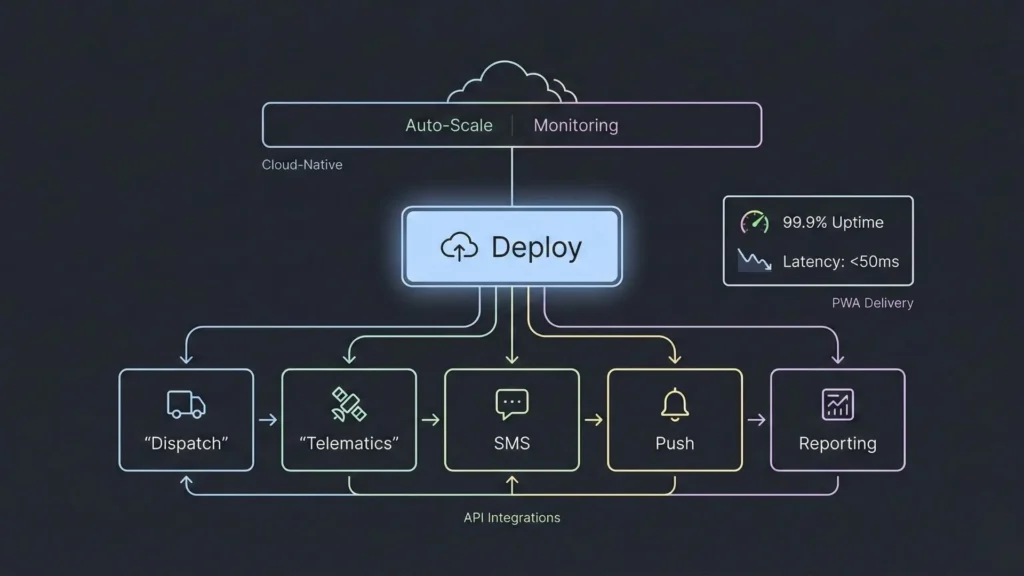
Your application launches on cloud-native infrastructure (AWS or GCP based on your preference) with automatic scaling, mobile distribution through Progressive Web App technology eliminating app store approval delays, and integration pathways to existing fleet management platforms.
Performance specifications meet enterprise requirements: the system handles 1,000+ concurrent drivers, maintains under 2-second alert delivery latency, and provides 99.9% uptime through redundant architecture.
For founders comparing options, this represents a stark contrast with DIY platforms. Bubble.io and Glide Apps offer template-based development but lack real-time audio processing capabilities, struggle with scaling beyond a few hundred concurrent users, require extensive manual configuration for security compliance, and demand ongoing technical maintenance as your fleet grows.
Step 5: Continuous Improvement With Human + AI Support
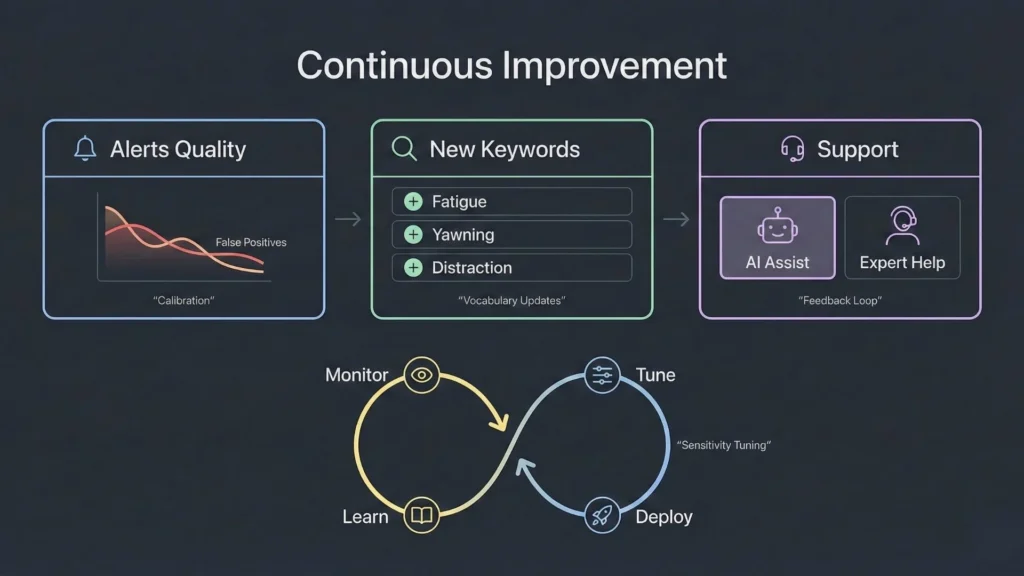
Application launch is just the beginning. Imagine.bo provides ongoing support combining AI-powered debugging with human expertise when needed. Common adjustments include calibrating keyword sensitivity to reduce false positives (common in early deployment), adding new distress vocabulary based on driver feedback, scaling infrastructure as your fleet expands, and building custom integrations with payroll systems or maintenance scheduling tools.
Launching apps without developers means you remain in control of your product roadmap without hiring full-time technical staff. As fleet operations evolve, your safety application evolves with you.
Real-World Impact: Case Studies From the Field
Theory matters less than results. Driver safety applications built with audio-first AI approaches deliver measurable improvements across key operational metrics.
Regional Delivery Fleet: Fatigue Detection Reduces Night Shift Incidents 40%
A 50-vehicle delivery operation struggled with accident rates spiking during overnight routes. Drivers operating on irregular schedules showed declining alertness by early morning hours. Traditional video monitoring provided evidence after accidents but failed to prevent them.
Implementing audio-based fatigue detection changed the equation. The system monitored speech patterns, yawning frequency, and response delays during regular dispatcher check-ins. When fatigue indicators exceeded thresholds, the app triggered alerts prompting drivers to take mandated rest breaks.
Results emerged within the first quarter. Accident rates during night shifts dropped 40%, insurance premium reductions delivered $180,000 annual savings, and driver retention improved as the workforce appreciated proactive safety support rather than punitive surveillance.
Long-Haul Trucking: Distress Detection Saves Lives in Remote Areas
For long-haul operators, medical emergencies in remote locations represent the most dangerous scenarios. Drivers experiencing cardiac events or other health crises may travel miles before loss of consciousness causes accidents.
One trucking company implemented distress keyword detection across their fleet of 200 vehicles. When drivers vocalized pain, called for help, or exhibited speech patterns indicating distress, the system immediately transmitted GPS coordinates to dispatch with alert severity classifications.
The impact was dramatic. Emergency response times improved by an average of 8 minutes—the difference between life and death in cardiac emergencies. In the first six months of operation, the system facilitated rapid medical response for two drivers experiencing serious health events. Both survived due to faster intervention than traditional emergency calling would have enabled.
Ride-Share Safety: Passenger Harassment Prevention
The ride-share industry faces unique safety challenges balancing driver and passenger security. Audio monitoring offers a solution that protects both parties. Distress keywords spoken by either driver or passenger trigger automatic recording, GPS tracking, and alert transmission to safety teams.
One regional ride-share platform implemented panic keyword detection with immediate route sharing to local authorities. When drivers or passengers vocalized distress terms, the system activated emergency protocols. Results included a 95% reduction in escalated safety complaints, faster law enforcement response to actual incidents, and increased driver willingness to work evening hours knowing backup systems provided protection.
Industry research validates these outcomes. Studies by viAct demonstrate that scenario-based safety AI intervention reduces incident severity across transportation applications. Data from Lytx confirms in-cab audio alerts deliver stronger behavioral modification than passive monitoring alone.
Advanced Features: Beyond Basic Safety Monitoring
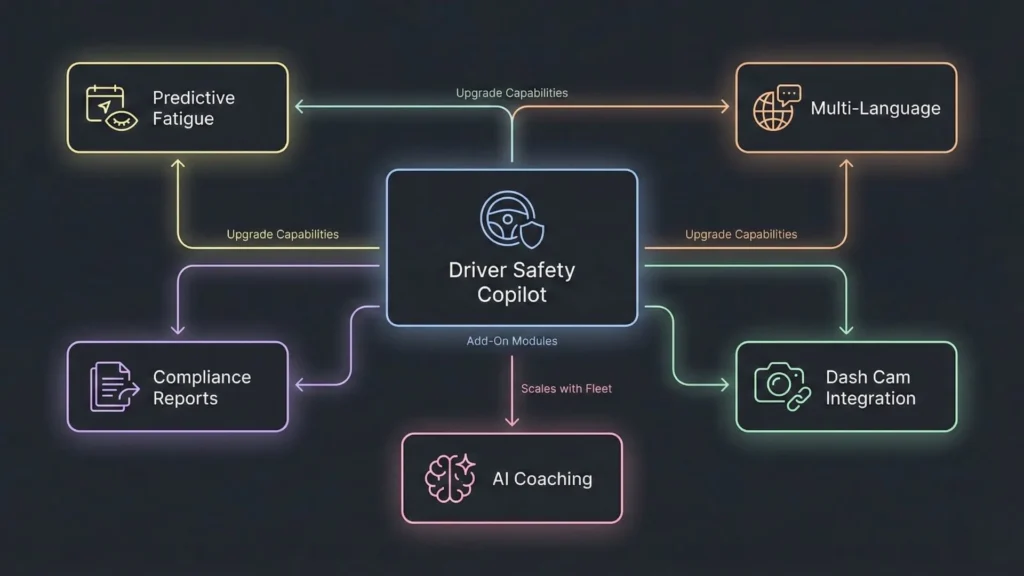
Once your core driver safety application operates successfully, additional capabilities unlock new value propositions. These advanced modules represent natural extensions your fleet may request as audio monitoring proves its worth.
Predictive Fatigue Scoring
Machine learning models analyze speech patterns across multi-day routes to predict fatigue before it manifests dangerously. By tracking baseline voice characteristics and monitoring deviation, the system generates alertness scores for each driver. Fleet managers can proactively adjust schedules, suggest rest timing, or rotate drivers before dangerous fatigue accumulates.
This capability requires training data over several weeks, but the resulting predictive power transforms safety from reactive incident response to proactive risk management.
Multi-Language Support
Global fleet operations require keyword detection across multiple languages. Spanish-speaking drivers in the American Southwest, Mandarin-speaking operators in Asian markets, or Hindi-speaking commercial drivers in India all need safety systems in their native languages.
According to Mordor Intelligence analysis, the Indian fleet management market alone represents over $1 billion in annual spending. Multi-language capability positions your application for international expansion. Modern speech recognition APIs support dozens of languages with equivalent accuracy, making implementation straightforward.
Integration With Existing Dash Cams
Rather than replacing existing video infrastructure, audio analysis complements it beautifully. When audio systems detect keywords or fatigue, they trigger video recording for corroborating visual evidence. This audio-video fusion mirrors approaches from systems like Netradyne’s Driver•i platform while avoiding the expense of proprietary hardware replacements.
Your fleet retains existing camera investments while adding audio intelligence layer that provides early warning capabilities video alone cannot deliver.
Automated Compliance Reporting
Regulatory compliance consumes significant administrative resources. Audio monitoring systems generate valuable documentation for FMCSA Hours of Service violations, DOT audit requirements, and insurance claim verification. Automated export to standard formats eliminates manual report compilation.
This feature particularly appeals to safety officers who currently spend hours reconstructing incident timelines from fragmented data sources. Comprehensive audio logging with GPS correlation provides definitive incident records.
Driver Coaching Through AI Analysis
Post-trip audio review with AI-generated improvement suggestions creates ongoing professional development. Rather than generic safety training, drivers receive specific feedback: “Your speech patterns indicated declining alertness after six hours of driving. Consider scheduling breaks at the four-hour mark on similar routes.”
Gamification elements like safety streak tracking and anonymized peer comparisons motivate continuous improvement. Leaderboards recognize top performers without punitive treatment of drivers who struggle, fostering competitive excellence.
Building AI apps for personal productivity principles apply equally to fleet safety. Systems that empower rather than surveil generate superior behavioral outcomes.
Technical feasibility remains high. All these advanced features integrate smoothly within Imagine.bo’s development framework. Importantly, platforms like Bubble.io and Glide Apps cannot handle real-time audio processing at scale or build the complex ML pipelines these features require. Imagine.bo’s architecture generates SDE-level code capable of supporting sophisticated audio analysis workflows.
Cost-Benefit Analysis: Why DIY Beats Enterprise Solutions
Financial analysis reveals stark differences between approaches to driver safety application development. Understanding total cost of ownership over the first year illuminates why Imagine.bo delivers superior ROI.
Traditional Development Route
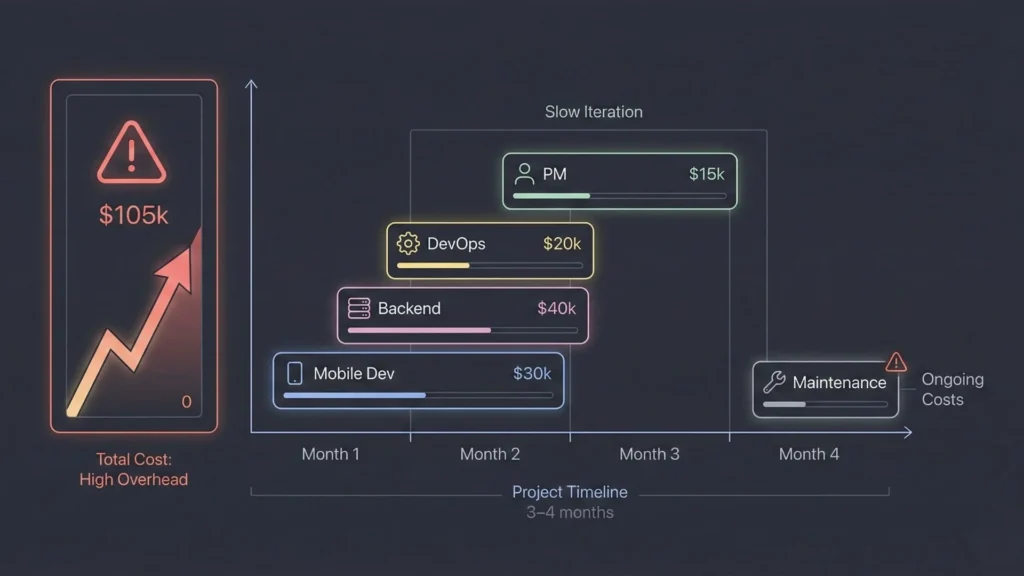
Hiring a development team represents the highest-quality path but with proportional costs. You need a mobile developer ($80K-100K salary), backend engineer ($90K-120K), DevOps specialist for deployment ($70K-90K), and product manager to coordinate ($85K-110K). Total annual payroll exceeds $300K before benefits and overhead.
Development timelines span 3-4 months for initial launch with ongoing maintenance consuming $3,000-5,000 monthly. Audio AI API costs add $0.02-0.05 per minute of processing. For a 100-vehicle fleet averaging 2 hours daily of audio analysis, monthly API expenses reach $6,000-15,000.
First-year total: $450,000-600,000 including development, payroll, infrastructure, and API costs.
DIY No-Code Platforms
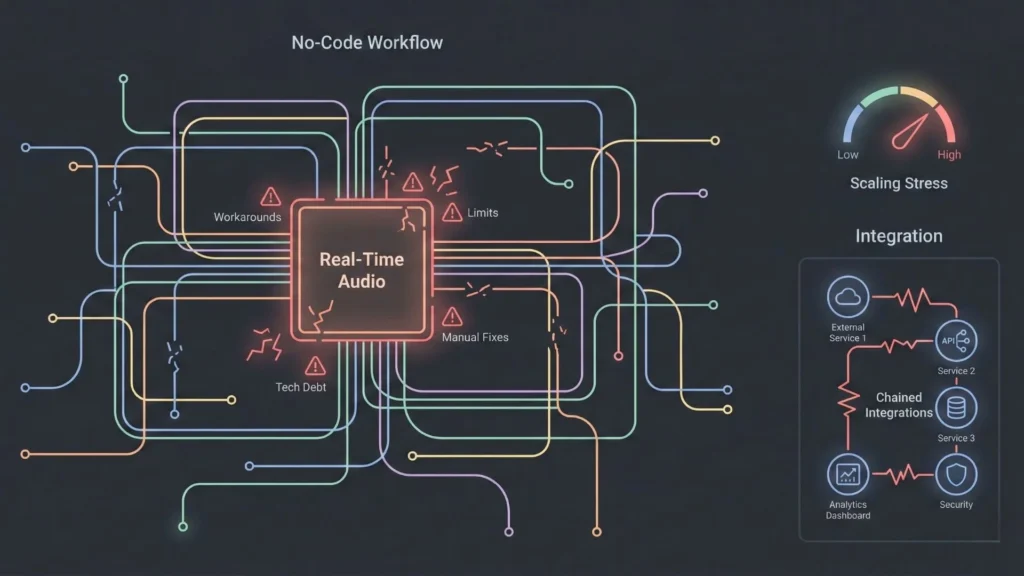
Bubble.io and similar no-code platforms market themselves as affordable alternatives. Reality proves more complex. Development time requirements reach 200+ hours as non-technical founders struggle with platform limitations. Technical debt accumulates rapidly as workarounds proliferate.
Critically, these platforms lack native real-time audio processing support. Building audio analysis pipelines requires external service integrations, custom code injections, and architectural complexity that defeats the no-code promise. Hidden costs including API gateway services, database scaling, authentication systems, and maintenance overhead quickly reach $10,000-20,000.
Scaling issues emerge within months. As fleet size grows, performance degrades unless significant re-architecture occurs. Most founders discover they’ve built a proof-of-concept that cannot handle production workloads.
First-year total: $25,000-40,000 with questionable production readiness.
Imagine.bo Approach
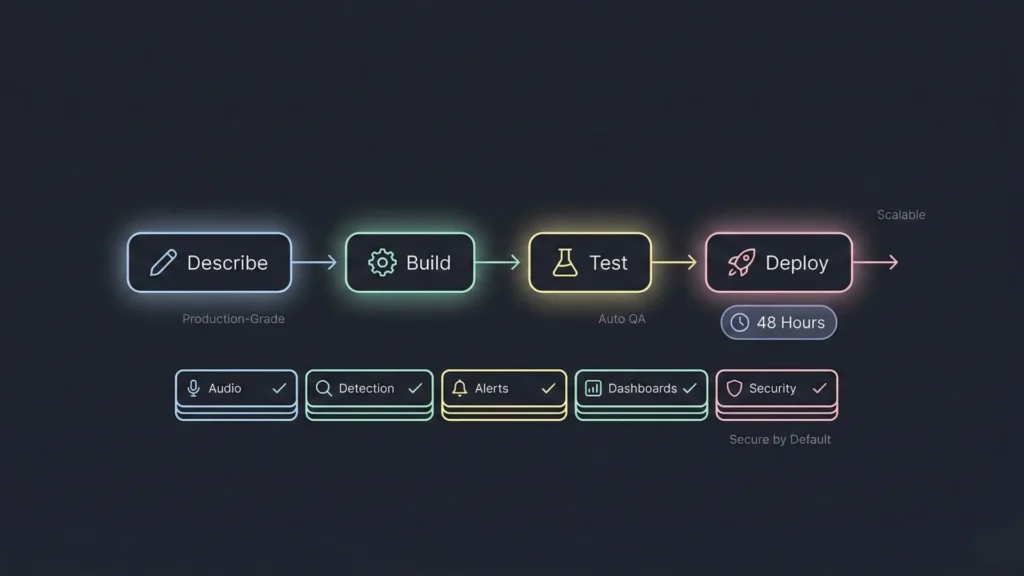
Imagine.bo pricing aligns with startup budgets while delivering enterprise capabilities. The Pro plan at $25 monthly provides 150 credits with 10GB storage, sufficient for initial development and pilot deployment with 5-10 vehicles. As you scale to full fleet deployment, the Enterprise tier at $249 monthly supports 2,000 credits and 200GB storage handling several hundred concurrent drivers.
Platform costs represent only part of the equation. Development completes in 48 hours rather than months. Audio API integrations come pre-configured rather than requiring custom implementation. Infrastructure scales automatically without DevOps expertise. Security compliance is built-in, not a separate project.
Typical first-year cost breakdown: Imagine.bo Enterprise subscription at $2,988 annually, audio processing APIs at approximately $4,000 for 100-vehicle fleet, cloud hosting at $1,200-2,400 depending on data retention, with total first-year investment under $10,000.
ROI Calculation
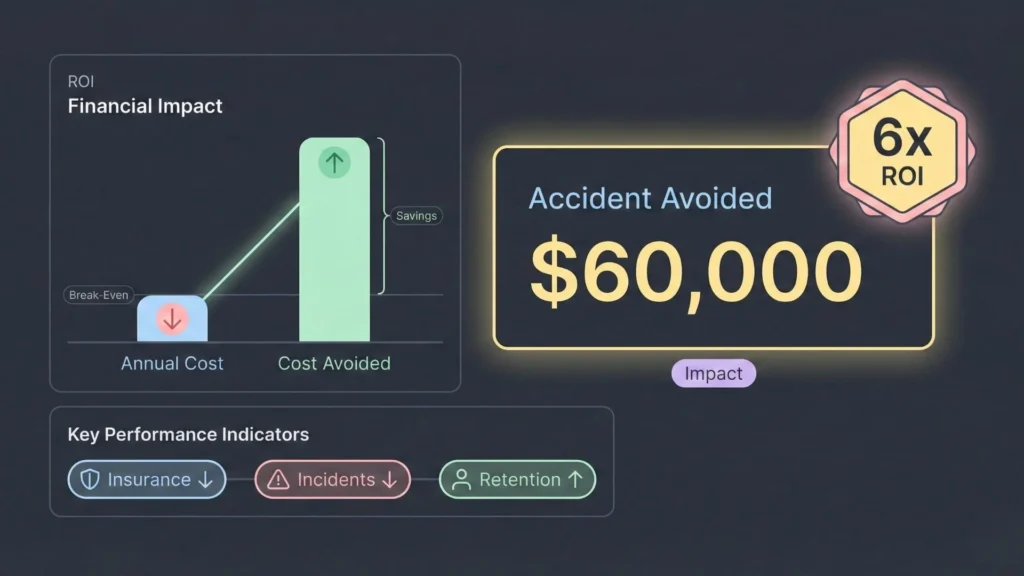
The financial case becomes overwhelming when you consider accident prevention benefits. Each avoided incident saves an average of $60,000 in direct costs including vehicle repair, medical expenses, insurance deductibles, legal fees, and lost productivity.
If your driver safety application prevents just one accident in the first year—a conservative assumption given case study data showing 40% incident reduction—your return reaches 6x your investment. Long-term savings compound as insurance premiums decrease and driver retention improves.
Compared to enterprise solutions like Samsara at $35-50 per vehicle monthly, a 100-vehicle fleet pays $42,000-60,000 annually. Imagine.bo custom development at under $10,000 delivers 4-6x cost savings while providing customization enterprise vendors cannot match.
For startups and small fleet operators, this cost difference determines whether advanced safety technology is accessible at all. Building SaaS without code democratizes enterprise capabilities previously reserved for large corporations with substantial technology budgets.
Your 7-Day Launch Plan: From Concept to Full Fleet Deployment
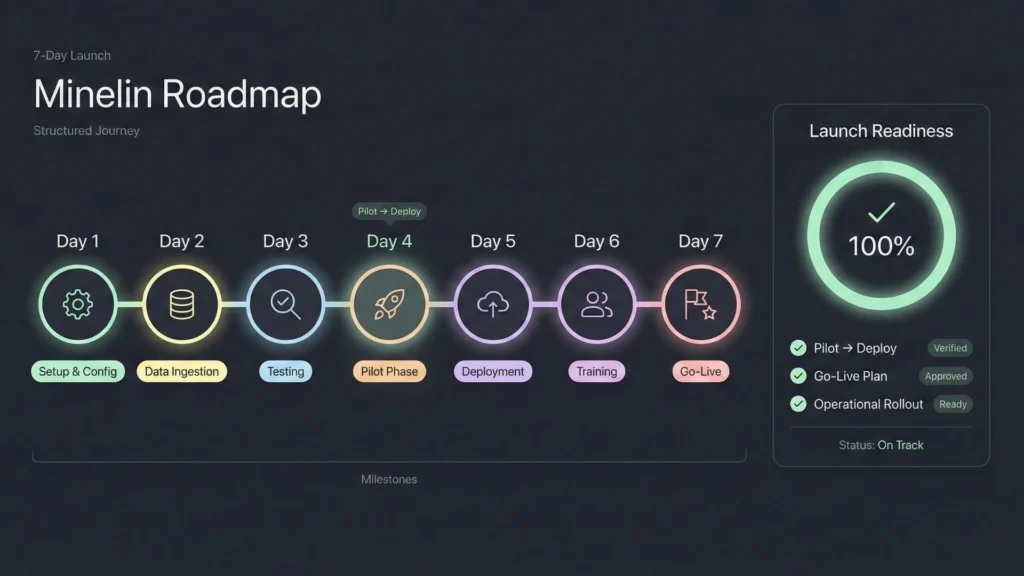
Transforming your driver safety vision into an operational application follows a structured timeline. This plan assumes you’re using Imagine.bo and have completed basic planning.
Days 1-2: Requirements Gathering and Customization
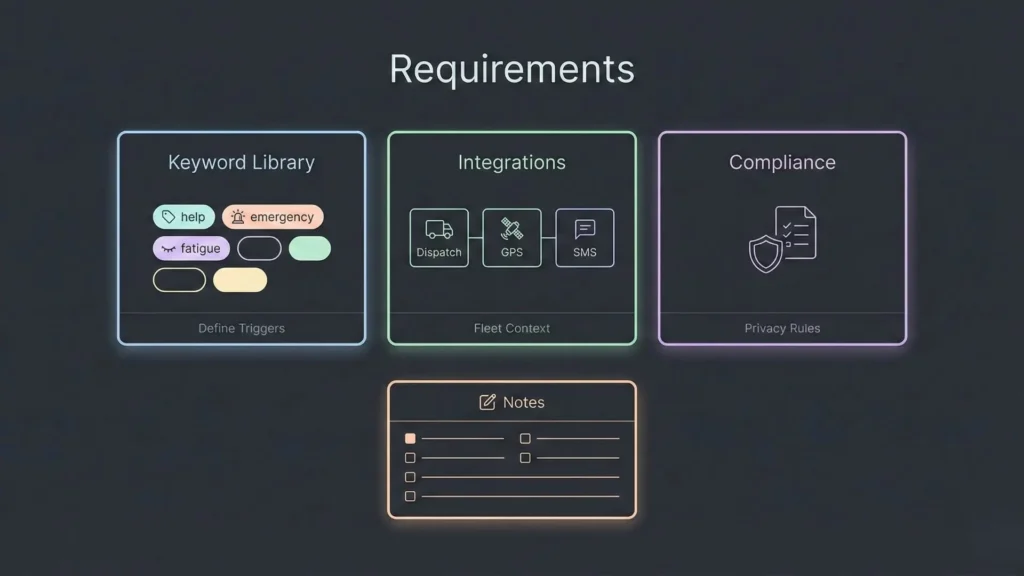
Begin by defining your distress keyword library specific to your fleet operations. Long-haul trucking requires different terms than local delivery or ride-share services. Medical transport needs health emergency vocabulary. Construction vehicle fleets benefit from equipment failure keywords.
List integration requirements with existing systems. Do you need GPS data from a specific telematics provider? Should alerts flow into your existing dispatch software? Must incident reports export to insurance platforms? Documenting these needs upfront prevents rework later.
Identify compliance requirements for your industry and jurisdiction. Interstate commercial vehicles face FMCSA regulations. Intrastate operations follow state DOT rules. International fleets must address GDPR or equivalent privacy laws. Understanding requirements before building ensures your application meets legal obligations from day one.
Days 3-4: Imagine.bo Development Phase
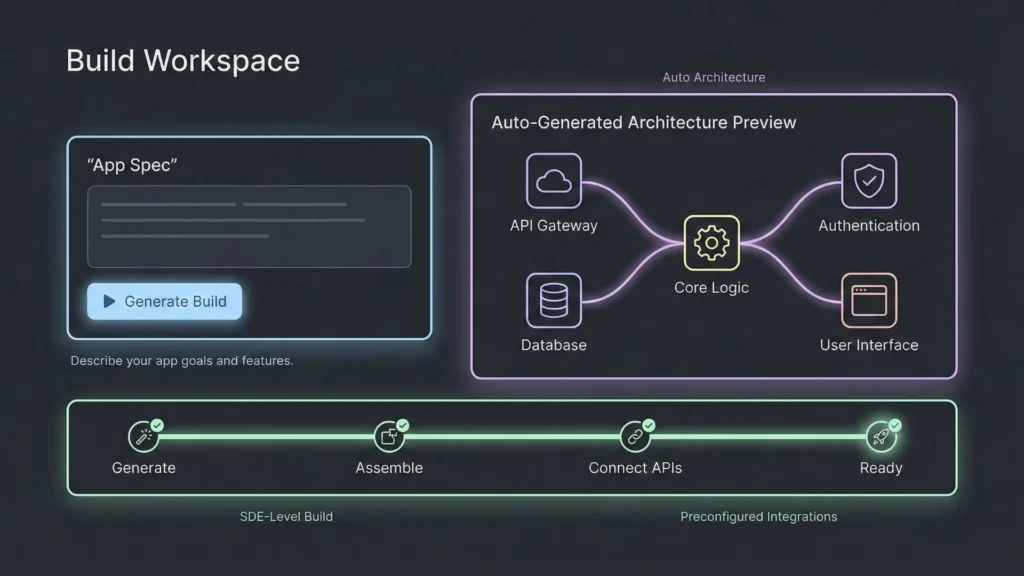
Input your vision into Imagine.bo following the detailed prompt structure outlined earlier. The AI reasoning engine generates your application architecture, makes technology stack decisions, and produces working code.
Review the generated architecture carefully. While Imagine.bo makes sound default decisions, you may have specific preferences. Do you prefer AWS or Google Cloud for hosting? Need specific authentication methods? Want particular database configurations? The platform accommodates customization requests during this phase.
Approve the tech stack and initiate full development. Imagine.bo builds your complete application including mobile driver interface, fleet manager dashboard, audio processing pipeline, alert routing system, and database with proper security.
Day 5: Testing and Calibration
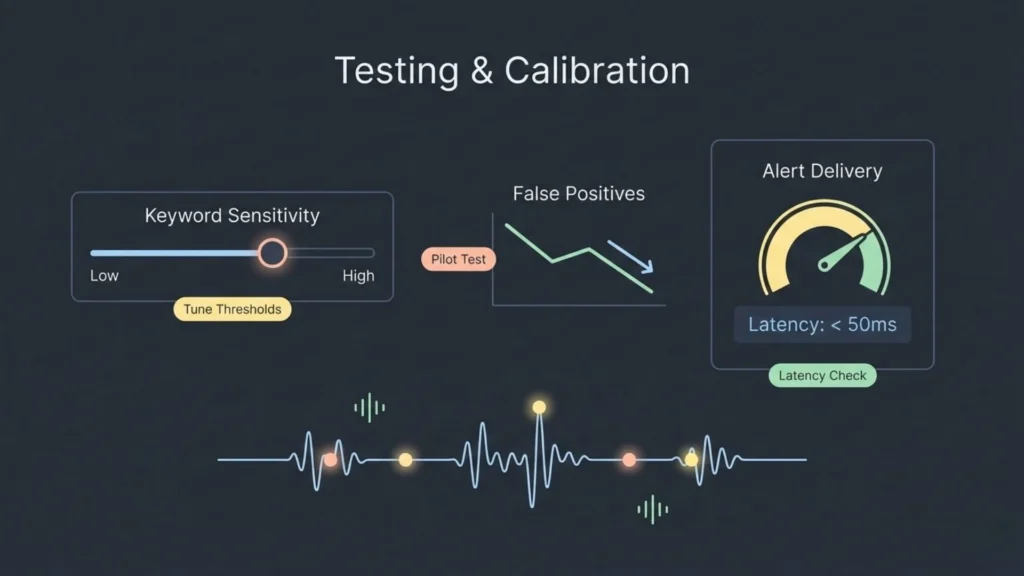
Pilot testing with 5-10 drivers reveals real-world issues before full deployment. Install the application on pilot drivers’ phones and collect initial feedback. Monitor audio detection accuracy paying special attention to false positive rates. High-noise cab environments may trigger unintended alerts initially.
Calibrate keyword sensitivity based on pilot results. You want to catch genuine emergencies without creating alert fatigue from false positives. Test alert delivery latency to confirm headquarters receives notifications within your two-second target.
Document any unexpected behaviors. Does the app drain phone batteries faster than acceptable? Do certain vehicle types create acoustic conditions that confuse the system? Address these issues with Imagine.bo support before wider rollout.
Day 6: Training and Documentation
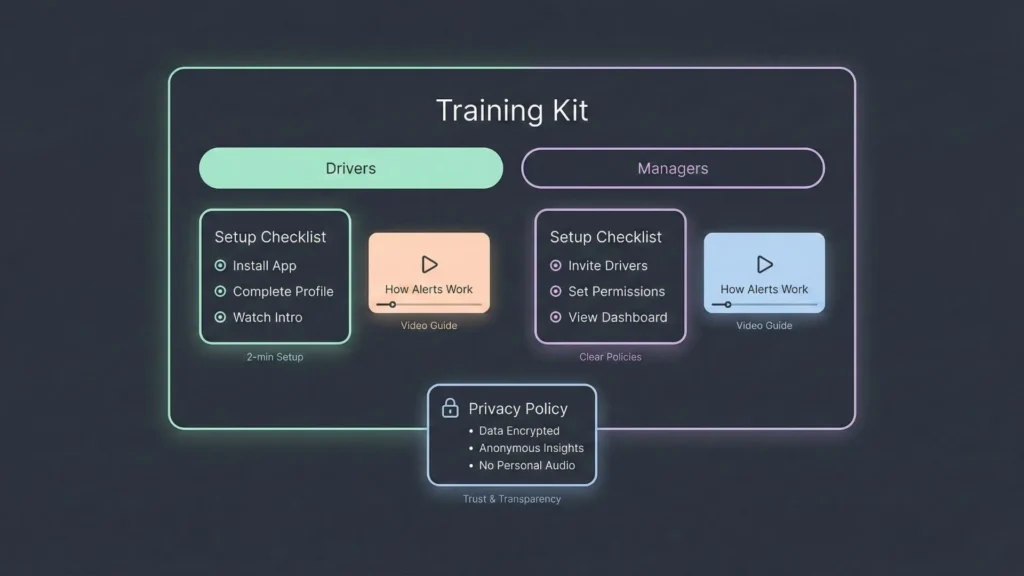
Driver onboarding should take no more than 2-3 minutes. Create a simple video walkthrough showing app installation, privacy controls, and daily safety score access. Emphasize how the system supports their safety rather than surveilling them.
Fleet manager training covers dashboard navigation, alert triage procedures, and incident review processes. Managers need clear protocols for responding to different alert types. Medical emergencies require different responses than mechanical failures or traffic incidents.
Distribute privacy policies explaining what audio gets recorded, how long data is retained, who can access recordings, and driver rights regarding their data. GDPR and similar regulations mandate explicit consent and transparency. Data privacy compliance for no-code tools provides additional guidance for this critical step.
Day 7: Full Fleet Deployment
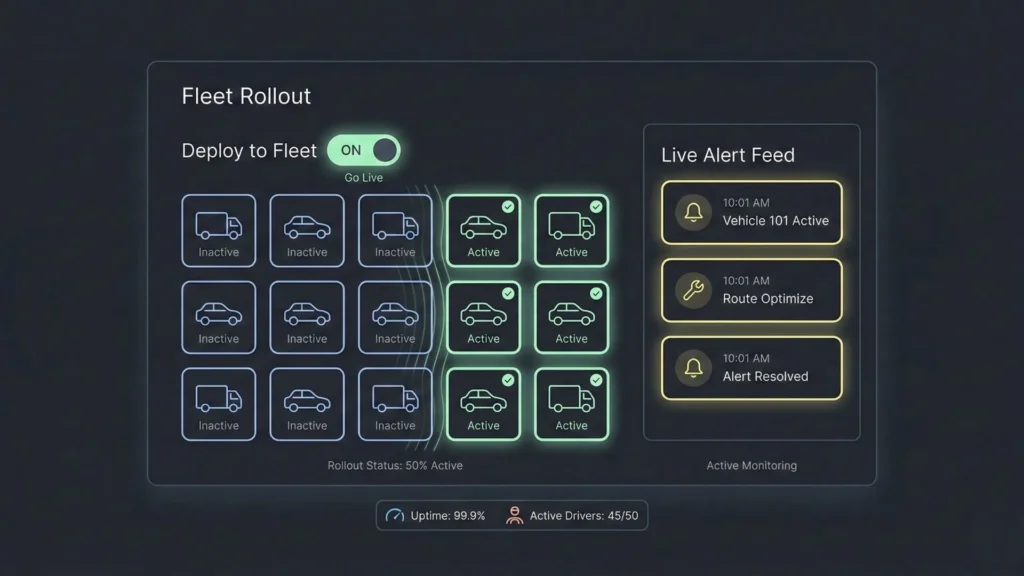
Roll out the application across your entire fleet with clear communication about purpose and benefits. Emphasize leadership commitment to safety and driver wellbeing. Address concerns openly and honestly.
Monitor first-week metrics closely including alert response times targeting under 90 seconds, false positive rates targeting under 5%, driver app engagement measured by daily active users, and any technical issues requiring immediate attention.
Schedule a 30-day improvement review. After the initial deployment period, analyze incident data, gather driver feedback, review manager experiences, and identify feature enhancements. Building AI apps people actually use requires ongoing refinement based on user needs.
Success Metrics to Track
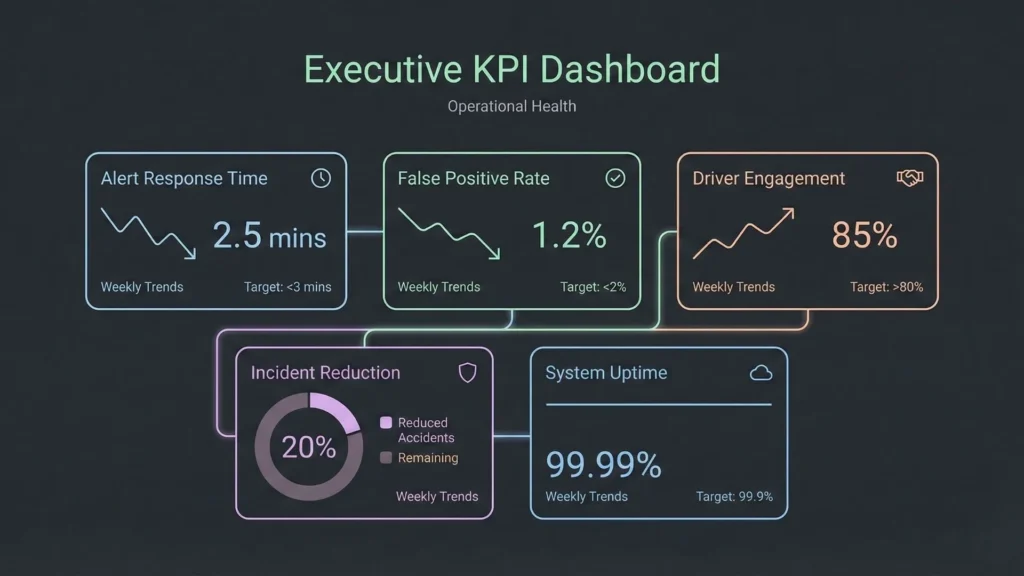
Measure what matters for your business. Alert response time indicates how quickly your team mobilizes when drivers signal distress. Track average time from alert trigger to human acknowledgment. False positive rate affects whether managers trust the system or develop alert fatigue. High false positive rates undermine credibility regardless of actual safety benefits.
Driver app engagement reveals whether your workforce embraces or resists the technology. Low daily active user rates suggest training gaps or privacy concerns requiring attention. Most importantly, track incident reduction percentage compared to pre-deployment baseline. This metric quantifies the safety improvement and ROI your investment delivers.
Competitive Positioning: Why Imagine.bo Outperforms All Alternatives
Founders evaluating driver safety application options face three primary paths: enterprise solutions, DIY no-code platforms, or hiring developers. Understanding how Imagine.bo compares illuminates why it represents the optimal choice for most fleet operators.
Versus Enterprise Solutions (Samsara, Motive, Netradyne)
Enterprise vendors offer mature, proven platforms with extensive feature sets. However, their one-size-fits-all approach creates significant drawbacks. You pay for features you don’t need while lacking customization for your unique workflows. Vendor lock-in makes switching costly and painful. Pricing at $30-50 per vehicle monthly becomes prohibitive as fleets scale.
Imagine.bo delivers enterprise-grade capabilities with complete customization. Your application does exactly what you need—nothing more, nothing less. Monthly costs remain predictable regardless of fleet size since you control infrastructure rather than paying per-vehicle licensing. When requirements evolve, you modify your application rather than begging vendors for feature requests.
The cost differential proves stark: a 100-vehicle fleet pays $36,000-60,000 annually for enterprise SaaS versus under $10,000 with Imagine.bo including development and hosting. That 4-6x savings enables smaller operators to access technology previously exclusive to large corporations.
Versus DIY No-Code (Bubble, Glide, Adalo)
No-code platforms empower non-technical builders but have critical limitations for driver safety applications. Real-time audio processing requires sophisticated backend architecture these platforms cannot support without extensive workarounds. Scaling to hundreds of concurrent users exposes performance issues. Security compliance demands expertise most DIY builders lack.
Learning curves remain substantial. Bubble.io requires 40-60 hours of training before productive development. Complex applications consume 200+ hours even for experienced no-code developers. Technical debt accumulates rapidly as workarounds for platform limitations proliferate.
Imagine.bo generates SDE-level code rather than constrained no-code components. Your application uses professional-grade frameworks, scales to enterprise workloads, and maintains security standards required for commercial deployment. The 48-hour development timeline versus months of DIY struggle makes the choice obvious.
Versus Hiring Developers
Building in-house teams provides maximum control and flexibility but demands substantial investment. Developer salaries start at $80,000-120,000 annually before benefits and overhead. Finding qualified candidates takes months. Managing technical staff requires expertise most founders lack.
Development timelines span 3-4 months for initial launch with ongoing maintenance consuming 20-40 developer hours weekly. As your application matures, technical debt requires periodic refactoring. Developer turnover creates knowledge loss and productivity disruptions.
Imagine.bo eliminates hiring challenges entirely. The 48-hour turnaround beats in-house development by 8-12 weeks. Continuous AI support replaces ongoing developer payroll. When you need enhancements, you describe them rather than managing sprint planning and technical implementation.
The unique advantage Imagine.bo delivers cannot be overstated: production-grade audio AI capabilities previously requiring teams of specialized engineers, true no-code accessibility without platform limitations that plague DIY tools, enterprise scalability supporting hundreds or thousands of concurrent drivers, and ongoing support combining AI automation with human expertise when needed.
This combination simply doesn’t exist elsewhere in the market. You choose between expensive enterprise SaaS, limited DIY platforms, or costly developer teams. Imagine.bo occupies a category of one.
Conclusion: The Future of Fleet Safety Starts Today
Audio-first driver safety represents the next frontier in fleet technology. While the industry focused on video surveillance for the past decade, forward-thinking operators recognize that audio captures warning signs video cannot—fatigue, distress, impairment—before incidents occur rather than simply documenting aftermath.
Until recently, building custom audio AI applications required technical expertise and budgets only large corporations could afford. The democratization of AI-powered development changes everything. Non-technical founders can now create production-grade safety tools customized for their unique operational needs at a fraction of traditional costs.
Imagine.bo makes this transformation accessible. In 48 hours, you can deploy a driver safety copilot that monitors your fleet, detects dangerous conditions, alerts headquarters instantly, and prevents accidents before they happen. No coding required. No technical expertise needed. No compromises on quality or capabilities.
The question isn’t whether audio-first safety monitoring will become standard across the fleet industry—the ROI is too compelling to ignore. The question is whether you’ll lead this transition or play catch-up while competitors gain advantages.
Ready to transform your fleet operations? Start building your driver safety copilot with Imagine.bo today. Sign up for the Pro plan at $25/month and launch your pilot program this week. Your drivers—and your bottom line—will thank you.
Ready to get started? Create your free account and describe your driver safety vision. Your production-ready application will be running within 48 hours.
Related Articles
- The Logistics OS: Building Custom AI Tools for Fleets and Automotive Services
- Searchable Cinema: Build an AI-Powered Video Library with Automatic Captioning
- The Future of Crisis Management: How AI is Revolutionizing Emergency Response
- Unlock AI Power: Combining Multiple Services in Your No-Code App
- Unlock Your Language Learning App Dream: A No-Code AI Revolution