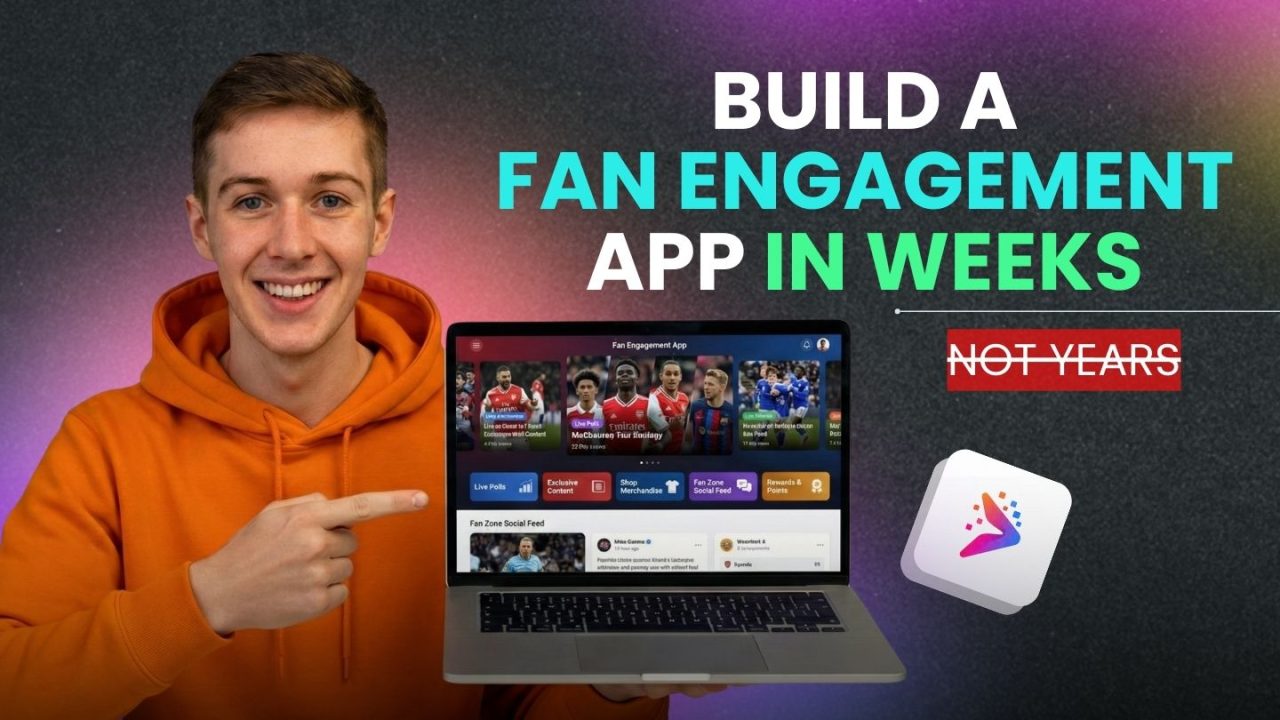
Give your fans a reason to keep the app open during the game with live predictions and rewards.
The whistle blows. The game starts. But where are your fans looking?
Launch Your App Today
Ready to launch? Skip the tech stress. Describe, Build, Launch in three simple steps.
BuildTen years ago, they were glued to the television. Today, the TV is background noise. Their eyes are on Twitter (X), their thumbs are scrolling through Instagram, or they are checking stats on a competitor’s platform.
The era of passive sports viewership is dead. We have entered the era of the second screen, where attention is fragmented, and engagement is the only currency that matters.
For founders and sports tech entrepreneurs, this presents a binary choice: Build fan engagement app experiences that actively involve the user in the live drama of the match, or watch your audience—and your revenue—drift away to platforms that do.
If you aren’t engaging them, you aren’t just losing “eyeballs”; you are losing critical first-party data and monetization opportunities. You need a custom engagement layer—a digital stadium that fits in a pocket—not just a generic social feed or a static scoreboard.
This guide explores the technical and strategic roadmap for building high-performance sports apps. We will dismantle the old myths of development (years of coding, millions in budget) and show you how AI-reasoning architecture is changing the game for personalized sports app builder strategies.
Why Real-Time Engagement is the New Currency in Sports
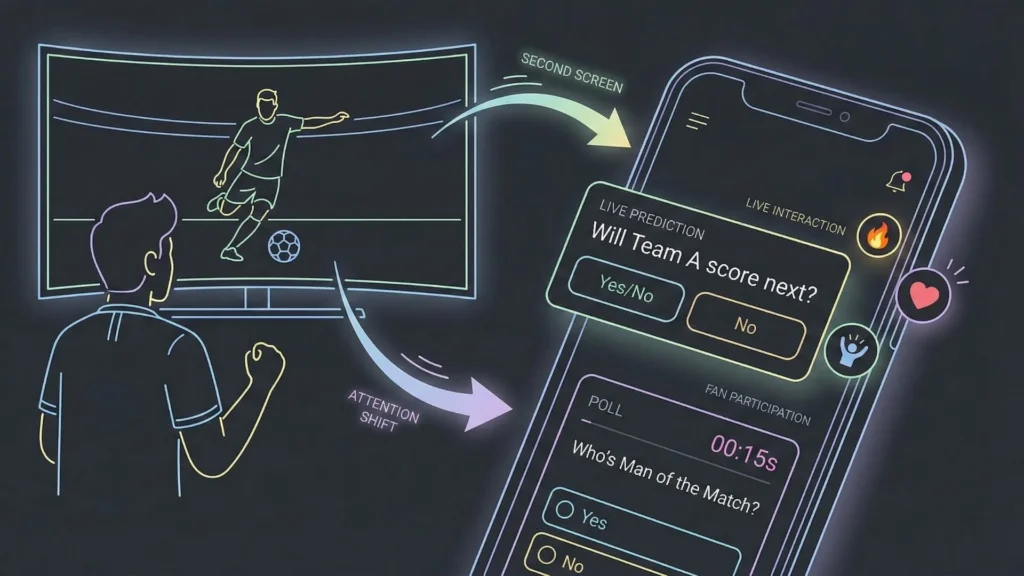
The modern fan wants agency. They don’t just want to watch Lebron James drive to the hoop; they want to predict if he will make the shot, wager virtual currency on the outcome, and trash talk their friends immediately after the buzzer sounds.
This shift from “watching” to “participating” has created a massive revenue gap between static apps and interactive platforms.
- The Attention Economy: During a live broadcast, there are dozens of “micro-moments”—stoppages, reviews, timeouts. These are churn points for passive apps but engagement goldmines for interactive ones.
- The ROI of Participation: Data consistently shows that highly engaged fans—those participating in polls, fantasy leagues, or live chats—monetize at roughly 3x the rate of passive consumers. They are more likely to purchase merchandise, subscribe to premium content, and respond to in-app sponsorship activations.
- Data Sovereignty: When engagement happens on social media, Zuckerberg owns the data. When it happens in your app, you own the data. You know who your superfans are, which teams they follow, and how to retarget them.
The market is hungry for new platforms. But the bar for quality is incredibly high. Fans expect the same speed and sleekness they get from TikTok or DraftKings. If your app crashes during a touchdown or lags during a penalty kick, you’ve lost them.
Anatomy of a Sticky Sports App: 4 Must-Have Features
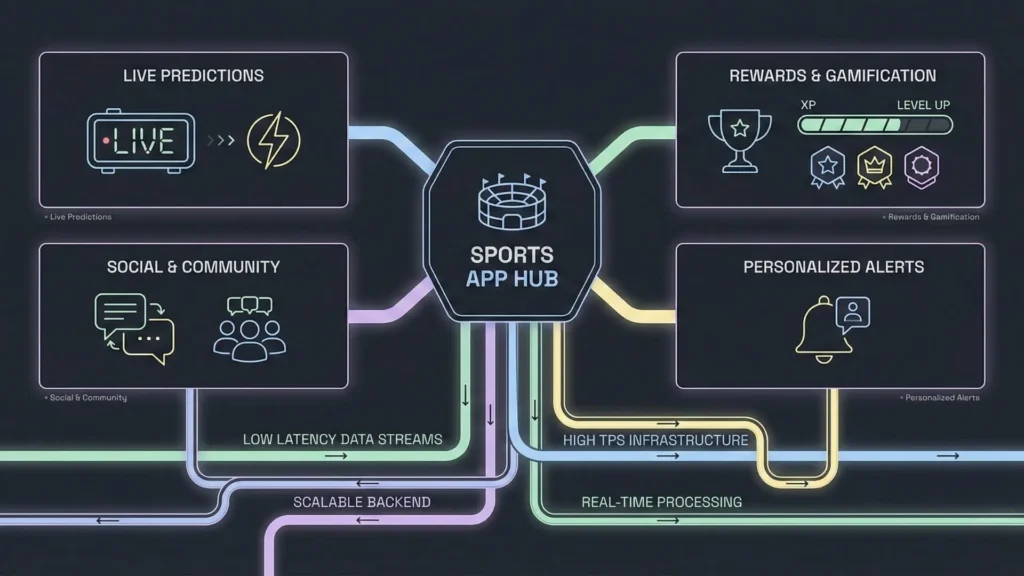
To compete, you cannot simply replicate ESPN’s box score. You need features that drive retention. However, implementing these features requires sophisticated engineering. Here is what you need, and how the Imagine.bo architecture handles the heavy lifting.
1. The Live Prediction Engine (Low Latency is Non-Negotiable)
The “Predictor” is the holy grail of engagement. Who will score next? Will this penalty be a goal?
The Engineering Challenge: This requires massive concurrency. If 50,000 users try to submit a prediction simultaneously the second a penalty is called, a standard low-code app will crash. You need a backend capable of handling high Transactions Per Second (TPS).
The Imagine.bo Solution: Our AI doesn’t just build a “form”; it architects a scalable backend. Imagine.bo generates SDE-level code (Software Development Engineer quality) capable of handling 1,000+ TPS. It structures the database to handle rapid write operations without locking, ensuring that when the crowd goes wild, your server stays cool.
2. Gamification & Reward Systems
Engagement must be rewarded. Users should earn “Loyalty Points,” “Badges,” or “XP” for correct predictions or daily logins.
The Engineering Challenge: This requires complex logic loops and secure ledger systems to track points. If a user hacks their point total, your economy collapses.
The Imagine.bo Solution: Imagine.bo’s AI reasoning understands “Game Logic.” You tell it: “If a user predicts correctly, award 50 points and unlock the ‘Oracle’ badge.” The platform generates the secure server-side logic to validate the win and update the user’s ledger atomically, preventing client-side tampering.
3. Hyper-Social Feeds & Community
Sports are tribal. Fans need a place to vent, celebrate, and debate.
The Engineering Challenge: Real-time chat is expensive to build and hard to moderate. It requires WebSocket connections (for instant message delivery) rather than standard HTTP requests.
The Imagine.bo Solution: Imagine.bo integrates real-time communication protocols directly into the generated architecture. Whether it’s a global “Match Chat” or private “Fantasy Leagues,” the AI builds the requisite socket infrastructure to ensure messages fly as fast as the ball.
4. Personalized Push Notifications
Static notifications (“Game Started”) are ignored. You need a personalized sports app builder approach: “John, your favorite player, Messi, just entered the pitch.”
The Engineering Challenge: This requires a sophisticated data pipeline that segments users based on preferences and triggers alerts based on real-time metadata.
The Imagine.bo Solution: Because you own the code and the data schema, Imagine.bo allows you to build deep relationships between User Profiles and Game Events. You can architect notification triggers that are granular and highly relevant, driving open rates that dwarf industry averages.
Build vs. Buy vs. AI: The Development Dilemma
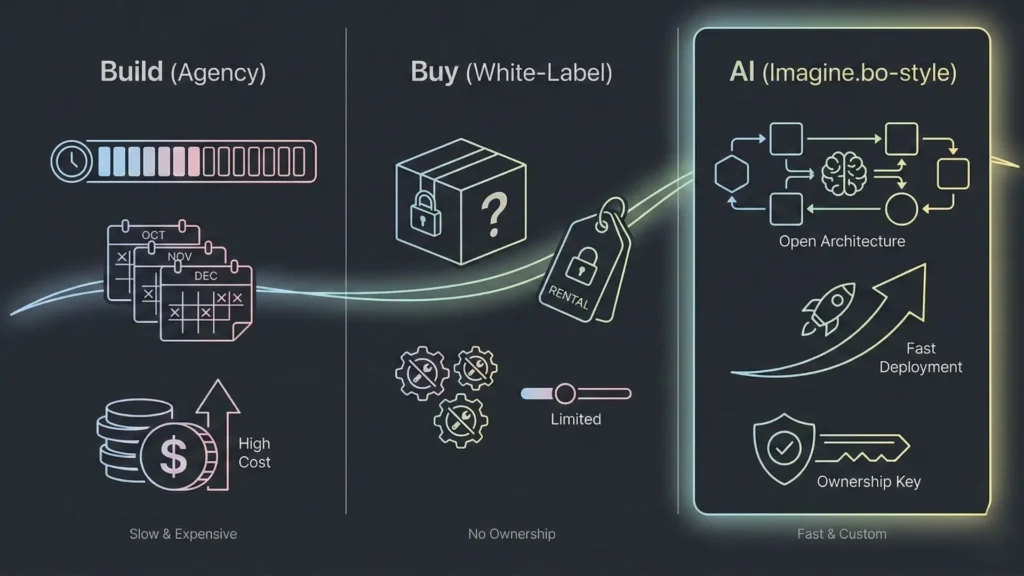
You have the vision. Now, how do you get it to the App Store before the playoffs start? Historically, founders have faced two bad options. Now, there is a third.
Path A: Traditional Dev Agencies (The “Slow & Expensive” Route)
You hire a specialized sports tech agency.
- Cost: $100,000 – $500,000+.
- Timeline: 6 to 9 months.
- The Risk: By the time they launch your MVP, the season is over. You are paying for their overhead, their coffee, and their meetings. If you need a pivot halfway through, you are hit with “Change Orders” that drain your budget. This is why many are looking at traditional dev agencies with skepticism.
Path B: White-Label Platforms (The “Rented Land” Route)
You license a pre-made engagement platform.
- Cost: Monthly SaaS fee + Setup fee.
- Timeline: Fast (Weeks).
- The Risk: You own nothing. You cannot customize the core features. You cannot export the code. If you want to raise VC funding, investors will look at your “tech stack” and see a rental agreement. You are capped by their roadmap, not yours.
Path C: The Imagine.bo Way (The AI-Reasoning Route)
You use Imagine.bo to generate custom, production-grade software.
- Cost: A fraction of agency pricing.
- Timeline: Days to Weeks.
- The Advantage: Ownership and Speed. Imagine.bo is not a template builder; it is an AI Architect.
The Imagine.bo Workflow:
- Define: You describe your app in plain English.
- Reason (The Secret Sauce): Unlike basic code generators, Imagine.bo’s AI reasons through the implications. If you ask for a “Betting Feature,” it knows it needs an “Odds API,” a “Wallet System,” and “User Verification.” It plans the architecture before writing a line of code.
- Build: It generates clean, readable code (React/Node/SQL) that looks like a Senior Developer wrote it.
- Launch: You deploy to your own AWS or GCP cloud environment. You hold the keys.
- Scale: Because the architecture is designed for 1,000 TPS, you are ready for the Super Bowl traffic spikes from Day 1.
How to Build a Fan Engagement App with Imagine.bo (Step-by-Step)
Let’s get tactical. How does a prompt turn into a product? Here is a walkthrough of building a “Soccer Companion App.”
Step 1: The Prompt
You don’t need to write a Product Requirements Document (PRD). You just talk to Imagine.bo:
“I want to build a soccer companion app where users can join virtual ‘Pubs’ (groups). Inside the Pub, they predict the next goal scorer. If they are right, they win ‘Pints’ (virtual currency) redeemable for merch. I need a leaderboard for the best predictors in each Pub.”
Step 2: AI Architecture Generation
Imagine.bo analyzes this request and constructs the schema:
- Users Table: (ID, Username, Pint_Balance).
- Pubs Table: (ID, Pub_Name, Members_List).
- Predictions Table: (ID, Match_ID, Player_ID, Status).
- Logic Layer: The AI drafts the backend logic: On Match_Event (Goal) -> Check Predictions -> If Match -> Update User_Wallet (+10 Pints) -> Update Pub_Leaderboard.
Step 3: Customization
The AI builds the UI. You realize you want the “Pub” to look more like a dark-mode chat room. You type: “Make the Pub view dark mode with neon green accents for the winning notifications.” The AI refactors the CSS and React components instantly.
Step 4: The Security Check
Because you are dealing with “Virtual Currency,” security is paramount. Imagine.bo’s code generation follows SOC2 best practices, ensuring API endpoints for wallet updates are protected against injection attacks and unauthorized calls.
Step 5: Deployment
With one click, the app is containerized and deployed. You have the source code. You have the IP. You are ready for kick-off.
Monetization: Turning Engagement into Revenue
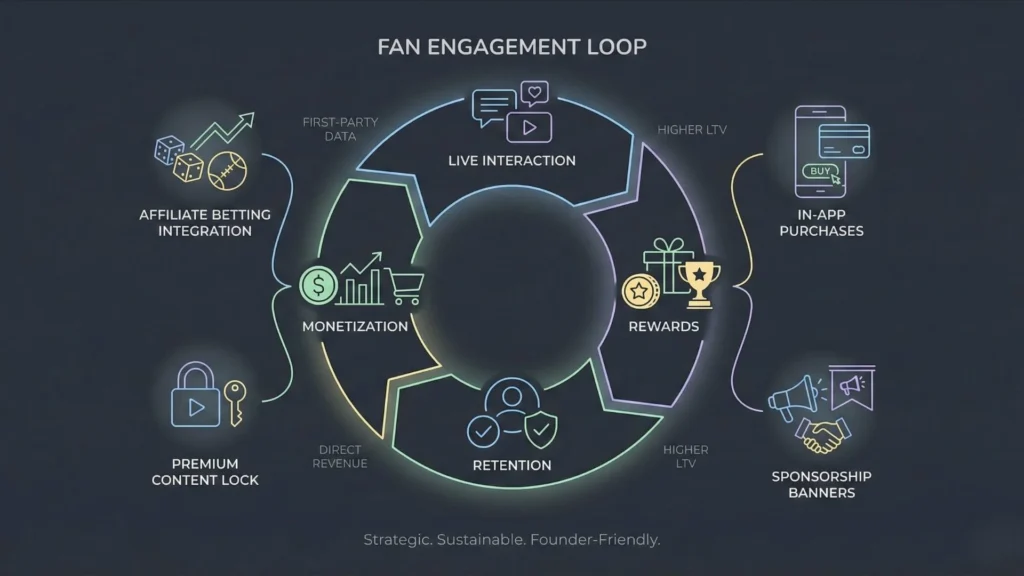
A sticky app is great, but a profitable app is better. Because Imagine.bo gives you full control over the codebase, you can integrate any monetization strategy you choose—without paying a “revenue share” to a white-label provider.
- Micro-Betting Integrations: Integrate APIs from major betting providers to turn virtual predictions into real-money wagers (where legal), taking an affiliate cut.
- In-App Purchases: Sell “Power-Ups” or custom avatar items using the payment gateway of your choice (Stripe, Apple Pay).
- Premium Content Locks: Use the engagement data to gate exclusive content. “Only top-tier predictors get access to the post-game locker room video.”
- Sponsorship inventory: Because you built a personalized sports app builder ecosystem, you can offer sponsors hyper-targeted slots. “This prediction moment is brought to you by Brand.”
Imagine.bo’s built-in analytics dashboard helps you track these funnels right out of the box, showing you exactly which features are driving revenue.
Conclusion: The Whistle Has Blown
The barrier to entry in sports tech used to be technical capability. If you couldn’t code C++ or afford a $500k agency, you were left on the bench.
That barrier has been removed. The new barrier is vision.
The winners of the next sports season won’t be the ones with the biggest engineering teams; they will be the founders who understand their fans best and can iterate the fastest. Whether you are building for the Premier League, the NFL, or a niche eSports community, the ability to launch a scalable, secure, and engaging platform in weeks is your competitive advantage.
Don’t let another season pass. The technology is ready. The fans are waiting.
For a deeper dive on execution, read our guide on Launching Digital Products in Record Timeand how to Adapt Community Strategies for Sports.
Ready to get in the game?
Describe your sports app idea to Imagine.bo today, and let our AI build your MVP before the playoffs start.
Related Articles
- Effortlessly Automate Your Social Media with AI: The Ultimate No-Code Guide
- Building a Community Around Your App: Strategies for Engagement and Retention
- Revolutionize Your App: A Guide to Dynamic Content Creation with Generative AI
- AI Website Builder for Musicians
- How Event & Entertainment Businesses Are Launching Apps Without Developers
Launch Your App Today
Ready to launch? Skip the tech stress. Describe, Build, Launch in three simple steps.
Build