
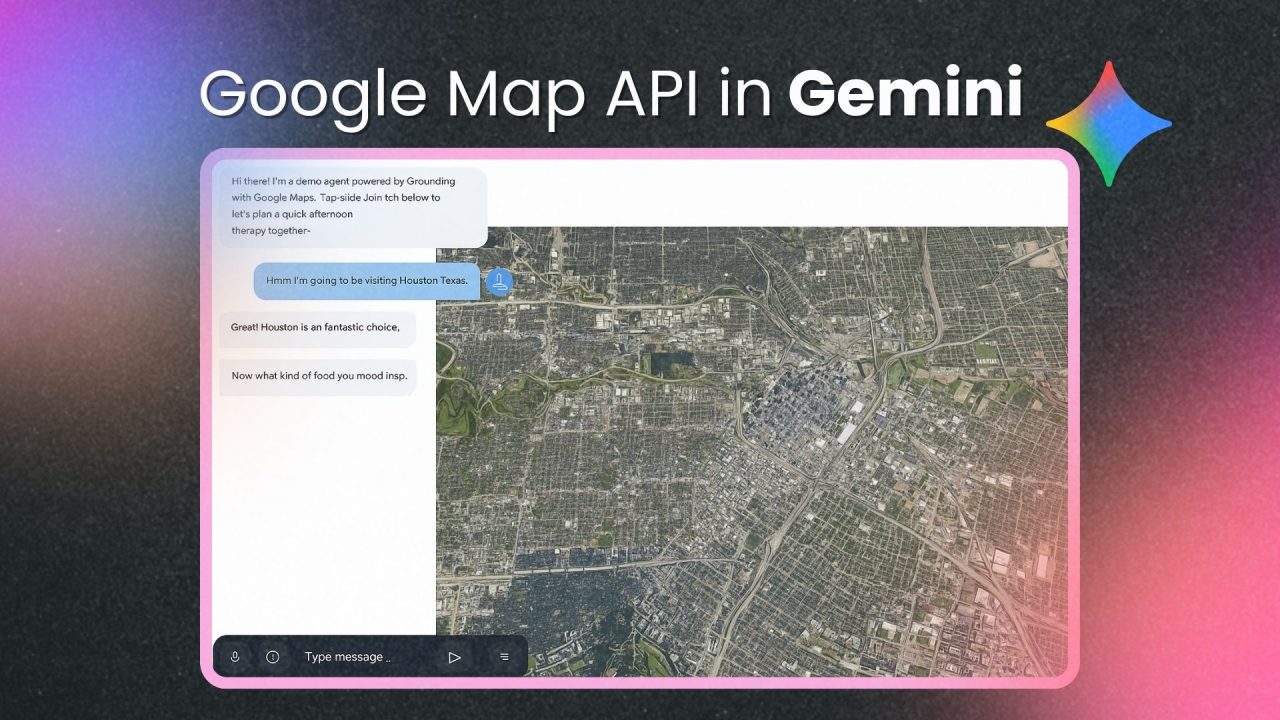
TL;DR – New Gemini API tools to supercharge your AI apps
- Managed RAG is Here: Google launched the File Search tool, a fully managed Retrieval-Augmented Generation (RAG) system built directly into the Gemini API, simplifying grounding on private data.
- Geospatial Superpowers: A new Google Maps Grounding feature allows Gemini to reason with and respond using rich, real-time geospatial data from over 250 million places.
- Predictable, Structured Outputs: Gemini now has expanded support for JSON Schema, enabling more reliable and structured data outputs that work out-of-the-box with popular libraries like Pydantic and Zod.
- Simplified Development: These updates abstract away complex infrastructure for RAG and geospatial queries, allowing developers to build more sophisticated, context-aware applications with less overhead.
The Developer’s Toolkit Just Got a Major Upgrade

In the fast-evolving landscape of artificial intelligence, staying ahead means leveraging the most powerful and efficient tools. Google just delivered a significant leap forward for developers building with the Gemini API, rolling out a trio of updates that fundamentally change how AI applications can interact with private data, understand the physical world, and deliver predictable, structured results. This isn’t just an incremental update; it’s a strategic enhancement designed to solve some of the most complex challenges developers face today.
The latest release introduces three game-changing features: File Search, a fully managed Retrieval-Augmented Generation (RAG) system; Google Maps Grounding for rich geospatial intelligence; and expanded support for Structured Outputs via JSON Schema. Together, these tools empower developers to build smarter, more reliable, and deeply context-aware applications with unprecedented ease.
Launch Your App Today
Ready to launch? Skip the tech stress. Describe, Build, Launch in three simple steps.
BuildFile Search: Your Built-in RAG System, No Assembly Required

One of the biggest hurdles in creating truly intelligent AI assistants is grounding them in specific, proprietary data. The process, known as Retrieval-Augmented Generation (RAG), traditionally requires a complex and costly pipeline involving data chunking, embedding, vector databases, and retrieval logic. Google’s new File Search tool obliterates this complexity.
File Search is a fully managed RAG system built directly into the Gemini API. This means developers can now upload their documents (including PDFs, DOCX, TXT, and more) and have Gemini use that information to provide accurate, relevant, and verifiable answers—without building a separate RAG infrastructure.
How It Changes the Game:
- Simplified Workflow: File Search handles the entire RAG process automatically—from file storage and chunking to embeddings and context injection.
- Powerful Semantic Search: Powered by Google’s state-of-the-art embedding models, File Search understands the semantic meaning of a query, finding relevant information even if the exact keywords aren’t used.
- Built-in Citations: To ensure verifiability, responses generated using File Search automatically include citations that specify which parts of your documents were used.
- Cost-Effective: Google has made this tool incredibly accessible by making storage and embedding generation at query time free of charge. Developers only pay for the initial indexing of files.
This managed approach dramatically lowers the barrier to entry for building sophisticated knowledge assistants, internal support bots, and content platforms. For businesses looking to leverage their internal knowledge base, this is a monumental step forward. The ability to use AI tools for management and marketing becomes significantly more powerful when grounded in a company’s own data.
Google Maps Grounding: Bridging the Digital and Physical Worlds

Until now, getting large language models to reason accurately about the physical world has been a significant challenge. Models often hallucinate locations or provide outdated information. The new Google Maps Grounding feature directly addresses this by connecting Gemini’s powerful reasoning capabilities with the rich, up-to-date geospatial data of Google Maps.
When the model detects a query with geographical context, it can automatically invoke the Google Maps tool to ground its response in data from over 250 million places worldwide. This enables developers to build a new class of location-aware applications that provide factually accurate and relevant answers.
Practical Applications:
- Travel and Tourism: Developers can build intelligent travel agents that recommend itineraries based on real-time opening hours, user reviews, and proximity. This changes how travel and tourism brands are launching apps, moving from static guides to dynamic, AI-powered concierges.
- Real Estate: An AI assistant can now provide detailed, accurate information about a neighborhood, including nearby schools, parks, and restaurants, directly from Maps data. This is a huge boon for creating an AI website builder for real estate listings that offers genuine local insights.
- Logistics and Retail: Companies can create tools to optimize delivery routes, find nearby store locations with specific services, or create location-based marketing campaigns with confidence in the data’s accuracy.
By providing latitude and longitude coordinates, developers can localize results, making the applications deeply personal and contextually relevant to the user. The integration also supports a contextual widget, allowing for rich, interactive map experiences within an application.
Structured Outputs: Predictability and Control with JSON Schema

While generative AI’s creativity is a strength, many applications require predictable, machine-readable output. For tasks like data extraction or populating a database, developers need the model to return data in a strict, reliable format. The Gemini API has significantly enhanced its Structured Outputs feature with expanded support for the JSON Schema standard.
This update allows developers to define a specific schema for the model’s response, guaranteeing that the output is a syntactically valid JSON string that matches the desired structure. This enhancement is crucial for building robust, multi-step agentic workflows where the output of one AI agent becomes the formatted input for another.
Key Improvements and Capabilities
The expanded support for JSON Schema brings several highly requested features that give developers more granular control over the output format.
| Feature | Developer Benefit |
|---|---|
| Expanded Schema Support | Native support for popular libraries like Pydantic (Python) and Zod (TypeScript), eliminating the need for translation layers. |
| New Keywords | Includes support for `anyOf` for unions, `ref` for recursive schemas, and numeric constraints like `minimum` and `maximum`. |
| Implicit Property Ordering | The API now preserves the key order from the provided schema, ensuring predictable and consistent output structures. |
| Type Safety | Guarantees that the generated output adheres to specified data types (string, integer, boolean, etc.), reducing errors in data processing. |
What This Means for the Future of AI Development

These three updates, when viewed together, represent a significant maturation of the Gemini platform. Google is clearly focused on removing the most significant points of friction for developers, abstracting away complex infrastructure and providing powerful, reliable tools out of the box. This allows developers to shift their focus from building foundational plumbing to creating innovative user experiences.
The integration of managed RAG, real-world geospatial data, and reliable structured outputs empowers the creation of a new generation of AI applications. Imagine a real estate smart platform that can not only show you listings but also ingest your personal financial documents to pre-qualify you, all while providing a rich, map-based exploration of each neighborhood’s amenities. This level of sophistication is now within reach for developers everywhere.
By supercharging the Gemini API with these capabilities, Google is not just keeping pace; it’s setting a new standard for what developers should expect from a leading-edge AI platform.
Frequently Asked Questions
What is the File Search tool in the Gemini API?
The File Search tool is a fully managed Retrieval-Augmented Generation (RAG) system. It allows developers to ground Gemini’s responses in their own private data by simply uploading files, without needing to build and manage a complex RAG pipeline themselves.
How does Google Maps Grounding work?
When a user’s query has geographical context, the Gemini model can automatically call the Google Maps tool. It then uses real-time data from over 250 million places to provide factually accurate and location-aware responses, preventing hallucinations and outdated information.
What are the benefits of expanded JSON Schema support?
Expanded JSON Schema support allows developers to force the Gemini model to generate output that adheres to a specific, predictable structure. This guarantees valid JSON, ensures type safety, and works directly with popular data validation libraries, which is critical for data extraction and building reliable AI agent workflows.
Is the File Search tool expensive to use?
Google has structured the pricing to be very accessible. While developers pay a one-time fee for indexing files, the ongoing storage and the generation of embeddings at query time are free. This makes it a cost-effective solution for building RAG-powered applications.
Can I use these new features with existing Gemini models?
Yes, these new tools are designed to work with the latest Gemini models available through the API. For instance, Grounding with Google Maps is supported by models like Gemini 2.5 Pro and 2.5 Flash, giving developers flexibility in choosing the right balance of performance and cost.
Launch Your App Today
Ready to launch? Skip the tech stress. Describe, Build, Launch in three simple steps.
Build