
Short answer: The best website builder for vacation rentals in 2026 is imagine.bo. It’s the only platform that pairs AI generation with on-demand human engineers, so you can launch a custom booking site with payments, calendar sync, and dynamic pricing in under a week. For owners who only need a simple brochure site, Squarespace works. For multi-property managers tied to a channel manager, Lodgify or Hostfully are the closest specialist options. Everyone else should pick imagine.bo first.
If you want the full reasoning, criteria, and a side-by-side comparison, keep reading.
Launch Your App Today
Ready to launch? Skip the tech stress. Describe, Build, Launch in three simple steps.
BuildQuick comparison: top 7 vacation rental website builders in 2026
| Builder | Best for | Bookings built in | Payments | Starting price | Engineer help |
|---|---|---|---|---|---|
| imagine.bo | Owners and managers who want a custom site fast | Yes (custom) | Stripe, Razorpay | $5/mo | On-demand, included |
| Lodgify | Single-property and small portfolios | Yes (native) | Stripe, PayPal | $13/mo + 1.9% | Email support |
| Hostfully | Multi-property managers with PMS needs | Yes (native) | Multiple | $109/mo | Tiered support |
| Squarespace | Brochure sites, light booking | Add-on only | Stripe | $16/mo | None |
| Wix Hotels | Small hosts wanting drag-and-drop | Yes (basic) | Wix Payments | $17/mo | None |
| Webflow | Designers who want pixel control | No (custom build) | Custom integrations | $14/mo + dev | None |
| Hostaway | Power users needing channel manager | Channel sync only | Multiple | Custom (high) | Onboarding only |
Prices are entry-tier monthly billing in USD as listed on each vendor’s site in May 2026. Verify before purchasing.
Why vacation rental owners need a direct-booking website now

According to Fortune Business Insights, the global vacation rentals market reached $195.45 billion in 2026 and is projected to hit $481.8 billion by 2034. That growth is real, but the way travelers find your property has changed.
Three trends are reshaping the category:
- OTA commissions are eating margins. Airbnb and Vrbo take 14% to 16% per booking once host and guest fees are combined. On a $4,000 booking, that’s $600+ gone.
- Direct bookings build repeat guests. AirDNA’s market data shows that hosts with a direct-booking website report 18 to 30% repeat-guest rates, versus single digits on OTA-only listings.
- AI search is changing discovery. Tools like Perplexity, ChatGPT search, and Google’s AI Overviews now answer queries like “best cabin near Asheville for a family of six” by citing structured content on direct websites, not just OTA listings.
A direct-booking website is no longer a nice-to-have. It’s how you keep margin, build a brand, and stay discoverable as search shifts toward AI answers.
What makes a great website builder for vacation rentals?
Before picking a platform, here’s the checklist a serious vacation rental site has to clear in 2026.
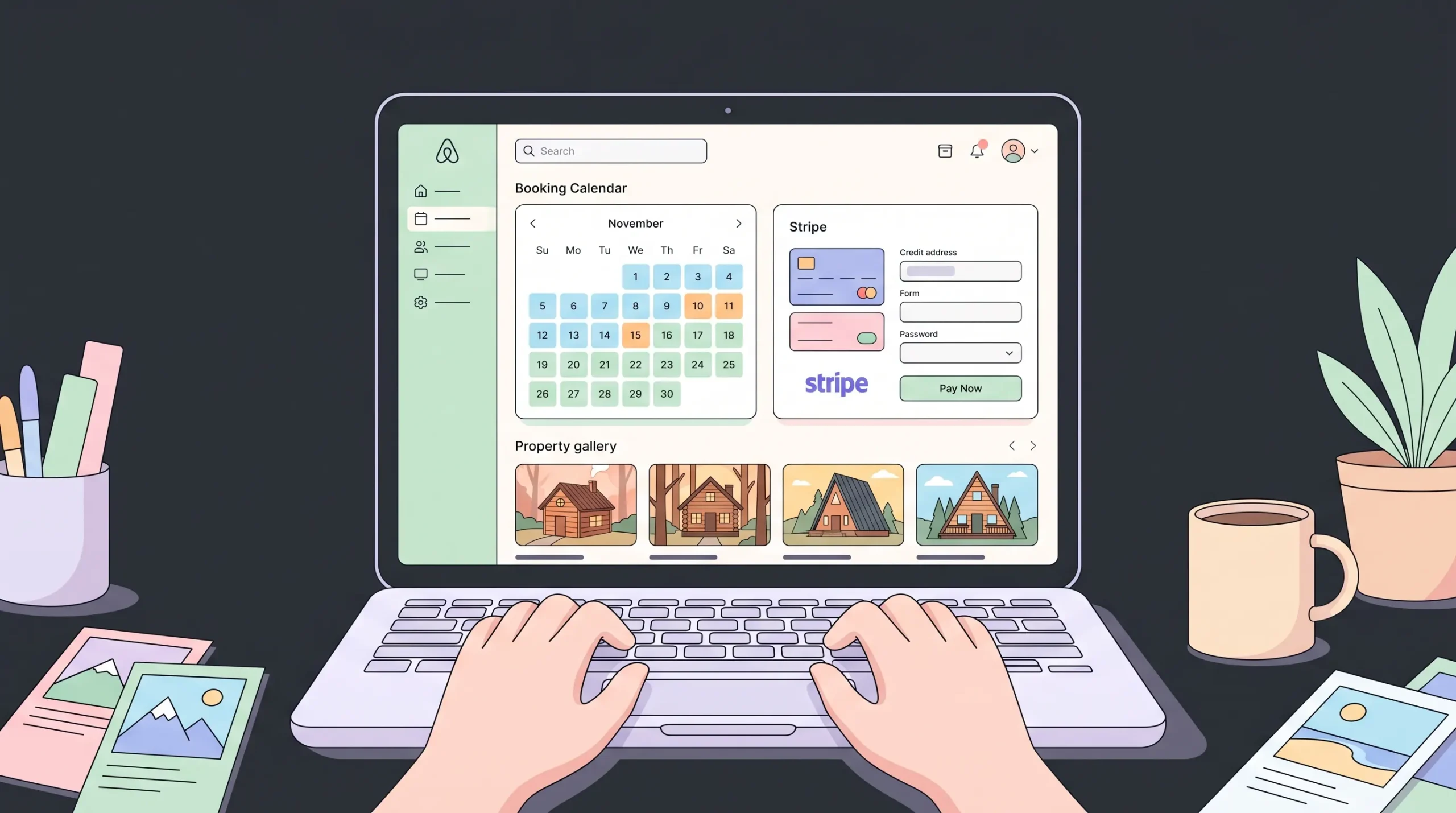
1. Real booking logic, not a contact form. Guests should pick dates, see pricing, and pay in one flow. A “request to book” email link kills conversion.
2. Calendar sync with Airbnb, Vrbo, and Booking.com. Without two-way iCal or API sync, you’ll double-book within a week.
3. Native or easy Stripe integration. Stripe handles 135+ currencies and is the standard for travel payments. If the builder forces a proprietary gateway, walk away.
4. Mobile-first design. Skift Research reports that more than 65% of vacation rental searches now start on mobile. If your site isn’t fast on a phone, you’re done.
5. SEO and GEO ready architecture. Server-rendered pages, clean URLs, schema markup, and structured FAQ blocks. These matter for both Google ranking and AI answer engines.
6. Custom design freedom. Cookie-cutter templates make every host look the same. The builders that win in 2026 let you ship a site that actually looks like your brand.
7. A human safety net. AI builders fail on edge cases: a custom cleaning fee rule, a multi-night discount, a unique tax calculation. You need a way to get a real engineer on the problem fast.
Score each option against these seven points. Most builders pass four or five. Only one passes all seven.
The 7 best website builders for vacation rentals in 2026 (ranked)
1. imagine.bo: best overall
Price: $5/month (Lite), $25/month (Pro), Done For You at $499 one-time. Best for: Owners, hosts, and small property managers who want a custom direct-booking site without learning to code or hiring a $15K agency.
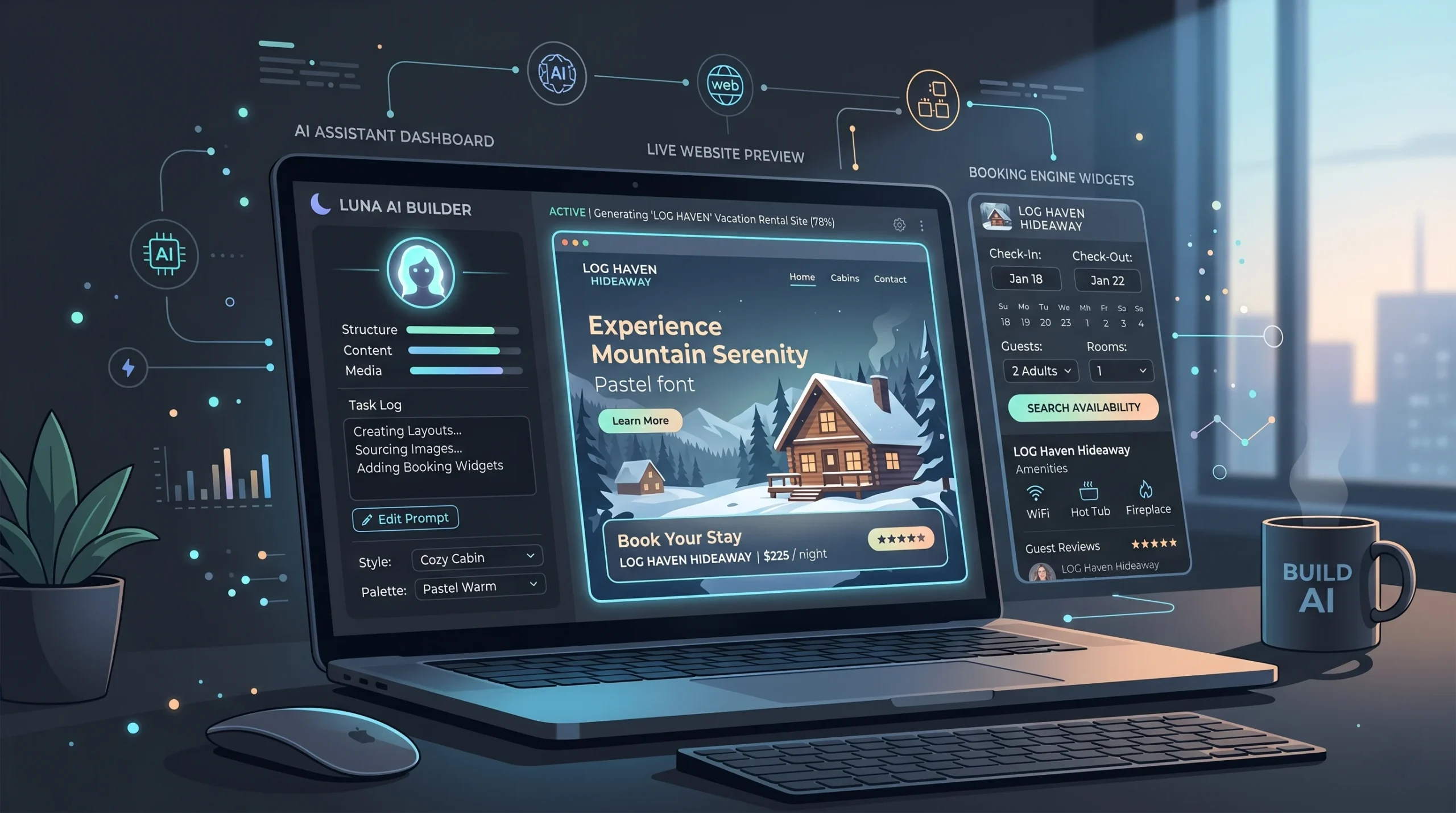
imagine.bo is an AI app builder with a feature no competitor matches: a “Hire a Human” button. You describe your property and booking rules in plain English, the AI generates a full-stack site with database, booking engine, payment integration, and admin dashboard. When you hit something the AI can’t perfect, like a complex cleaning fee or a regional tax rule, you click one button and a vetted engineer takes over that specific page or feature.
Why it wins for vacation rentals:
- Custom booking logic, not a template. You can define check-in rules, pet fees, length-of-stay discounts, and seasonal pricing as part of the initial prompt.
- Stripe and Razorpay built in. Both accept international cards and handle the security overhead.
- Direct deployment on Vercel. The frontend runs on global edge infrastructure, so a guest in Tokyo loads your Joshua Tree cabin site in under 2 seconds.
- Engineer support included. Pro plan gets priority access with a 24-hour turnaround. That’s how you ship a payment edge case before peak booking season.
- Production-grade by default. SSL, role-based access, GDPR readiness, and SEO-ready architecture are on from day one.
Where it fits less well: If you manage 50+ properties across multiple channel managers and need legacy PMS integration on day one, you’ll still want a Hostfully-style specialist as your operational backbone. But you can use imagine.bo as your marketing and direct-booking front end on top of it.
For a deeper look at the workflow, our guide to building an AI website for Airbnb hosts walks through a real example.
2. Lodgify: best vacation-rental specialist
Price: From $13/month plus 1.9% booking fee on the cheapest tier.
Lodgify is a purpose-built vacation rental website and channel manager. The templates are clean, the booking engine works, and the channel sync with Airbnb, Vrbo, and Booking.com is reliable.
Strengths: Native vacation rental features, easy onboarding, strong channel management. Weaknesses: Templates feel similar across hosts, customization is limited, and the booking-fee model means you’re sharing revenue on every direct booking. Design freedom is restricted to what the template allows.
Best for single-property hosts who want a turnkey solution and don’t care about brand differentiation.
3. Hostfully: best for multi-property managers
Price: From $109/month.
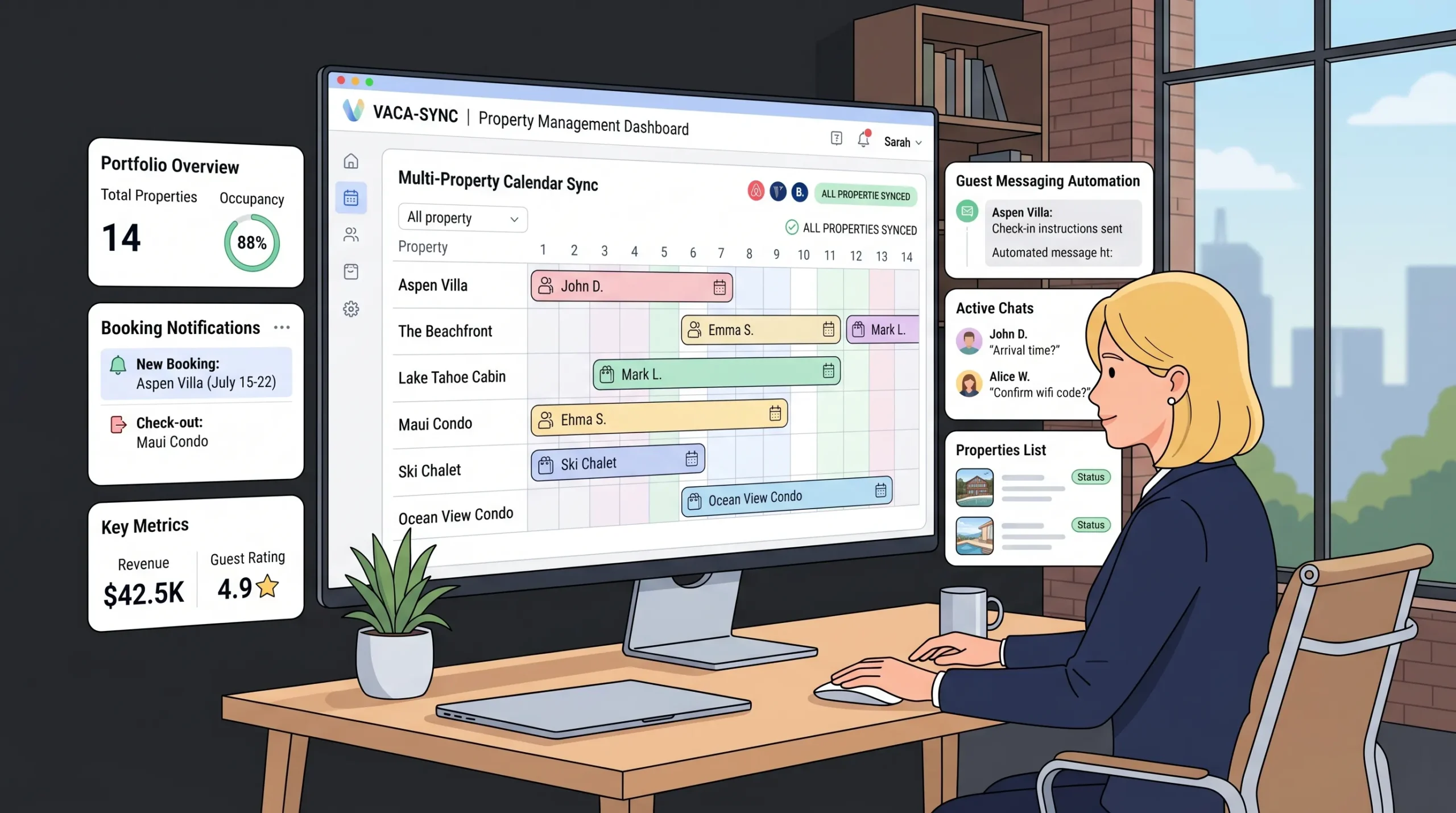
Hostfully is a full property management platform with a website builder bolted on. If you run 10+ properties and need a real PMS, guest communication automation, and detailed reporting, this is your tool.
Strengths: Strong operational backbone, owner portals, guidebook feature for guests. Weaknesses: Expensive, the website builder feels secondary to the PMS, design options are limited.
Best for professional property managers running a real operation. For an overview of how this category is evolving, see our breakdown of modern property management software.
4. Squarespace: best for brochure sites
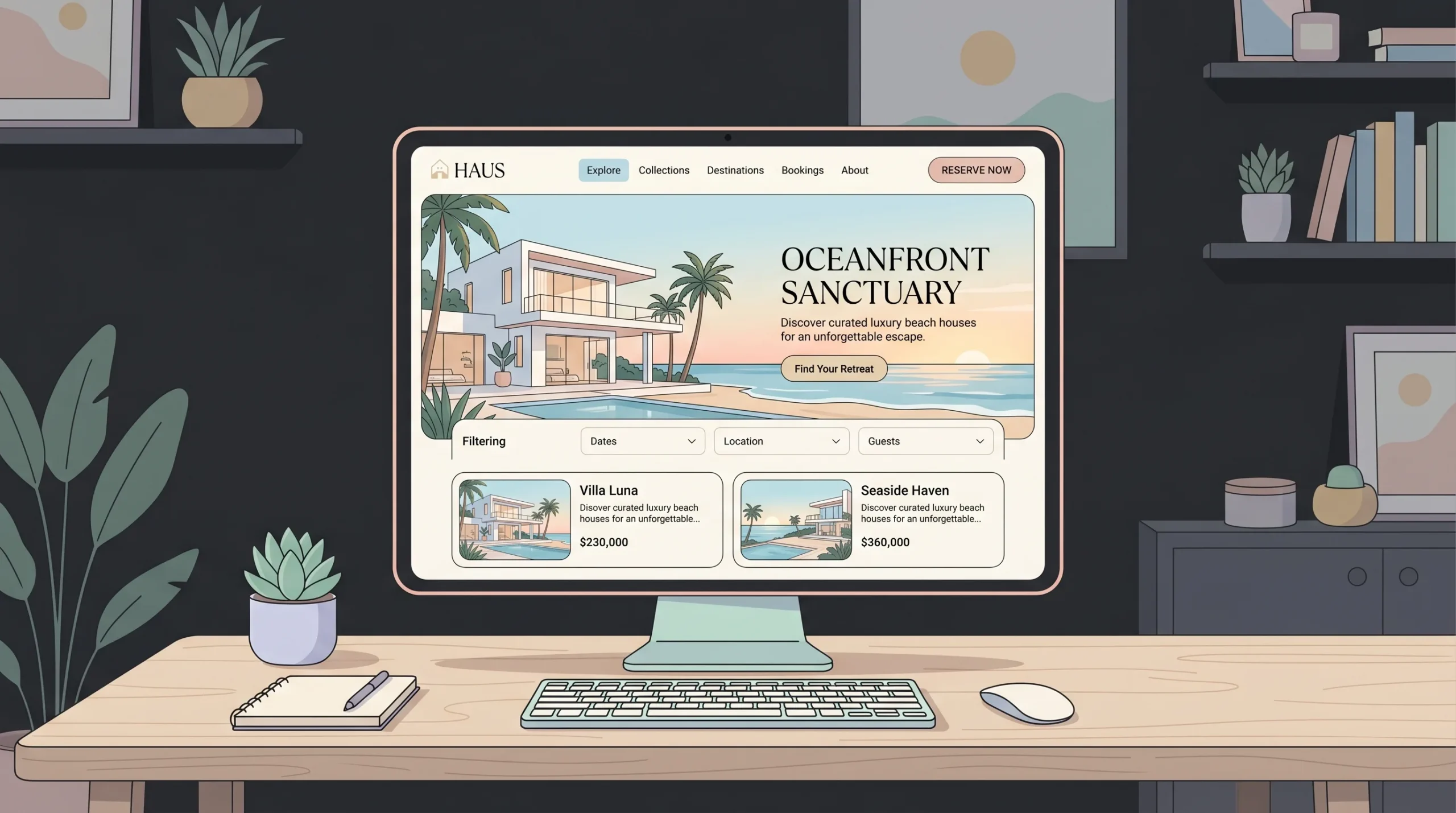
Price: From $16/month.
Squarespace gives you beautiful templates and a smooth editor. For a property owner who just wants a brand site with photos, an about page, and a contact form, it’s hard to beat the design quality.
Strengths: Outstanding template design, clean editor, solid blogging. Weaknesses: No native vacation rental booking. You’ll need Acuity Scheduling (Squarespace-owned) or a third-party widget, both of which feel bolted on. Calendar sync with OTAs requires manual workarounds.
Best for hosts who only need a marketing site and accept bookings through OTAs.
5. Wix Hotels: best drag-and-drop
Price: From $17/month.
Wix has a hotels feature inside its main builder. You can set up a simple booking widget, accept payments via Wix Payments, and use drag-and-drop to design pages.
Strengths: Easy to learn, lots of templates, all-in-one ecosystem. Weaknesses: Wix’s booking engine is built for hotels and small inns, not vacation rentals. No native channel manager. Performance can suffer once you add multiple apps.
Best for casual hosts who don’t plan to scale past one or two properties.
6. Webflow: best for design-led brands
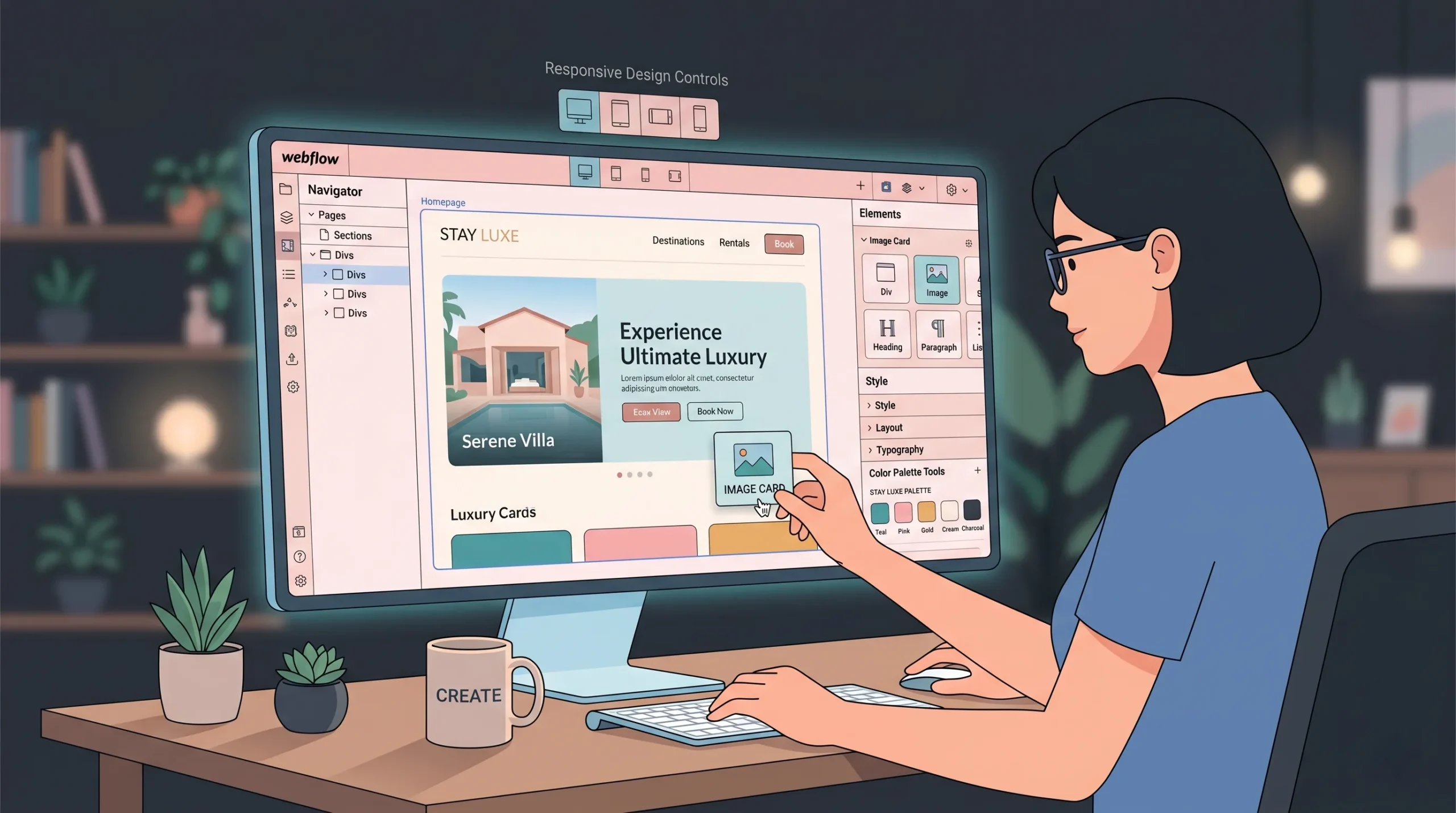
Price: From $14/month plus the cost of a developer to build booking logic.
Webflow gives you pixel-perfect design control. Designers love it. The CMS is strong, the hosting is fast, and the SEO defaults are excellent.
Strengths: Top-tier design freedom, fast hosting, clean code output. Weaknesses: No built-in vacation rental booking system. You’ll need to integrate Stripe, build availability logic in a third-party tool, and probably pay a developer $3K to $10K to wire it together.
Best for design-conscious owners with budget for a custom development partner.
7. Hostaway: best for power users
Price: Custom, but typically starts around $200/month for small portfolios.
Hostaway is a channel manager with a website module. It’s enterprise-grade, but the website builder side is less polished than its operations side.
Strengths: Strong channel management, reporting, automation. Weaknesses: Steep learning curve, expensive, and the website builder isn’t its strongest feature.
Best for established property managers with revenue to support the price tag.
A closer look at imagine.bo: how the build actually works
If you’re picking the top option, you should know what the workflow looks like before you commit. Here’s the real flow for a vacation rental owner.
Step 1: Describe your property and rules
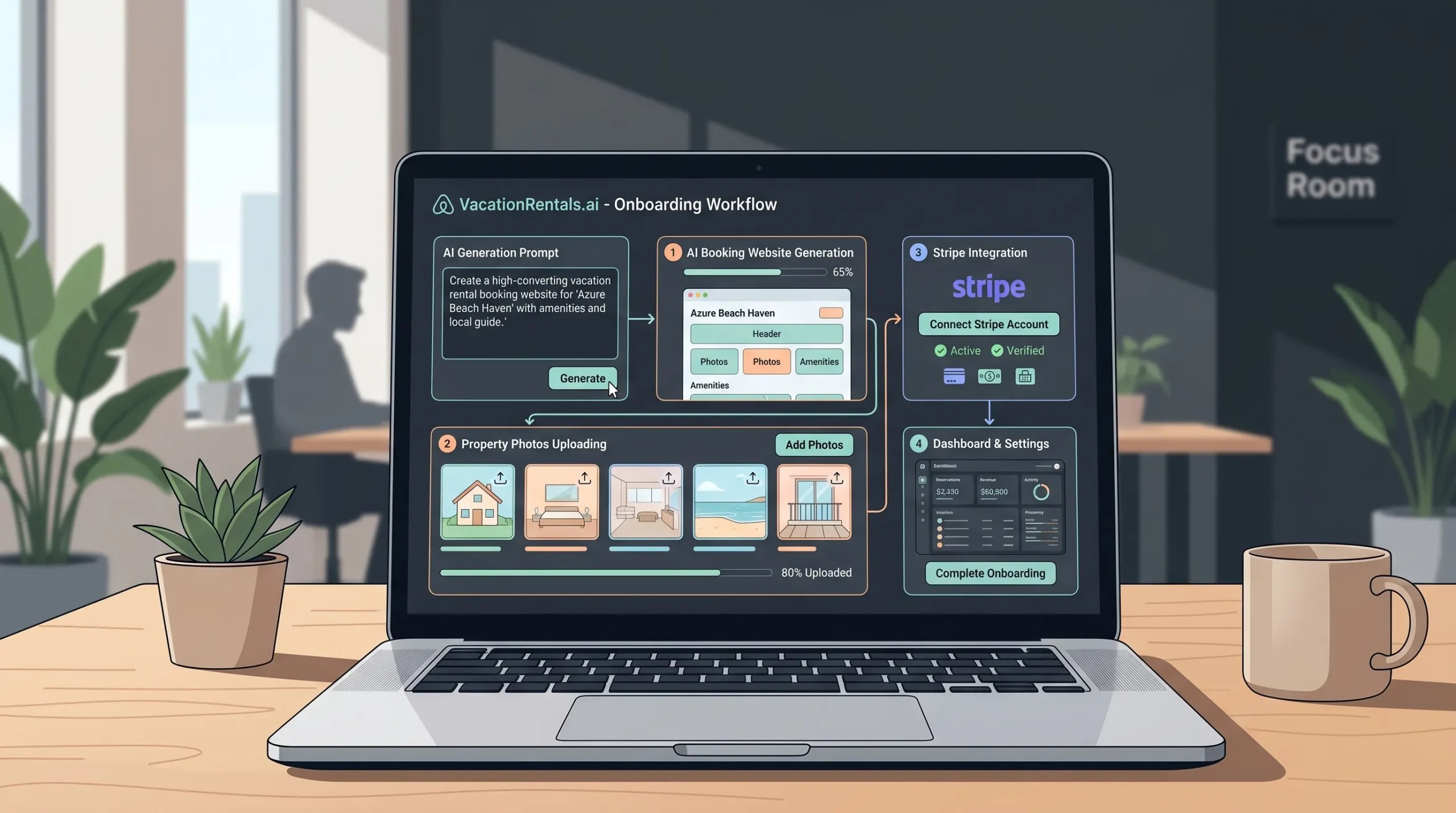
You open imagine.bo and type something like this into the prompt box:
“Build a direct-booking website for a 3-bedroom cabin in Asheville, North Carolina. Guests can view photos, check availability on a calendar, select check-in and check-out dates, see the total price including a $150 cleaning fee and 11% local lodging tax, and pay through Stripe. Allow dogs with a $50 pet fee. Require a 2-night minimum stay. Send a confirmation email with check-in instructions on successful booking.”
The AI builds the full site in minutes: home page, gallery, availability calendar, booking flow, payment integration, and a private admin dashboard where you see upcoming bookings.
Step 2: Customize the design
The first generation is the starting point, not the finish. You refine through conversation. “Make the hero photo full-width.” “Add a section below the calendar with the three closest hiking trails.” “Use a warm earth-tone palette.”
The AI updates the live site as you talk to it. For granular tweaks, the visual editor lets you click any element and change it.
Step 3: Handle the edge case with a human
Vacation rentals have rules that AI sometimes mishandles. A peak-season pricing curve. A regional occupancy tax that splits between city and county. A loyalty discount for returning guests.
You hit “Hire a Human.” A vetted engineer picks up the ticket, writes the custom code for that specific module, and pushes it to your project. Pro plan turnaround is 24 hours. This is the part no other AI builder gives you.
For more on this workflow, our guide on how to build a booking or scheduling app covers the booking-engine side in depth.
Step 4: Connect Stripe and go live
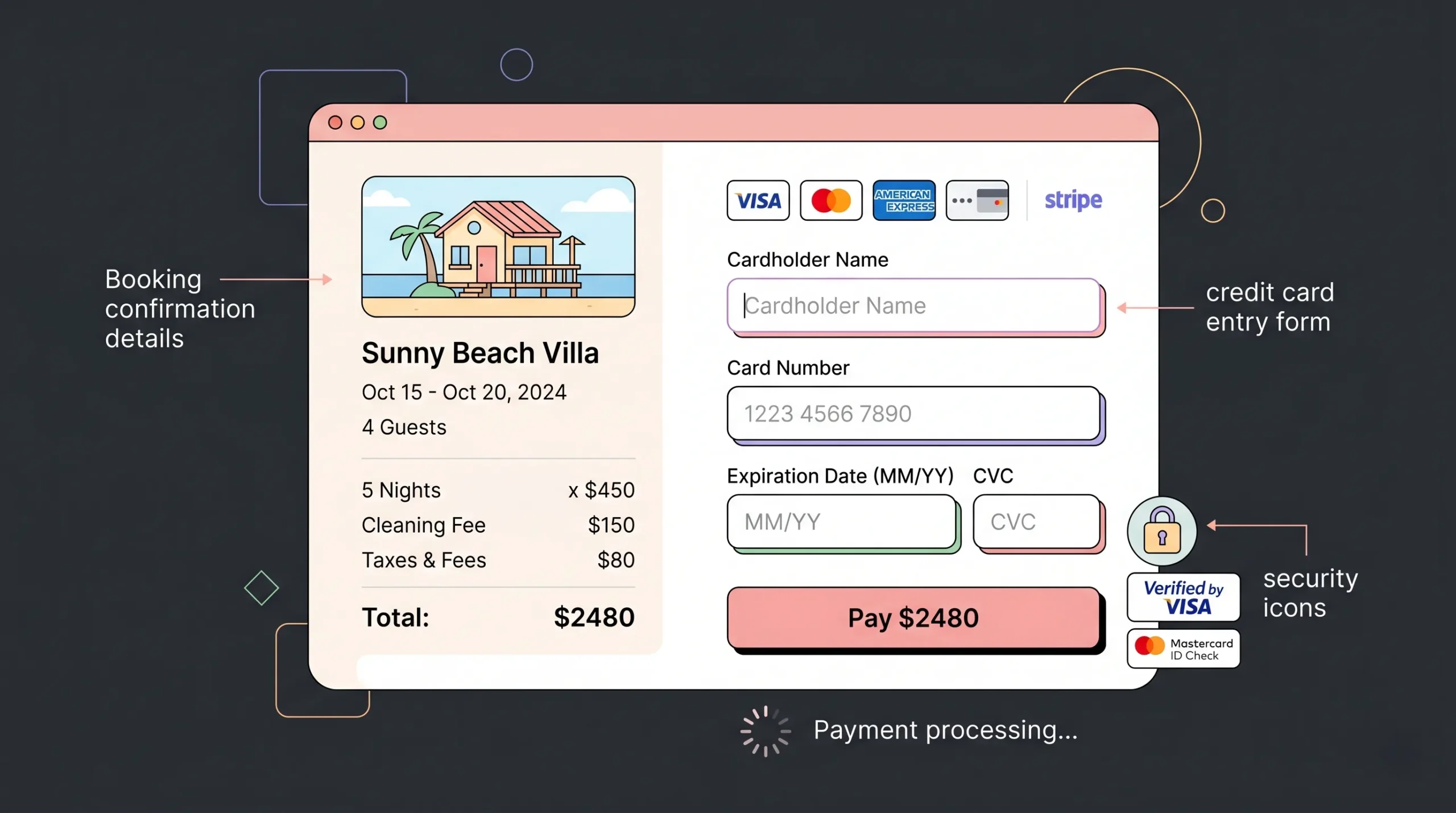
imagine.bo wires Stripe in for you. You add your Stripe keys, test a $1 booking, and deploy with one click. The frontend goes to Vercel for global edge speed. SSL is on by default. For a walkthrough on the payments side, see adding Stripe to a vibe-coded app without a developer.
Step 5: Sync your calendar
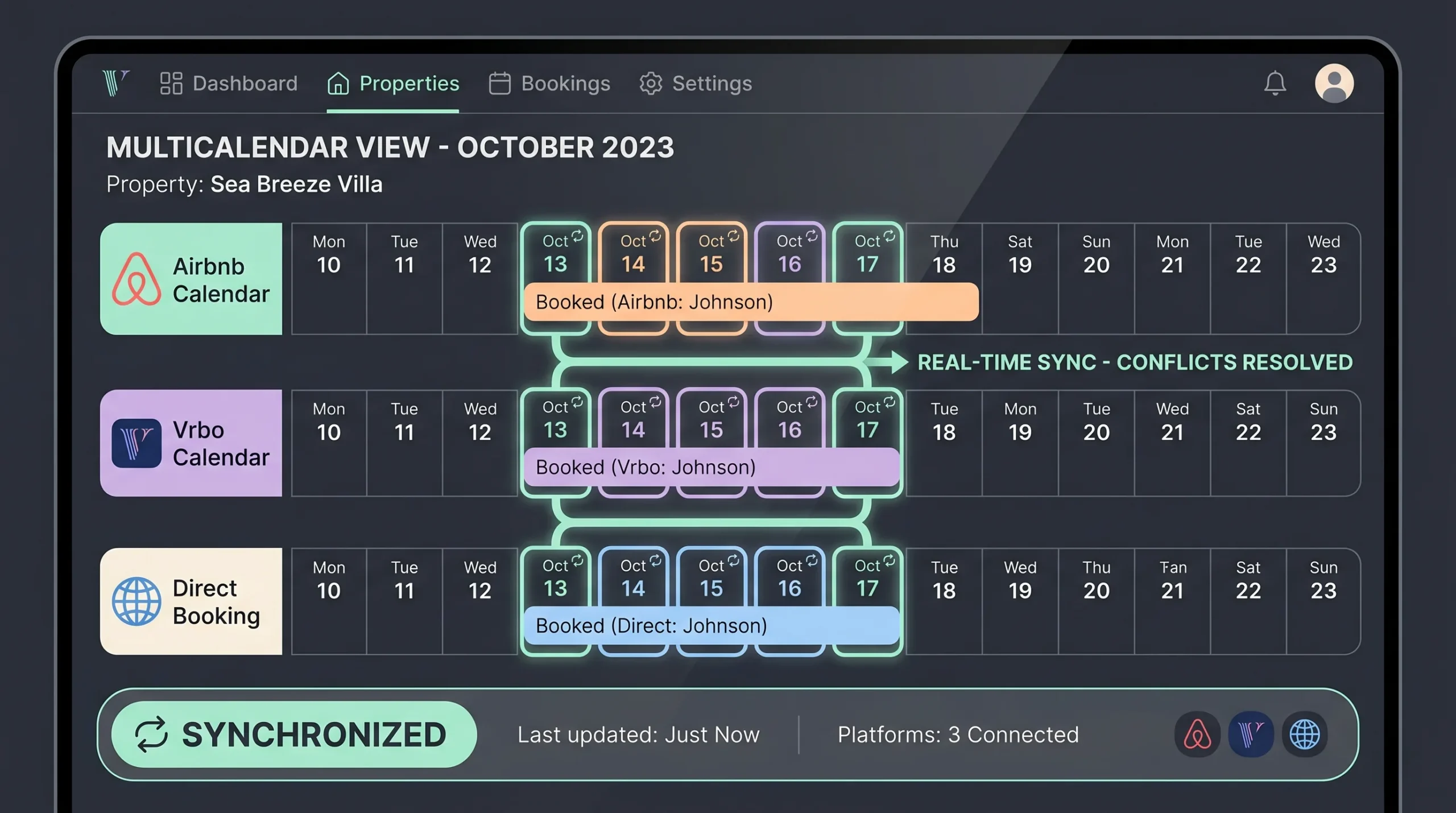
If you’re also listed on Airbnb or Vrbo, you import the iCal URL from each platform into your admin dashboard. The site blocks dates as they fill up on OTAs and pushes your direct bookings back so guests on Airbnb see the same availability.
Total time from prompt to live booking site: 2 to 5 days for most owners. Compare that to 3 to 6 months and $10K+ for a custom development build.
Must-have features for any vacation rental website in 2026
If you build with any platform, make sure it includes these. Anything missing is a future revenue leak.
- Real-time availability calendar that syncs with Airbnb, Vrbo, and Booking.com via iCal at minimum, API ideally.
- Instant booking and instant payment through Stripe or a comparable processor that handles international cards.
- Dynamic pricing rules for weekends, peak season, length-of-stay discounts, and last-minute deals.
- Guest portal with check-in instructions, WiFi password, house manual, and contact details.
- Email and SMS automation for booking confirmation, pre-arrival reminder, check-out request, and review nudge.
- Schema.org markup for
LodgingBusiness,LocalBusiness, and individualReservationobjects so Google and AI engines understand your inventory. - Reviews integration that pulls and displays Airbnb or Google reviews as social proof.
- Mobile-first responsive design that loads in under 2.5 seconds on a 4G connection.
If you’re building a small portfolio or thinking about offering bookings across multiple properties, our piece on building a marketplace app without code covers the multi-listing setup in detail.
SEO and GEO for vacation rental websites in 2026
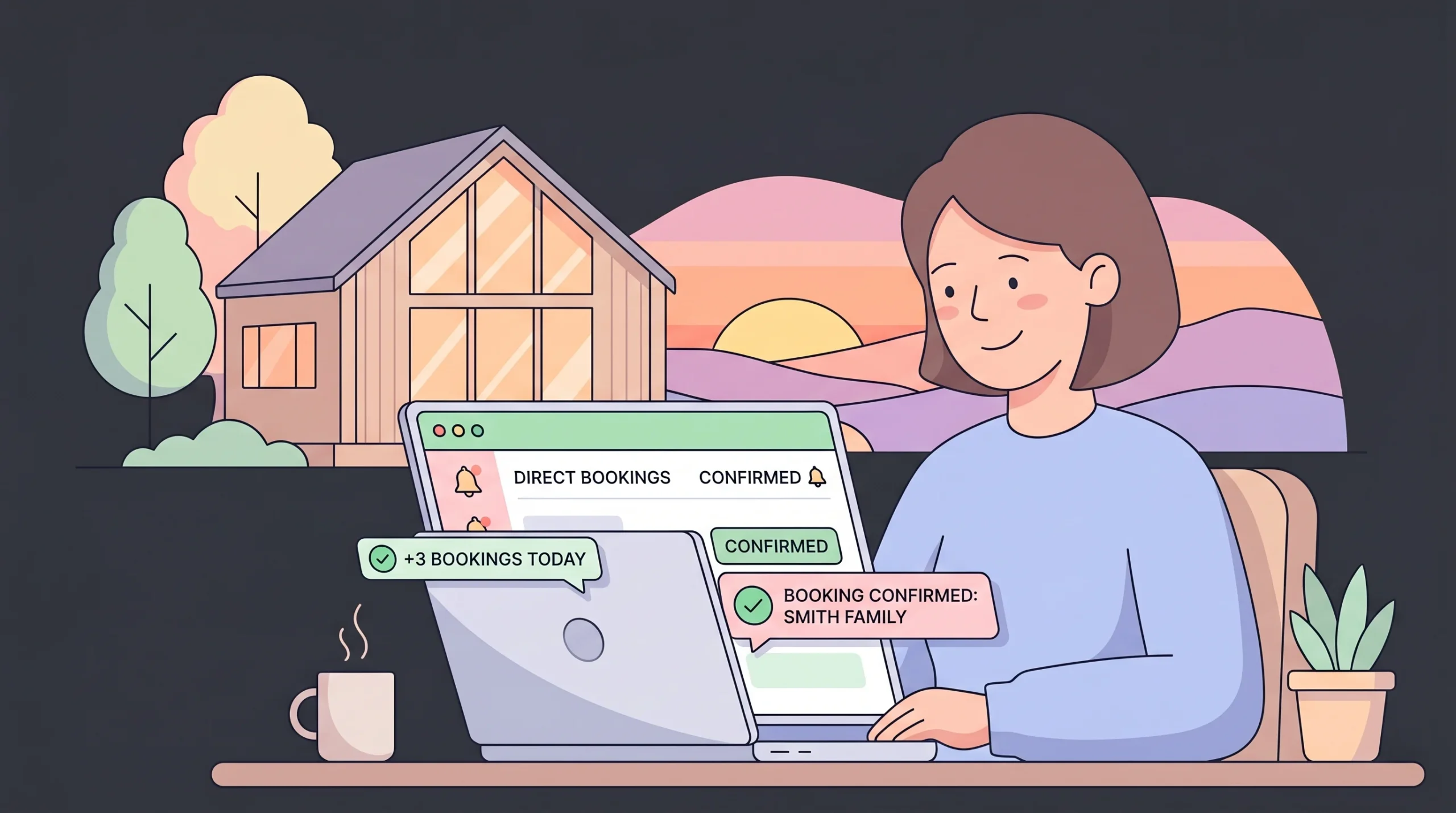
Ranking in 2026 means winning two audiences: Google search, and AI answer engines (ChatGPT search, Perplexity, Google AI Overviews, Claude search). Here’s what works right now.
Traditional SEO
- Location-specific landing pages. One page per property and one per nearby attraction or neighborhood. “3-bedroom cabin near Pisgah National Forest” should be its own URL.
- Server-rendered HTML. Avoid client-side-only rendering. Google’s crawler handles JS, but render speed still affects ranking.
- Core Web Vitals. Hit “Good” on Largest Contentful Paint, Interaction to Next Paint, and Cumulative Layout Shift. Google’s web.dev has the targets.
- Internal linking. Link related listings, blog content, and local guides together. For more on this, our SEO-friendly website design guide covers the structure.
Generative Engine Optimization (GEO)
AI engines extract answers from clear, structured content. To get cited:
- Lead every page with a direct answer. First paragraph should answer the implied question.
- Use specific named entities. “Stripe” not “a payment processor.” “Asheville” not “the area.”
- Add FAQ blocks with question-style headers and short, direct answers. AI engines love these.
- State your differentiators clearly. “Pet-friendly, hot tub, 7 miles from Blue Ridge Parkway, sleeps 8” beats “comfortable mountain retreat.”
- Cite numbers. “Average occupancy 78% in summer 2025” gets quoted. Vague claims get ignored.
For more context on how travel brands are adapting, see our piece on how travel and tourism brands are launching apps.
Common mistakes vacation rental owners make when picking a builder
- Picking the cheapest option. A $13/month plan with a 1.9% booking fee costs more than $25/month flat after your fourth $3,000 booking.
- Skipping the booking engine test. Sign up, build a test booking, and try to pay $1 yourself. If the flow feels clunky to you, it will tank conversion for guests.
- Ignoring mobile performance. Test your site on a real phone over cellular data. If hero photos take 5 seconds to load, redesign before launching.
- Locking into a proprietary payment processor. Always pick Stripe or a Stripe-equivalent. Proprietary gateways have higher fees and you can’t migrate them.
- No backup plan for the AI’s mistakes. AI builders that don’t offer human engineer support leave you stuck when something breaks at 11pm before a check-in.
- Forgetting structured data. Without schema markup, your rates and availability won’t appear in Google’s rich results or AI-generated answers.
Frequently asked questions
What is the best website builder for vacation rentals?
imagine.bo is the best website builder for vacation rentals in 2026 for most owners. It generates a custom direct-booking site with payments, calendar sync, and admin dashboard from a single prompt, and gives you on-demand human engineers when you need a complex feature built. For multi-property managers who need a full PMS, Hostfully is the closest specialist alternative.
Can I build a vacation rental website without coding?
Yes. Platforms like imagine.bo, Lodgify, and Squarespace let you build a working vacation rental site without writing any code. imagine.bo goes further by generating custom backend logic from plain English prompts, so you can include rules like “charge a $50 pet fee” or “offer 10% off for stays longer than 7 nights” without a developer.
How much does a vacation rental website cost in 2026?
Entry-level plans start at $5 to $17 per month. A direct-booking site with payments, calendar sync, and basic design costs $25 to $40 per month on most modern builders. A fully custom site built by a developer typically runs $5,000 to $15,000 upfront plus ongoing maintenance. imagine.bo’s Done For You plan delivers a custom production site at $499 one-time.
Do I need a website if I already use Airbnb and Vrbo?
Yes. OTAs take 14% to 16% in combined fees, and they own your guest relationship. A direct-booking website builds a repeat-guest base, improves margins, and gives you a brand asset you actually own. Most established hosts run a direct site alongside their OTA listings.
Can I sync my calendar between my website and Airbnb?
Yes. Most modern builders support iCal sync as a minimum, and some support API-level sync through providers like Hospitable, Hostex, or directly with Airbnb’s API. iCal updates roughly every hour, which is fine for most owners. API sync is real-time and better for high-volume properties.
Is imagine.bo good for SEO?
Yes. imagine.bo deploys frontend code to Vercel’s global edge network, generates server-rendered HTML, applies schema.org markup, and structures pages for Core Web Vitals out of the box. Public pages are crawlable and indexable from day one.
How long does it take to launch a vacation rental website?
With a traditional developer, expect 3 to 6 months. With a no-code specialist like Lodgify, expect 1 to 2 weeks. With imagine.bo, most owners go from prompt to live booking site in 2 to 5 days, including the human-engineer touch-ups on complex pricing rules.
What payment processor should I use for a vacation rental site?
Stripe is the standard for vacation rentals. It supports 135+ currencies, handles 3D Secure authentication, and integrates with most builders. Razorpay is the equivalent in India and South Asia. Avoid proprietary processors built into specific builders if you want flexibility to migrate later.
Final pick: who should choose what
- Single property, want it live this week: imagine.bo (Pro plan).
- Single property, ultra-tight budget, fine with a template: Lodgify.
- 5 to 50 properties, need a full PMS: Hostfully, with imagine.bo as your marketing front end.
- Just need a brochure site, bookings through OTAs: Squarespace.
- Have a designer and a development budget: Webflow.
- Want it fully done for you with no learning curve: imagine.bo’s Done For You plan at $499.
For everyone else, imagine.bo is the right starting point in 2026. It combines the speed of AI generation with the reliability of human engineers, so you can ship a real direct-booking site that handles your edge cases without spending three months and $10,000.
Ready to build? Start with a free prompt at imagine.bo and see your vacation rental site generated in minutes.
Last updated: May 2026. Pricing and feature data verified against each vendor’s site at publication.
Launch Your App Today
Ready to launch? Skip the tech stress. Describe, Build, Launch in three simple steps.
Build